Introducing DEISO GHG Kata: GHG emission factors where no database has one. Multi-industry, agriculture and CBAM-ready, with every step and its uncertainty shown.
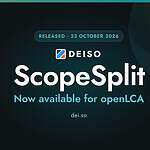
Introducing DEISO ScopeSplit: Calculate Scope 1, 2 and 3 from your openLCA model. All 15 Scope 3 categories, checked against openLCA’s own total, shown in a Scope report.
The licence key is activated on each computer it covers, and each computer uses one seat. Changing or renaming a computer counts as a new computer; DEISO can move a seat for you.
1
1
Up to 5
6 to 25, as chosen
26 or more, as agreed
Time starts when the key is first activated.
14 days
1 year
1 year
1 year
1 year
Create, import, duplicate and run your own cases. A trial runs only the demo cases shipped with the app.
—
Included
Included
Included
Included
Emission factors from first principles, calculation steps, uncertainty (SD and 95% interval), sensitivity analysis, Monte Carlo simulation, PDF report, Excel, CSV and openLCA export, Sync & Backup, in-app updates, method guide and user manual.
With demo cases
Included
Included
Included
Included
Click i for details. Enterprise is priced per computer: 6 computers USD 6,000 a year, 25 computers USD 25,000.
Trial limitation
The 14-day trial is for evaluation with the demo cases included in the app. Your own processes cannot be created or run with a trial licence.
Hands-on remote training in DEISO GHG Kata, in English, one-to-one or one-to-group, for process industries, agriculture and CBAM goods. Prices are per trainee; the software licence is sold separately.
Kata ProfessionalUSD 1,190per trainee6 hours of trainingTrial or paid licenceDemo cases run on the free trial; your own cases need a paid licence
The training price covers the sessions only. A DEISO GHG Kata licence is sold separately, and an optional examination and training certificate is available at an extra fee.
Choose the DEISO ScopeSplit plan for your organisation
Every paid plan includes every feature to calculate and report your Scope 1, 2 and 3 emissions. Plans differ only in the number of computers the licence covers. Prices in US dollars, per year.
The licence key is activated on each computer it covers, and each computer uses one seat. The plan follows the number of computers: 1 is Pro, 2 to 3 is Team, 4 or more is Enterprise.
1
1
3
4 or more, as chosen
Time starts when the key is first activated.
14 days
1 year
1 year
1 year
Calculate from your own openLCA models and databases. A trial reads databases of up to 200 processes; a licence reads any size.
Up to 200 processes
Any size
Any size
Any size
The total of your model and every kg CO₂e of Scope 1, Scope 2 and the 15 Scope 3 categories, checked against openLCA’s own total. Trial results carry a trial mark and are not for reporting.
With trial mark
Included
Included
Included
A trial runs 6 calculations a day, reset at midnight. A licence has no daily limit.
6 per day
Unlimited
Unlimited
Unlimited
Monte Carlo uncertainty, sensitivity analysis with what-if, the model check and the Sankey diagram on screen, in every plan.
Included
Included
Included
Included
Six checks that every kg CO₂e sits in one scope only, with the inputs involved.
—
Included
Included
Included
A review-ready Scope 1, 2 and 3 report in your company’s name, with AI-supported drafting and a readiness score.
—
Included
Included
Included
PDF, Excel and CSV exports, Sankey export as PNG or SVG, chat PDFs, and copying numbers from any result.
—
Included
Included
Included
Ask questions about your results in plain language, with your own OpenAI key.
10 per day
Unlimited
Unlimited
Unlimited
Calculate every process of a database at once, save a model as a small snapshot file, and keep your runs in sync across computers with scheduled backups. History keeps every run; a trial keeps 10.
—
Included
Included
Included
Every rule, equation and validation test behind ScopeSplit, as a PDF guide.
—
Included
Included
Included
The user guide and the searchable Help center, open in every plan, including the trial.
Included
Included
Included
Included
Click i for details. Enterprise is priced per computer: USD 950 each for computers 4 to 10 and USD 850 each for 11 to 26, so 4 computers are USD 3,800 a year and 26 computers USD 23,100. For 27 or more, DEISO sends a quotation.
Trial limitation
The 14-day trial calculates your own openLCA databases of up to 200 processes, with 6 calculations and 10 chat questions a day, and every result on screen with a trial mark. Double counting, exports, the Scope report, copying numbers, snapshots, Sync & Backup, whole-database mode and the method guide come with Pro, Team or Enterprise.
Hands-on training in DEISO ScopeSplit, in English: calculate, split and report Scope 1, 2 and 3 with all 15 Scope 3 categories from an openLCA model. The same ten modules in every format. Remote training is priced per trainee; on-site and off-site training is quoted for your team.
RecommendedRemoteUSD 990per trainee6 hours of trainingTraining licence includedDEISO provides a demo openLCA model and a training licence for the sessions
10 of 10 modules
Two live online sessions of 3 hours
Join from any location
Checks, uncertainty, sensitivity and the Scope report
The training price covers the sessions only. A DEISO ScopeSplit licence for your own work is sold separately, and an optional examination and training certificate is available at USD 240 per trainee, with two attempts included.
Every licence covers one user on one computer, with every edition of the database included: Excel and openLCA where a database has both. For several users or several computers, DEISO sends you a quotation.
Prices are in US dollars, for one user on one computer. For several users, users sharing a computer, or several computers, request a quotation and tell us how many users and computers you need. Full licence terms come with your order or quotation.
Plans and pricing
DEISO LCA plans and pricing
Four plans for single-product, comparative and multi-product Life Cycle Assessment. Every plan is executed by LCA practitioners in professional LCA software and runs on DEISO’s own cloud platform.
DEISO Grid and DEISO Drive are included in every plan: follow your project, share files securely and give your whole team access to the results.
Compare all plan features44 features in 7 groups, side by side for Basic, Pro, Expert and Expert+
Select any feature name to read what it includes.
DEISO LCA plan comparison: Basic, Pro, Expert and Expert+
Feature
BasicFromUSD 8,500
ProFromUSD 19,000
ExpertFromUSD 31,000
Expert+FromUSD 45,000
Scope
Study type?
The depth of the study. Basic is a screening LCA; Pro and Expert are full ISO 14040/14044 product LCAs; Expert+ is a comparative or multi-product LCA, including technology comparisons.
Screening LCA
Full ISO 14040/14044 LCA
Full ISO 14040/14044 LCA
Comparative or multi-product LCA
Products or technologies covered?
The number of products or technologies assessed in one study. Studies covering more than 3 are quotation based.
1
1
1
Up to 3
Typical timeline?
Counted from receipt of complete project data. Your own data collection is usually the longest step, so timelines start once the data is in.
1 month
2–3 months
2–4 months
3–5 months
Industries supported: 15+?
DEISO carries out LCAs across 15+ industries: energy and renewables, oil and gas, refining and petrochemicals, hydrogen and low-carbon fuels, CCUS, batteries and energy storage, chemicals and process industries, construction and building materials, automotive and mobility, electronics, packaging, food and agriculture, healthcare, research institutions and public-sector agencies.
System boundaryBasic covers one boundary per study. Pro, Expert and Expert+ set the boundaries to your goal and scope. Well-to-wheel and other energy-carrier boundaries are available on request.
Extraction, production, transport, use and end of life. Typical for consumer products and full product LCAs.
Gate-to-gate?
One process or plant only. Typical for process optimisation and supplier data.
Gate-to-grave?
From the factory gate to end of life. Typical for downstream use and disposal studies.
Cradle-to-cradle?
Cradle-to-grave, with end of life feeding back into new production. Typical for circular economy and recycling studies.
Data and modelling
Professional foreground data collection?
DEISO collects your foreground data (materials, energy, processes, transport and waste) using a structured Excel data collection template and framework, with guidance and validation checks built in, so the data is complete, consistent and traceable.
DEISO evaluates your project before choosing the background data. Depending on your product, region and goal, that may be ecoinvent, using the system model that fits (cut-off, APOS or consequential), or the LCA for Experts (GaBi) databases. The choice is made for your study and documented, not applied by default.
Standard screening selection
Evaluated and justified
Evaluated and justified
Evaluated and justified, with sensitivity check across options
LCA software?
LCA for Experts (formerly GaBi) or openLCA. DEISO selects the software after evaluating your product, data, database needs and review pathway, so each study runs in the tool that fits it best. For Expert and Expert+, your existing software licence is taken into account.
Selected by DEISO
Selected by DEISO
Selected by DEISO
Selected by DEISO
Expert-built LCA models?
Every model is built, calculated and checked by LCA practitioners in professional LCA software. AI supports visualisation and insight only; it never generates or alters your results.
Data quality assessment?
A structured review of the reliability, completeness and representativeness of the data behind your results.
Laboratory data integration?
Laboratory measurements, such as material composition, emissions or performance tests, are converted into LCA inventory data and built into your model, using results from your own or a third-party laboratory.
Aspen Plus integration?
Mass and energy balances from Aspen Plus process simulations are translated into LCA inventory data, using simulation results supplied by your team, so emerging or not-yet-built process designs can be assessed before plant data exists.
Impact assessment and analysis
10+ LCIA impact categories?
Results cover more than 10 environmental impact categories, for example climate change, acidification, eutrophication, resource use and water use, using an established LCIA method selected for the study.
Climate change results broken down by life cycle stage, process and emission source, separating fossil, biogenic and land-use change contributions, in line with ISO 14067 reporting. Basic reports total GWP only.
Total GWP only
Energy grid mix analysis and breakdown?
Analyses the electricity and energy mix behind your product, showing how much each energy source contributes and how a different grid or renewable supply would change the results. Basic and Pro apply a grid mix without a separate analysis.
Hotspot analysis?
Identifies the life cycle stages, materials and processes that contribute most to each impact.
Sensitivity analysis?
Tests how the results change when key assumptions and data vary, showing which inputs drive the conclusions and how stable the results are.
Uncertainty analysis?
Quantifies how data variability affects the results, using statistical methods such as Monte Carlo simulation where the data allow.
Parameter analysis?
Builds key inputs into the model as parameters, so results can be recalculated for alternative values and scenarios.
Scenario analysis?
Models alternative futures or design choices, such as energy mix, materials, recycling routes or technology options, and compares their results side by side.
Up to 2 scenarios
Up to 2 scenarios
Extended scenarios and technology pathways
Results and reporting
LCA report?
A written report documenting goal and scope, inventory, impact results and interpretation, with the assumptions and data sources behind every figure.
Screening report
ISO 14044-structured report
ISO 14044-structured report
ISO 14044-structured report
Professional results presentation?
Results presented in clear, publication-quality charts and tables.
Executive summary?
A short summary written for decision-makers, alongside the technical report.
Full results Excel workbook?
All results in a structured Excel workbook, with impact results by category, stage and process, ready for your own analysis and reporting. Results only; model files are part of Expert and Expert+.
Report revision rounds?
Rounds of revisions to the draft report based on your comments.
1
2
2
3
Results walkthrough session?
A live session at the end of the study to walk your team through the results and what they mean.
EPD and PCR alignment?
The study follows the applicable Product Category Rules, so it can support an Environmental Product Declaration.
ISO 14067 carbon footprint readiness?
Results and documentation structured to support a product carbon footprint under ISO 14067.
Critical review preparation?
Documentation and technical responses prepared for an ISO 14040/14044 critical review. Panel critical reviews for public comparative assertions are quoted separately.
DEISO cloud platform
DEISO Grid?
DEISO Grid is DEISO’s own cloud project platform, built and run in-house. Chat with the LCA team, share working files and drafts, comment, follow tasks and progress in real time, and give your whole team access to the final results, from any device.
DEISO Drive?
Confidential project files are exchanged through DEISO’s own secure file system, not through public file-sharing services, and access is limited to your project team.
DEISO Visly?
DEISO’s visual storytelling platform. It turns your LCA into clear system-boundary and life cycle flow diagrams, with AI-supported insights from DEISO AI that explain what the results mean.
Training, handover and support
Model files handed over?
You receive the LCA model files, so your team can open, run and update the model.
Training on LCA methodology?
Training on the LCA method behind your study: goal and scope, system boundaries, allocation, impact assessment and interpretation, so your team can understand, explain and defend the results. Trainees are trained as one group.
Up to 2 trainees
Up to 3 trainees
Training on the LCA software?
Hands-on training in the LCA software used for your study, built around your own model, so your team can open it, run it and update it themselves.
Up to 2 trainees
Up to 3 trainees
Training to reproduce and reuse the model?
Step-by-step training on rebuilding your model and adapting it to a new product or variant, so future LCAs can be run in-house.
Up to 2 trainees
Up to 3 trainees
After-report support?
After the final report, the LCA team answers questions, explains results and helps apply the model, within the period and hours shown, whichever limit is reached first.
1 month, up to 10 hours
2 months, up to 15 hours
Additional support hours?
Extra support hours can be added at any point, on request.
Available
Available
Available
Available
Upgrade credit to Pro?
The Basic fee is credited toward Pro if you upgrade within an agreed period.
Confidentiality?
An NDA is available for every plan.
Please note
Prices are starting prices. Comparative and multi-product studies covering more than 3 products or technologies, and infrastructure or energy asset studies, are quotation based.
Timelines are counted from receipt of complete project data.
Panel critical reviews for public comparative assertions under ISO 14044 are quoted separately.
Model handover and training assume you hold a licence for the chosen LCA software; openLCA is free to use.
Plans for EPD readiness and for single-product, multiple-product and sector EPDs to ISO 14025 and EN 15804+A2. Every plan runs on DEISO’s own cloud platform.
DEISO Grid and DEISO Drive are included in every plan: follow your project, share files securely and give your whole team access to the results.
Before you commit
DEISO Readiness
FromUSD 4,500per product or product family
PCR and programme operator selection, data gap analysis, screening results and a roadmap. Credited toward an EPD.
LCA model files, training on methodology, software and model reuse for up to 2 trainees, 1 month or up to 10 hours of after-report support, and a renewal-ready model.
Important: third-party fees
Verification and programme operator fees are not covered by DEISO. They are paid by the client directly to the verifier and the programme operator, and DEISO coordinates the process.
Compare all plan features31 features in 8 groups, side by side for Readiness, Single-product, Multiple-product and Sector EPD
Select any feature name to read what it includes.
DEISO EPD plan comparison: readiness, single-product, multiple-product and sector EPD
Feature
ReadinessFromUSD 4,500
Single-productFromUSD 11,500
Multiple-productFromUSD 17,500
SectorFromUSD 27,500
Scope
EPD type?
Readiness is an assessment before committing to an EPD. A single-product EPD covers one product; a multiple-product (group) EPD covers similar products under one background report; a sector EPD declares an industry-average product across several manufacturers.
Readiness assessment
Single-product EPD
Multiple-product (group) EPD
Sector EPD
Products or manufacturers covered?
Projects beyond these limits are quotation based.
Assessment only
1 product
Up to 5 similar products
Up to 5 manufacturers
Typical timeline?
Counted from receipt of complete project data. Verification time depends on the verifier and programme operator.
2–4 weeks
2–4 months
3–5 months
4–6 months
Declared product?
How the declared results represent your products. Group EPDs declare an average or representative (worst-case) product; sector EPDs declare an industry-average product.
Specific product
Average or representative product
Industry-average product
Standards and PCR
PCR and programme operator selection?
DEISO identifies the applicable Product Category Rules and a suitable programme operator, such as EPD International, IBU, EPD Hub, UL or SuMPO.
ISO 14025 and EN 15804+A2 (or ISO 21930)?
The EPD and its background LCA are prepared to ISO 14025 and, for construction products, EN 15804+A2 or ISO 21930. Readiness checks your gaps against these requirements.
DEISO evaluates your project before choosing the background data — ecoinvent with the system model that fits, or the LCA for Experts (GaBi) databases — as the PCR allows.
LCA for Experts (formerly GaBi) or openLCA, selected by DEISO for each project based on the product, PCR, data and verification pathway.
Selected by DEISO
Selected by DEISO
Selected by DEISO
Selected by DEISO
Expert-built LCA models?
Every model is built, calculated and checked by LCA practitioners in professional LCA software. AI supports visualisation and insight only; it never generates or alters your results.
Data quality assessment?
A structured review of the reliability, completeness and representativeness of the data behind your EPD.
EPD outputs
Screening results and EPD roadmap?
Indicative results, PCR fit, data gaps and a step-by-step plan to a published EPD.
PCR-compliant LCA background report?
The project report the verifier reviews, documenting methods, data, assumptions and results.
EPD document drafted?
The declaration itself, drafted to the programme operator’s template and PCR requirements.
Verification coordination and technical responses?
DEISO manages the verifier’s questions and corrections until the EPD is approved.
Publication support?
Support through registration and publication with the programme operator.
Full results Excel workbook?
All results in a structured Excel workbook, ready for your own analysis and reporting.
Report revision rounds?
Rounds of revisions to the draft documents based on your comments.
1
2
2
3
Results walkthrough session?
A live session at the end of the project to walk your team through the results.
Third-party fees
Verification fee?
Verification and programme operator fees are not covered by DEISO. They are paid by the client directly to the verifier and the programme operator, and DEISO coordinates the process.
Not included — paid by client
Not included — paid by client
Not included — paid by client
Programme operator fee?
Registration and annual fees are set by each programme operator and paid by the client directly.
Not included — paid by client
Not included — paid by client
Not included — paid by client
DEISO cloud platform
DEISO Grid?
DEISO Grid is DEISO’s own cloud project platform, built and run in-house. Chat with the team, share working files and drafts, comment, follow tasks and progress in real time, and give your whole team access to the final results, from any device.
DEISO Drive?
Confidential project files are exchanged through DEISO’s own secure file system, not through public file-sharing services, and access is limited to your project team.
DEISO Visly?
DEISO’s visual storytelling platform. It turns your EPD results into clear system-boundary and life cycle flow diagrams, with AI-supported insights from DEISO AI.
Expert handover add-on (+ USD 7,500)Available with any EPD plan. Training is run for up to 2 trainees as one group.
Model files handed over?
You receive the LCA model files, so your team can open, run and update the model.
Add-on
Add-on
Add-on
Training: methodology, software and model reuse?
Training on the EPD and LCA method, the LCA software, and adapting the model to new products or renewals.
Add-on
Add-on
Add-on
After-report support?
1 month, up to 10 hours, whichever limit is reached first.
Add-on
Add-on
Add-on
Renewal-ready model?
The model is structured so the EPD can be updated efficiently when it is renewed.
Add-on
Add-on
Add-on
Commercial terms
Readiness fee credited?
The readiness fee is credited toward an EPD plan if you proceed within an agreed period.
Additional support hours?
Extra support hours can be added at any point, on request.
Available
Available
Available
Available
Confidentiality?
An NDA is available for every plan.
Please note
Prices are starting prices and exclude third-party fees. Projects with more than 5 products or 5 manufacturers are quotation based.
Verification and programme operator fees are not covered by DEISO. They are paid by the client directly to the verifier and the programme operator, and DEISO coordinates the process.
Timelines are counted from receipt of complete project data; verification time depends on the verifier and programme operator.
Model handover and training assume you hold a licence for the chosen LCA software; openLCA is free to use.
Four plans for single-product, comparative and multi-product Social Life Cycle Assessment under ISO 14075. Every plan is modelled in openLCA and runs on DEISO’s own cloud platform.
DEISO Grid and DEISO Drive are included in every plan: follow your project, share files securely and give your whole team access to the results.
S-LCA screening
DEISO S-LCA Basic
FromUSD 9,500per single-product screening study
A fast, credible screening of country and sector social risk to find your hotspots.
Compare all plan features41 features in 9 groups, side by side for Basic, Pro, Expert and Expert+
Select any feature name to read what it includes.
DEISO S-LCA plan comparison: Basic, Pro, Expert and Expert+
Feature
BasicFromUSD 9,500
ProFromUSD 21,000
ExpertFromUSD 34,000
Expert+FromUSD 49,500
Scope
Study type?
The depth of the study. Basic is an S-LCA screening; Pro and Expert are full S-LCAs under ISO 14075:2024; Expert+ is a comparative or multi-product S-LCA, including supplier and sourcing comparisons.
S-LCA screening
Full S-LCA (ISO 14075)
Full S-LCA (ISO 14075)
Comparative or multi-product S-LCA
Products or options covered?
The number of products, supplier options or sourcing options assessed in one study. Studies covering more than 3 are quotation based.
1
1
1
Up to 3
Typical timeline?
Counted from receipt of complete project data, including supplier responses. Supplier data collection is usually the longest step.
1 month
2–3 months
2–4 months
3–5 months
Industries supported?
DEISO carries out S-LCAs across renewable energy and infrastructure, manufacturing and industrial production, electronics and technology, construction materials, food and agriculture, consumer goods, automotive and mobility, and extractives and raw materials.
Standards and method
ISO 14075:2024?
The international standard for social life cycle assessment of products. Full studies conform to it; the Basic screening follows its framework at screening level.
Aligned (screening)
Conforms
Conforms
Conforms
UNEP S-LCA Guidelines (2020) and Methodological Sheets?
Applied for stakeholder categories, subcategories and indicators within the ISO 14075 framework.
Stakeholder categories covered?
Workers, local communities, value chain actors, consumers and society. Basic covers the categories most relevant to your product; full studies cover all five.
Priority categories
All 5
All 5
All 5
Activity variable (worker hours)?
Social risks are weighted by the worker hours behind each process, so results reflect where labour actually sits in the supply chain.
System boundaryBasic covers one boundary per study. Pro, Expert and Expert+ set the boundaries to your goal and scope.
Gate-to-gate?
A specific production stage or facility. Useful for assessing a plant, evaluating Tier 1 suppliers or targeted screening.
The full life cycle, including use-phase and end-of-life social effects. The widest and most resource-intensive boundary.
Data and modelling
Professional foreground data collection?
DEISO collects your foreground data using a structured Excel data collection template and framework, with guidance and validation checks built in, so the data is complete, consistent and traceable.
Key foreground inputs
Full foreground data
Full foreground data
Full foreground data, up to 3 products
Social risk database (PSILCA or SHDB)?
Country- and sector-level social risk data from PSILCA or the Social Hotspots Database (SHDB), selected for your product and supply regions.
Site-specific supplier data?
Structured questionnaires and follow-up with your suppliers, replacing generic country and sector risk with supplier-level evidence.
Every DEISO S-LCA is modelled in openLCA, which is free to use, so your team can open the model without a licence fee.
openLCA
openLCA
openLCA
openLCA
Expert-built S-LCA models?
Every model is built, calculated and checked by DEISO practitioners. AI supports visualisation and insight only; it never generates or alters your results.
Data quality assessment?
A structured review of the reliability, completeness and representativeness of the social data behind your results.
Impact assessment and analysis
Country and sector risk screening?
Identifies the countries and sectors in your supply chain with the highest social risk.
Social hotspot and risk mapping?
Visual mapping of high-risk supply regions, priority stakeholder concerns and critical intervention points.
Supplier risk ranking?
Compares your suppliers on social risk levels, so engagement and audits go where they matter most.
Sensitivity analysis?
Tests how the results change when key assumptions and data vary, showing how stable the conclusions are.
Scenario analysis?
Compares alternative sourcing, supplier or design choices on their social risk profile.
Up to 2 scenarios
Up to 2 scenarios
Extended sourcing scenarios
Regulation and due diligence
Regulatory mapping?
Maps your results to the EU CSDDD, CSRD and ESRS S1–S4, Germany’s Supply Chain Act (LkSG) and Japan’s human rights due diligence guidelines.
Human rights due diligence input pack?
Findings structured as input for your due diligence process: risk identification, prioritisation and suggested actions.
Results and reporting
S-LCA report?
A written report documenting goal and scope, stakeholder mapping, indicator rationale, data sources, hotspot and risk analysis and interpretation.
Screening report
ISO 14075-structured report
ISO 14075-structured report
ISO 14075-structured report
Executive summary?
A concise decision brief covering key exposure areas, risk severity ranking and a short-, medium- and long-term action roadmap.
Professional results presentation?
Results presented in clear, publication-quality charts, maps and tables.
Full results Excel workbook?
All results in a structured Excel workbook, ready for your own analysis and reporting. Results only; model files are part of Expert and Expert+.
Report revision rounds?
Rounds of revisions to the draft report based on your comments.
1
2
2
3
Results walkthrough session?
A live session at the end of the study to walk your team through the results and what they mean.
DEISO cloud platform
DEISO Grid?
DEISO Grid is DEISO’s own cloud project platform, built and run in-house. Chat with the team, share working files and drafts, comment, follow tasks and progress in real time, and give your whole team access to the final results, from any device.
DEISO Drive?
Confidential project and supplier files are exchanged through DEISO’s own secure file system, not through public file-sharing services, and access is limited to your project team.
DEISO Visly?
DEISO’s visual storytelling platform. It turns your S-LCA into clear supply chain and risk diagrams, with AI-supported insights from DEISO AI that explain what the results mean.
Training, handover and support
Model files handed over?
You receive the openLCA model files, so your team can open, run and update the model.
Training on S-LCA methodology?
Training on ISO 14075, the UNEP Guidelines, stakeholder categories, indicators and interpretation, so your team can understand, explain and defend the results. Trainees are trained as one group.
Up to 2 trainees
Up to 3 trainees
Training on openLCA?
Hands-on openLCA training built around your own model, so your team can open it, run it and update it themselves.
Up to 2 trainees
Up to 3 trainees
Training to reproduce and reuse the model?
Step-by-step training on rebuilding your model and adapting it to a new product, supplier or sourcing region.
Up to 2 trainees
Up to 3 trainees
After-report support?
After the final report, the team answers questions, explains results and helps apply the model, within the period and hours shown, whichever limit is reached first.
1 month, up to 10 hours
2 months, up to 15 hours
Additional support hours?
Extra support hours can be added at any point, on request.
Available
Available
Available
Available
Upgrade credit to Pro?
The Basic fee is credited toward Pro if you upgrade within an agreed period.
Confidentiality?
An NDA is available for every plan.
Please note
Prices are starting prices. Studies covering more than 3 products or supplier options are quotation based.
Timelines are counted from receipt of complete project data, including supplier responses; supplier data depends on your suppliers’ cooperation.
Social database licence costs (PSILCA or SHDB) are confirmed in your quotation.
openLCA is free to use, so handed-over models need no software licence.
Plans for Scope 1 and 2, Scope 3 only, or the full Scope 1–3 inventory, following the GHG Protocol and ISO 14064-1. Every plan runs on DEISO’s own cloud platform.
DEISO Grid and DEISO Drive are included in every plan: follow your project, share files securely and give your whole team access to the results.
Operational emissions
DEISO Scope 1 + 2 inventory
FromUSD 8,500per company, up to 3 sites
Direct and purchased-energy emissions, with location-based and market-based Scope 2.
The full calculation workbook with formulas, training on the method and workbook for up to 2 trainees, 1 month or up to 10 hours of after-report support, and a next-year update guide.
Important: verification fees
Third-party verification fees are not covered by DEISO. Verification to ISO 14064-3 is carried out by an independent verifier and paid by the client directly; DEISO prepares the inventory for verification and coordinates the process.
Compare all plan features38 features in 9 groups, side by side for Scope 1 + 2, Scope 3 screening, Scope 3 inventory and Full Scope 1–3
Select any feature name to read what it includes.
DEISO GHG accounting plan comparison: Scope 1 and 2, Scope 3 screening, Scope 3 inventory and full Scope 1 to 3
Feature
Scope 1 + 2FromUSD 8,500
Scope 3 screeningFromUSD 9,500
Scope 3 inventoryFromUSD 22,000
Full Scope 1–3FromUSD 27,500
Scope
Inventory type?
Choose the scopes you need: Scope 1 and 2 only, Scope 3 only (screening or full inventory), or the full Scope 1–3 inventory.
Scope 1 and 2
Scope 3 screening
Scope 3 inventory
Scope 1, 2 and 3
Organisation covered?
Prices cover one company with up to 3 sites. Groups and larger multi-site organisations are quotation based.
1 company, up to 3 sites
1 company, up to 3 sites
1 company, up to 3 sites
1 company, up to 3 sites
Reporting year?
Each plan covers one reporting year. Annual updates can be quoted separately.
1 year
1 year
1 year
1 year
Typical timeline?
Counted from receipt of complete project data. Supplier responses can extend Scope 3 timelines.
3–5 weeks
4–6 weeks
2–3 months
2–4 months
Standards and boundaries
GHG Protocol Corporate Standard and Scope 2 Guidance?
The global standard for corporate Scope 1 and 2 accounting.
GHG Protocol Scope 3 Standard?
The standard for value-chain emissions across the 15 Scope 3 categories.
ISO 14064-1:2018 alignment?
The inventory is structured to align with ISO 14064-1 for organisation-level GHG reporting.
Organisational boundary and consolidation approach?
Equity share, financial control or operational control, chosen to match your reporting obligations.
Base year and recalculation policy?
A documented base year and clear rules for recalculating it after structural or methodology changes.
Scope 2: location-based and market-based?
Dual reporting of grid-average results and results reflecting contractual instruments such as energy attribute certificates and PPAs.
Scope 3
Relevance screening of all 15 categories?
Every category is screened to find where emissions, risks and reduction opportunities are concentrated.
Calculation of relevant categories?
Screening uses spend-based estimates; full inventories use hybrid methods combining supplier-specific, average-data and spend-based data.
Spend-based estimates
Hybrid methods
Hybrid methods
Supplier data requests?
DEISO designs the supplier data request, sends it with you and reviews the responses.
Up to 10 suppliers
Up to 10 suppliers
Category method documentation?
The calculation method for each category is documented, as the GHG Protocol requires.
Factors from sources such as IPCC AR6 GWP100, UK DESNZ, IEA, US EPA and ecoinvent, documented for every factor used.
Data-quality assessment?
Each data source is scored for quality, so you can see where accuracy can improve next year.
Uncertainty review?
A review of the main sources of uncertainty in the inventory.
Hotspot analysis?
Identifies the sources and categories that contribute most to your emissions.
Reduction opportunities?
Priority areas for reduction, based on the hotspot results.
Results and reporting
Methodology report?
Documents boundaries, methods, data sources, factors and assumptions, ready for review.
Screening summary
Management summary?
A short summary of results and priorities for decision-makers.
Full results Excel workbook?
All results in a structured Excel workbook, ready for your own reporting.
Reporting framework mapping?
Results mapped to CDP, SBTi target setting, IFRS S2, CSRD and ESRS E1, and Japan’s SSBJ standards, as relevant.
Review-readiness recommendations?
What to fix or strengthen before disclosure or third-party verification.
Report revision rounds?
Rounds of revisions to the draft documents based on your comments.
1
1
2
2
Results walkthrough session?
A live session to walk your team through the results.
Third-party fees
Verification fee (ISO 14064-3)?
Third-party verification fees are not covered by DEISO. Verification is carried out by an independent verifier and paid by the client directly; DEISO prepares the inventory for verification and coordinates the process.
Not included — paid by client
Not included — paid by client
Not included — paid by client
Not included — paid by client
DEISO cloud platform
DEISO Grid?
DEISO Grid is DEISO’s own cloud project platform, built and run in-house. Chat with the team, share working files and drafts, comment, follow tasks and progress in real time, and give your whole team access to the final results, from any device.
DEISO Drive?
Confidential project and supplier files are exchanged through DEISO’s own secure file system, not through public file-sharing services, and access is limited to your project team.
DEISO Visly?
DEISO’s visual storytelling platform. It turns your inventory into clear emissions and value-chain diagrams, with AI-supported insights from DEISO AI.
Handover add-on (+ USD 7,500)Available with any GHG plan. Training is run for up to 2 trainees as one group.
Calculation workbook handed over?
The full calculation workbook with formulas, so your team can update the inventory itself.
Add-on
Add-on
Add-on
Add-on
Training: methodology and workbook?
Training on the GHG Protocol method, the workbook and how to recalculate for a new reporting year.
Add-on
Add-on
Add-on
Add-on
After-report support?
1 month, up to 10 hours, whichever limit is reached first.
Add-on
Add-on
Add-on
Add-on
Next-year update guide?
A step-by-step guide for updating the inventory in the following reporting year.
Add-on
Add-on
Add-on
Add-on
Commercial terms
Screening fee credited?
The Scope 3 screening fee is credited toward a Scope 3 or full inventory if you proceed within an agreed period.
Additional support hours?
Extra support hours can be added at any point, on request.
Available
Available
Available
Available
Confidentiality?
An NDA is available for every plan.
Please note
Prices are starting prices for one company with up to 3 sites and one reporting year. Groups and larger multi-site organisations are quotation based.
Third-party verification fees are not covered by DEISO. Verification is carried out by an independent verifier and paid by the client directly; DEISO prepares the inventory for verification and coordinates the process.
Timelines are counted from receipt of complete project data; supplier responses depend on your suppliers’ cooperation.
LCA model files, training on ISO 14067, the software and model reuse for up to 2 trainees, 1 month or up to 10 hours of after-report support, and an update-ready model.
Important: verification fees
Third-party verification and critical review fees are not covered by DEISO. They are paid by the client directly to the verifier; DEISO prepares the PCF for verification and coordinates the process.
Compare all plan features39 features in 10 groups, side by side for Screening, Single-product, Multiple-product and Programme
Select any feature name to read what it includes.
DEISO PCF plan comparison: screening, single-product, multiple-product and programme
Feature
ScreeningFromUSD 4,500
Single-productFromUSD 10,500
Multiple-productFromUSD 16,500
ProgrammeFromUSD 26,500
Scope
PCF type?
Screening is a fast first estimate. A single-product PCF covers one product; a multiple-product PCF covers a family of similar products under one model; a PCF programme covers a wider range with data prepared for customer exchange.
PCF screening
Single-product PCF
Multiple-product PCF
PCF programme
Products covered?
Projects beyond these limits are quotation based.
1 product
1 product
Up to 5 similar products
Up to 10 products
System boundary?
Cradle-to-gate (partial PCF) or cradle-to-grave (full PCF), set to your goal and customers’ requirements.
Cradle-to-gate
Cradle-to-gate or cradle-to-grave
Cradle-to-gate or cradle-to-grave
Cradle-to-gate or cradle-to-grave
Typical timeline?
Counted from receipt of complete project data.
2–4 weeks
6–10 weeks
2–4 months
3–5 months
Standards and data exchange
ISO 14067:2018?
The international standard for the carbon footprint of products. Full PCFs conform to it; the screening follows its framework at screening level.
LCA for Experts (formerly GaBi) or openLCA, selected by DEISO for each project.
Selected by DEISO
Selected by DEISO
Selected by DEISO
Selected by DEISO
Expert-built LCA models?
Every model is built, calculated and checked by LCA practitioners. AI supports visualisation and insight only; it never generates or alters your results.
Data quality assessment?
A structured review of the reliability, completeness and representativeness of the data behind your PCF.
Primary data share reported?
The share of supplier- and site-specific data in the result, as PACT-based requests ask.
Method
Allocation and cut-off rules documented?
Co-product allocation and cut-off criteria documented, following ISO 14044 and ISO 14067.
Biogenic carbon and land-use change?
Reported separately from fossil emissions.
Electricity modelling disclosed?
Grid-average and, where you hold them, contractual instruments, transparently disclosed.
Analysis
Hotspot analysis?
Identifies the life cycle stages, materials and processes that drive your footprint.
Reduction recommendations?
Practical priorities for lowering the footprint, based on the hotspots.
Sensitivity analysis?
Tests how the result changes when key assumptions vary.
Product comparisons and scenarios?
Compares products in the family or alternative design and sourcing options.
Across products
Across products
Results and reporting
PCF report?
Documents goal and scope, boundary, data, methods, assumptions and results.
Screening summary
ISO 14067 report
ISO 14067 report
ISO 14067 report
Full results Excel workbook?
All results in a structured Excel workbook, ready for your own reporting.
Emissions dashboard?
A visual dashboard of your results on DEISO’s cloud platform.
Verification-ready documentation?
Documentation structured for third-party verification or critical review.
Report revision rounds?
Rounds of revisions to the draft report based on your comments.
1
2
2
3
Results walkthrough session?
A live session to walk your team through the results.
Third-party fees
Verification or critical review fee?
Third-party verification and critical review fees are not covered by DEISO. They are paid by the client directly to the verifier; DEISO prepares the PCF for verification and coordinates the process.
Not included — paid by client
Not included — paid by client
Not included — paid by client
DEISO cloud platform
DEISO Grid?
DEISO Grid is DEISO’s own cloud project platform, built and run in-house. Chat with the team, share working files and drafts, comment, follow tasks and progress in real time, and give your whole team access to the final results, from any device.
DEISO Drive?
Confidential project and supplier files are exchanged through DEISO’s own secure file system, not through public file-sharing services, and access is limited to your project team.
DEISO Visly?
DEISO’s visual storytelling platform. It turns your PCF into clear life cycle flow and hotspot diagrams, with AI-supported insights from DEISO AI.
Handover add-on (+ USD 7,500)Available with any full PCF plan. Training is run for up to 2 trainees as one group.
Model files handed over?
You receive the LCA model files, so your team can open, run and update the model.
Add-on
Add-on
Add-on
Training: methodology, software and model reuse?
Training on ISO 14067, the LCA software, and adapting the model to new products or updates.
Add-on
Add-on
Add-on
After-report support?
1 month, up to 10 hours, whichever limit is reached first.
Add-on
Add-on
Add-on
Update-ready model?
The model is structured so the PCF can be recalculated efficiently when data changes.
Add-on
Add-on
Add-on
Commercial terms
Screening fee credited?
The screening fee is credited toward a full PCF plan if you proceed within an agreed period.
Additional support hours?
Extra support hours can be added at any point, on request.
Available
Available
Available
Available
Confidentiality?
An NDA is available for every plan.
Please note
Prices are starting prices. Projects with more than 10 products are quotation based.
Third-party verification and critical review fees are not covered by DEISO. They are paid by the client directly to the verifier; DEISO prepares the PCF for verification and coordinates the process.
Timelines are counted from receipt of complete project data.
Model handover and training assume you hold a licence for the chosen LCA software; openLCA is free to use.
Third-party assurance fees are not covered by DEISO. Assurance is carried out by an independent assurance provider and paid by the client directly; DEISO prepares the report for assurance and coordinates the process.
Compare all plan features35 features in 9 groups, side by side for Basic, Pro, Expert and Expert+
Select any feature name to read what it includes.
DEISO ESG plan comparison: Basic, Pro, Expert and Expert+
Feature
BasicFromUSD 9,500
ProFromUSD 32,000
ExpertFromUSD 44,000
Expert+FromUSD 59,000
Scope
Engagement type?
Basic is an ESG readiness assessment. Pro produces an ESG report. Expert adds double materiality, datapoint mapping, assurance readiness and team handover. Expert+ extends Expert to groups.
ESG readiness
ESG report
ESG report with double materiality
Group ESG programme
Entities covered?
Prices cover one legal entity. Expert+ covers up to 3 entities; larger groups are quotation based.
1 entity
1 entity
1 entity
Up to 3 entities
Reporting year?
Each plan covers one reporting year. Annual cycles can be quoted as a retainer.
1 year
1 year
1 year
1 year
Typical timeline?
Counted from receipt of complete data and stakeholder availability.
3–5 weeks
2–4 months
3–5 months
4–6 months
Frameworks
Framework selection and gap analysis?
DEISO identifies the frameworks that apply to you — GRI Standards, IFRS S1 and S2, CSRD and ESRS, Japan’s SSBJ standards or CDP — and assesses your gaps against them.
Reporting frameworks covered?
The frameworks the report is prepared against.
Gap analysis, up to 3
1 framework (GRI or ISSB)
1 framework (GRI, ISSB or ESRS)
Up to 2 frameworks
ESRS and ISSB datapoint mapping?
Your data mapped to the specific disclosure requirements of ESRS or IFRS S1 and S2.
Materiality
Materiality approach?
Basic screens likely material topics. Pro runs a materiality assessment. Expert and Expert+ run a double materiality assessment covering impact and financial materiality.
Screening
Materiality assessment
Double materiality
Double materiality, group-level
Stakeholder engagement?
Stakeholder input through a structured survey and workshop.
Impacts, risks and opportunities (IRO) register?
A documented register of material impacts, risks and opportunities, as ESRS requires.
Data and evidence
ESG KPI set defined?
A defined set of environmental, social and governance indicators matched to your material topics.
Existing life cycle, social and product-level evidence built into your ESG metrics, so claims rest on quantified, system-based data.
Gap check
ESG data system architecture?
Design of structured data flows, indicator systems, documentation protocols and digital management logic.
Reporting
Roadmap and recommendations?
Prioritised steps to close gaps and strengthen your ESG position.
ESG report drafted?
The report drafted to the chosen framework, with traceable data behind every figure.
Content index prepared?
The framework content index, such as the GRI content index, prepared with the report.
Assurance readiness review?
Documentation and evidence trails reviewed for third-party assurance.
Governance integration?
ESG responsibilities, controls and review cycles embedded in your governance structure.
KPI results Excel workbook?
All indicator results in a structured Excel workbook.
Report revision rounds?
Rounds of revisions to the draft based on your comments.
1
2
2
3
Results walkthrough session?
A live session to walk your team through the findings.
Third-party fees
Assurance fee?
Third-party assurance fees are not covered by DEISO. Assurance is carried out by an independent assurance provider and paid by the client directly; DEISO prepares the report for assurance and coordinates the process.
Not included — paid by client
Not included — paid by client
Not included — paid by client
GRI Report Services fee?
If you use GRI’s own content index services, GRI’s fees are paid by the client directly.
Not included — paid by client
Not included — paid by client
Not included — paid by client
DEISO cloud platform
DEISO Grid?
DEISO Grid is DEISO’s own cloud project platform, built and run in-house. Chat with the team, share working files and drafts, comment, follow tasks and progress in real time, and give your whole team access to the final results, from any device.
DEISO Drive?
Confidential ESG data is exchanged through DEISO’s own secure file system, not through public file-sharing services, and access is limited to your project team.
DEISO Visly?
DEISO’s visual storytelling platform. It turns your ESG results into clear diagrams and dashboards, with AI-supported insights from DEISO AI.
Training, handover and support
KPI workbook and templates handed over?
The full KPI workbook with formulas and the data collection templates, so your team can run the next cycle.
Training: frameworks and materiality?
Training on the reporting frameworks and the materiality method. Trainees are trained as one group.
Up to 2 trainees
Up to 3 trainees
Training: ESG data and workbook?
Training on the data collection process and the KPI workbook.
Up to 2 trainees
Up to 3 trainees
After-report support?
Questions answered and results explained after the report, whichever limit is reached first.
1 month, up to 10 hours
2 months, up to 15 hours
Commercial terms
Basic fee credited?
The Basic fee is credited toward Pro if you proceed within an agreed period.
Additional support hours?
Extra support hours can be added at any point, on request.
Available
Available
Available
Available
Confidentiality?
An NDA is available for every plan.
Please note
Prices are starting prices for one entity and one reporting year; Expert+ covers up to 3 entities. Larger groups are quotation based.
Third-party assurance fees are not covered by DEISO. Assurance is carried out by an independent assurance provider and paid by the client directly; DEISO prepares the report for assurance and coordinates the process.
GRI Report Services fees, if used, are paid to GRI directly.
A full Scope 1–3 GHG inventory is a separate DEISO GHG accounting plan.
Timelines are counted from receipt of complete data. Training is run for the trainees as one group.
Pre-submission review of lifecycle data across A1–D to identify readiness gaps, risks, and technical weaknesses.
One product or EPD under one product category rule (PCR)
Data completeness across lifecycle Modules A1–D
Consistency of assumptions, boundaries and data structure
Traceability of inputs, sources and supporting documentation
Readiness summary with gaps, risks and prioritised fixes before verification
Produced within 48–72 hours
Pricing note
The fixed price covers one product or EPD, assessed against one PCR and EN 15804 where it applies.
The 48–72 hour period starts once all files are received. Multi-product or average EPDs are quotation based. This is a readiness check, not third-party verification.
Review feeUSD 1,690per review, produced within 48–72 hours
Independent assessment of LCA model structure, lifecycle completeness, assumptions, and data quality risks.
One LCA model, one product system
Model structure, boundaries and lifecycle completeness
Functional unit and reference flow consistency
Data quality, representativeness and traceability
Assumptions, proxies and allocation choices against ISO 14040 and ISO 14044
Findings summary with technical risks and prioritised fixes
Produced within 48–72 hours
Pricing note
The fixed price covers one LCA model for one product system, built in openLCA, SimaPro, LCA for Experts (GaBi) or a documented spreadsheet model.
The 48–72 hour period starts once all files are received. Comparative studies and multi-product models are quotation based. This is a technical model review, not an ISO 14071 critical review.
Review feeUSD 2,190per review, produced within 48–72 hours
Prices per number of single-product LCA studies reviewed by one independent expert. Every review includes the same scope, set out below.
Important: review scope
Single-expert review of single-product, non-comparative LCA studies only. Comparative studies and panel reviews are outside DEISO’s scope. DEISO is not a verification or certification body and never reviews a study it prepared.
Cluster of similar LCAsStudies sharing one model or product family
Quotation based
Lower per study
—
What every review includes8 items: ISO 14040/14044 and ISO/TS 14071 scope, findings register, recommendations, review conclusion, one response round, secure exchange and NDA
Review against ISO 14040 and ISO 14044, following ISO/TS 14071
Goal and scope, functional unit and reference flow, system boundary, allocation, data quality, impact assessment, interpretation and reporting
Structured findings register: gaps, risks and non-conformities
Actionable recommendations aligned with ISO 14040 and ISO 14044
Independent technical review conclusion for publication, governance or submission
One round of review of the practitioner’s responses and revisions
Secure exchange of study files through DEISO Drive and progress on DEISO Grid
Confidentiality: an NDA is available for every review
Please note
Prices are per LCA study and version reviewed. Additional review rounds beyond the first round of responses are quoted separately.
Clusters of similar LCAs sharing one model or product family, and volumes above 5 studies, are quotation based.
Comparative studies and panel reviews are outside DEISO’s scope. EPD verification, certification and programme operator fees are not included.
Two services, each with three fixed-fee levels. Choose the service below; the levels differ in how much is covered and how far we go with you after the first findings.
Independent audit of your EPD and its background LCA report before you submit to the program operator. Priced per EPD.
Essential
For a single EPD where your team will resolve the findings itself.
$1,200fixed fee
EPDs1 EPD
ModulesA1–A3
Re-review roundsNone
Turnaround10 business days
Desk review of the EPD document and the background LCA report
Structured findings log: each issue rated high, medium or low, with the reference and the recommended correction
Checks against ISO 14025, the applicable PCR and EN 15804: declared unit, modules, data quality, cut-off and mandatory content
What each level includes8 deliverables compared for Essential, Standard and Comprehensive
EPD pre-submission audit: deliverables by level
Deliverable
Essential
Standard
Comprehensive
Findings log with references and ratings
Written review report and readiness opinion
Check of results against model or workbook
Spot-check
Extended
Re-review of corrected EPD
1 round
2 rounds
Calls with our reviewer
1
2
3 + readiness session
Readiness statement letter
EPDs covered
1
Up to 3
Up to 5
Turnaround from complete files
10 days
15 days
10 days, priority
Independent single-expert critical review of your LCA study under ISO 14044 and ISO 14071. Panel reviews for public comparative assertions are quoted separately.
Essential
For a pre-review of a finished study before formal critical review or publication.
$3,500fixed fee
StudyUp to 60 pages
Review modeAfter completion
Re-review roundsNone
Turnaround10 business days
Review of the LCA report against ISO 14040/14044 requirements
Structured findings log: each issue rated high, medium or low, with the reference and the recommended correction
Checks on goal and scope, system boundary, allocation, data quality, impact method and interpretation
What each level includes8 deliverables compared for Essential, Standard and Comprehensive
LCA critical review: deliverables by level
Deliverable
Essential
Standard
Comprehensive
Findings log with references and ratings
Formal critical review report (ISO 14071)
Critical review statement for publication
Model or workbook consistency check
Review during the study (interactive)
3 stages
Re-review rounds
1
2
Study length
60 pages
120 pages
200 pages
Turnaround
10 days
15 days
Per stage, priority
Questions clients ask6 answers on levels, verification, panel reviews, independence and getting started
What is the difference between the three levels?
All three use the same review method. Essential gives you the findings and leaves the corrections to you. Standard adds a formal report and checks your corrections once. Comprehensive adds a second check, wider coverage, and support until you are ready for the program operator or for publication.
Is the EPD audit the same as program operator verification?
No. It is an independent pre-submission audit. It does not replace third-party verification under the program operator; it prepares your EPD so verification goes faster, with fewer queries and revision rounds.
When do we need a panel critical review instead of a single expert?
ISO 14044 requires a panel of at least three experts when LCA results support a comparative assertion disclosed to the public. We can coordinate a panel; it is quoted separately.
Do you prepare the EPD or the LCA for us?
No. To preserve independence, DEISO does not prepare the Environmental Product Declaration or the underlying Life Cycle Assessment subject to review. We tell you exactly what to correct and why.
What do you need from us to start?
The EPD draft or LCA report, the background report, the LCA model or calculation workbook, the PCR used, and a contact person for questions. Turnaround starts when the complete files are received.
Can we move up a level later?
Yes. If you start with Essential and later need a re-review or a written report, the fee you paid is credited toward Standard or Comprehensive.
Please note
Fees in USD, excluding taxes and travel. Final scope and fee are confirmed in a written quotation.
Pricing
Independent ESG report review: pricing
Three fixed-fee levels. Each one reviews the same thing — your existing ESG report — and differs in how far we go with you after the first findings: from a findings log you resolve yourself, to two rounds of re-review and a session to prepare you for your assurance provider.
Essential
For teams that want an independent check and will resolve the findings themselves.
$5,000fixed fee
Report sizeUp to 80 pages
Frameworks1
Re-review roundsNone
Turnaround10 business days
Desk review of the full report and its supporting data tables
Structured findings log: each issue rated high, medium or low, with the page reference and the recommended correction
Checks on unsupported claims, calculation consistency, boundary and materiality logic, and disclosure gaps against the chosen framework
What each level includes8 deliverables compared for Essential, Standard and Comprehensive
Independent ESG report review: deliverables by level
Deliverable
Essential
Standard
Comprehensive
Findings log with page references and ratings
Written review report and readiness opinion
Trace of figures to source data
Sample
All material disclosures
Re-review of corrected report
1 round
2 rounds
Calls with our reviewer
1
2
3 + readiness session
Readiness statement letter
Report size / frameworks
80 pages / 1
150 pages / 2
250 pages / 3
Turnaround from complete files
10 days
15 days
10 days, priority
Questions clients ask6 answers on levels, assurance, independence, limits and getting started
What is the difference between the three levels?
All three review the same report with the same method. Essential gives you the findings and leaves the corrections to you. Standard adds a formal report and checks your corrections once. Comprehensive checks your corrections twice, traces every material figure to its source, and prepares your team for the questions your assurance provider will ask.
Is this the same as external assurance?
No. This is an independent pre-submission review. It does not replace limited or reasonable assurance by an accredited provider; it prepares your report so that assurance goes faster, with fewer findings and fewer revision rounds.
Do you write or fix the report for us?
No. To stay independent, DEISO does not prepare the ESG reports it reviews. We tell you exactly what to correct and why; your team or your consultant makes the changes.
What if our report is longer or covers more frameworks?
Reports above the page or framework limit are quoted individually before work starts. You always receive a fixed fee in writing; there are no hourly overruns.
What do you need from us to start?
The draft report, its supporting data tables or workbook, the frameworks you report against, and a contact person for questions. Turnaround starts when the complete files are received.
Can we move up a level later?
Yes. If you start with Essential and later need a re-review or a written report, the fee you paid is credited toward Standard or Comprehensive.
Please note
Fees in USD, excluding taxes and travel. Final scope and fee are confirmed in a written quotation.
Pricing
GHG emissions audit & review: pricing
Three fixed-fee levels. Each one audits the same thing — your existing Scope 1, 2 and 3 inventory — and differs in the size of the organization covered and how far we go with you after the first findings: from a findings log you resolve yourself, to two rounds of re-review and a session to prepare you for your verifier.
Essential
For single-entity inventories where your team will resolve the findings itself.
$3,500fixed fee
Organization1 entity, up to 3 sites
Scope 3Up to 3 categories
Re-review roundsNone
Turnaround10 business days
Desk review of the inventory, calculation workbook and methodology notes
Structured findings log: each issue rated high, medium or low, with the source reference and the recommended correction
Checks on organizational and operational boundaries, activity data, emission factor selection, GWP values and calculation logic
What each level includes9 deliverables compared for Essential, Standard and Comprehensive
GHG emissions audit and review: deliverables by level
Deliverable
Essential
Standard
Comprehensive
Findings log with source references and ratings
Written review report and readiness opinion
Trace of activity data to source records
Sample
All material sources
Re-review of corrected inventory
1 round
2 rounds
Calls with our reviewer
1
2
3 + readiness session
Readiness statement letter
Entities / sites
1 / 3
3 / 10
5 / 25
Scope 3 categories reviewed
Up to 3
Up to 8
All relevant (1–15)
Turnaround from complete files
10 days
15 days
10 days, priority
Questions clients ask6 answers on levels, verification, independence, limits and getting started
What is the difference between the three levels?
All three audit your inventory with the same method; they differ in organizational size and follow-through. Essential gives you the findings and leaves the corrections to you. Standard adds a formal report, a sample data trace and one check of your corrections. Comprehensive checks your corrections twice, traces every material emission source, and prepares your team for the questions your verifier will ask.
Is this the same as ISO 14064-3 verification?
No. This is an independent pre-submission audit and review. It does not replace limited or reasonable assurance by an accredited verification body; it prepares your inventory so that verification goes faster, with fewer findings and fewer revision rounds.
Do you calculate or fix the inventory for us?
No. To preserve independence, DEISO performs audit or review engagements only and does not prepare the inventory subject to review. We tell you exactly what to correct and why; your team or your consultant makes the changes.
What if we have more entities, sites or Scope 3 categories?
Organizations above the entity, site or category limits are quoted individually before work starts. You always receive a fixed fee in writing; there are no hourly overruns.
What do you need from us to start?
The inventory report, the calculation workbook, activity data and emission factor sources, your boundary and consolidation approach, and a contact person for questions. Turnaround starts when the complete files are received.
Can we move up a level later?
Yes. If you start with Essential and later need a re-review or a written report, the fee you paid is credited toward Standard or Comprehensive.
Please note
Fees in USD, excluding taxes and travel. Final scope and fee are confirmed in a written quotation.
Three fixed-fee levels. Each one audits the same thing — your existing PCF study — and differs in the number of products covered and how far we go with you after the first findings: from a findings log you resolve yourself, to two rounds of re-review and a session to prepare you for your verifier or customer.
Essential
For a single product footprint where your team will resolve the findings itself.
What each level includes9 deliverables compared for Essential, Standard and Comprehensive
PCF audit and review: deliverables by level
Deliverable
Essential
Standard
Comprehensive
Findings log with source references and ratings
Written review report and readiness opinion
Trace of foreground data to source records
Sample
All material stages
Re-review of corrected study
1 round
2 rounds
Calls with our reviewer
1
2
3 + readiness session
Readiness statement letter
Products covered
1
Up to 3
Up to 5
Life cycle scope
Cradle-to-gate
Gate or grave
Cradle-to-grave
Turnaround from complete files
10 days
15 days
10 days, priority
Questions clients ask6 answers on levels, verification, independence, product limits and getting started
What is the difference between the three levels?
All three audit your PCF study with the same method; they differ in the number of products and the follow-through. Essential gives you the findings and leaves the corrections to you. Standard adds a formal report, a sample data trace and one check of your corrections. Comprehensive checks your corrections twice, traces every material life cycle stage, and prepares your team for the questions your verifier or customer will ask.
Is this the same as third-party PCF verification?
No. This is an independent pre-submission audit and review. It does not replace verification by an accredited verification body; it prepares your study so that verification goes faster, with fewer findings and fewer revision rounds.
Do you calculate or fix the footprint for us?
No. We do not prepare PCF studies in this engagement; we independently assess the study you have already produced. We tell you exactly what to correct and why; your team or your consultant makes the changes.
What if we have more products?
Product families above the product limit are quoted together, usually at a lower fee per product, before work starts. You always receive a fixed fee in writing; there are no hourly overruns.
What do you need from us to start?
The PCF report, the LCA model or calculation workbook, bills of materials, energy and supplier data, the datasets and emission factors used, and a contact person for questions. Turnaround starts when the complete files are received.
Can we move up a level later?
Yes. If you start with Essential and later need a re-review or a written report, the fee you paid is credited toward Standard or Comprehensive.
Please note
Fees in USD, excluding taxes and travel. Final scope and fee are confirmed in a written quotation.
Three fixed-fee levels. Priced by the number of Scope 3 categories you report. If you report up to 6 categories, Essential is priced per category. From 7 categories, Standard covers up to 10 for one flat fee, and Comprehensive covers all 15 — so the fee per category falls as coverage grows.
Essential
For organizations reporting a few material categories, resolving the findings themselves.
$800per category
Categories1 to 6
Total fee$800 – $4,800
Re-review roundsNone
Turnaround10 business days
Category-by-category review of boundary, method (spend-based, average-data, supplier-specific) and emission factor sources
Structured findings log: each issue rated high, medium or low, with the source reference and the recommended correction
Checks on relevance screening, double counting between categories, allocation and documentation for each category reviewed
What each level includes9 deliverables compared for Essential, Standard and Comprehensive
Scope 3 category-level review: deliverables by level
Deliverable
Essential
Standard
Comprehensive
Findings log with source references and ratings
Written review report and readiness opinion
Trace of activity data to source records
Sample
All material sources
Re-review of corrected inventory
1 round
2 rounds
Calls with our reviewer
1
2
3 + readiness session
Readiness summary letter
Scope 3 categories reviewed
1 to 6
Up to 10
All 15
Fee
$800 per category
$5,500 flat
$7,500 flat
Turnaround from complete files
10 days
15 days
10 days, priority
Questions clients ask6 answers on levels, verification, independence, category counts and getting started
What is the difference between the three levels?
All three review each category with the same method; they differ in how many categories are covered and the follow-through. Essential is priced per category and gives you the findings to resolve yourself. Standard covers up to 10 categories, adds a formal report, a sample data trace and one check of your corrections. Comprehensive covers all 15 categories, checks your corrections twice and prepares your team for the questions your verifier will ask.
Do you issue a verification statement?
No. This is an independent pre-submission audit and review. It does not replace limited or reasonable assurance by an accredited verification body; it prepares your inventory so that verification goes faster, with fewer findings and fewer revision rounds.
Do you calculate Scope 3 or collect supplier data for us?
Not within this engagement. Inventory development, supplier data collection, downstream lifecycle modelling or calculation execution are contracted separately and are never performed on the Scope 3 structure subject to this review. We tell you exactly what to correct and why; your team or your consultant makes the changes.
We report 7 to 10 categories. Which level applies?
Standard. At 7 categories or more, the Standard flat fee of $5,500 costs less than Essential at $800 per category, and it adds the written report and a re-review. Multi-entity groups are quoted individually before work starts. You always receive a fixed fee in writing; there are no hourly overruns.
What do you need from us to start?
Your Scope 3 inventory and methodology notes, the calculation workbook, spend and activity data, emission factor sources, your relevance screening, and a contact person for questions. Turnaround starts when the complete files are received.
Can we move up a level later?
Yes. If you start with Essential and later need a re-review or a written report, the fee you paid is credited toward Standard or Comprehensive.
Please note
Fees in USD, excluding taxes and travel. Final scope and fee are confirmed in a written quotation.
Pricing
Data governance & internal control audit: pricing
Three fixed-fee levels. Each one evaluates the same six control domains — data input, calculation, management review, documentation and audit trail, change control, and reporting infrastructure — and differs in the number of reporting systems covered and the depth of testing: from a design review you act on yourself, to tested controls, two re-reviews and a session to prepare you for your assurance provider.
Essential
For one reporting stream (ESG or GHG) needing an independent control design review.
$8,500fixed fee
Reporting systemsUp to 2
Testing depthDesign review
Re-review roundsNone
Duration3 weeks
Walkthrough of the six control domains with your data owners
Control gap log: each weakness rated high, medium or low, with the affected process and the recommended control
Design review of validation logic, formula and factor governance, approvals, file control and change workflows
What each level includes9 deliverables compared for Essential, Standard and Comprehensive
Data governance and internal control review: deliverables by level
Deliverable
Essential
Standard
Comprehensive
Control gap log with ratings
Written audit report and maturity rating
Control testing
Design review
Sample
Extended
Re-review of remediated controls
1 round
2 rounds
Calls with our reviewer
1
2
3 + readiness session
Readiness summary letter
Control domains
All 6
All 6
All 6
Reporting systems covered
Up to 2
Up to 4
Up to 8, multi-entity
Duration
3 weeks
5 weeks
6–8 weeks
Questions clients ask6 answers on levels, assurance, independence, reporting systems and getting started
What is the difference between the three levels?
All three cover the same six control domains. Essential reviews how your controls are designed and gives you the gaps to fix. Standard tests a sample of key controls, rates maturity in each domain and checks your remediation once. Comprehensive extends testing across all key controls and multiple entities, checks remediation twice, and prepares your team for the questions your assurance provider will ask.
Is this the same as external assurance?
No. DEISO does not act as a verification body or issue verification statements. This audit prepares your control environment so that assurance goes faster, with fewer findings and fewer revision rounds.
Do you implement the controls or systems for us?
Not within this engagement. Execution services, system implementation, inventory development or reporting support are contracted separately and are never performed on the control environment subject to this review. We tell you exactly what to correct and why; your team or your consultant makes the changes.
What counts as a reporting system?
One data flow from source to report — for example your GHG inventory workbook, an ESG data platform, or an ERP extract feeding emissions. Environments above the system limit are quoted individually before work starts. You always receive a fixed fee in writing; there are no hourly overruns.
What do you need from us to start?
A map of your reporting systems and data flows, existing procedures and policies, access to calculation files and change records, and time with the data owners for walkthroughs. The duration starts when access and documents are provided.
Can we move up a level later?
Yes. If you start with Essential and later need a re-review or a written report, the fee you paid is credited toward Standard or Comprehensive.
Please note
Fees in USD, excluding taxes and travel. Final scope and fee are confirmed in a written quotation.
Pricing
Exposure Diagnostic: one fixed fee
An initial technical assessment with a fixed scope, a fixed fee and a fixed timeline — so you know where the most critical gaps sit, and what to prioritize first, before committing budget to larger programs.
Week 1Kick-off and data requestInterview with your sustainability, operations and finance leads; we collect existing inventories, reports and data flows.
Week 2Carbon accounting reviewBoundaries, methods, emission factors and Scope 3 coverage assessed against the GHG Protocol and ISO 14064.
Week 3Governance and disclosure reviewData ownership, controls, documentation and readiness for PCF, EPD and ESG requests.
Week 4Report and briefingExposure map, prioritized actions and recommended pathway, presented to your leadership team.
You receive
A clear view of where the most critical gaps sit
Priorities ranked by disclosure and governance risk
A recommended pathway for the next step
This diagnostic is not
A full consulting implementation project
A GHG inventory, PCF or EPD calculation
A verification or assurance statement
Questions clients ask4 answers on why to start here, larger organizations, next steps and what we need
Why start with a diagnostic?
Many organizations recognize their sustainability challenges but are unsure where the most critical gaps sit or what to prioritize first. The diagnostic answers that before you commit budget to larger programs.
What if our organization is larger?
The fixed fee covers one legal entity with up to five sites. Groups with more entities or sites are quoted individually before work starts, always as a fixed fee in writing.
What happens after the diagnostic?
You can act on the findings with your own team, or continue with DEISO. If you continue with the Industrial Carbon Readiness Assurance Program, 50% of the diagnostic fee is credited toward it.
What do you need from us?
Your existing GHG inventory or emissions data, any sustainability or ESG reports, a description of your data flows, and access to the people who own them for the kick-off interview.
Please note
Fees in USD, excluding taxes and travel. Final scope and fee are confirmed in a written quotation.
Three program levels. They differ in how many of the eight program components are included, how many entities and products are covered, and how many pre-submission audit simulations we run with you before external scrutiny.
Essential
For organizations that need their Scope 1–3 foundation reinforced before tenders or supplier requests.
$18,000fixed fee
Organization1 entity
Components4 of 8
Audit simulationsNone
Duration6 weeks
Scope 1–2 inventory boundary validation and control logic review
Category-level Scope 3 prioritization and methodology reinforcement
Internal carbon data controls and documentation architecture
Carbon governance policy refinement
Readiness report with prioritized actions; two working sessions
Components by level10 program components compared for Essential, Standard and Comprehensive
Industrial Carbon Readiness Assurance Program: components by level
Program component
Essential
Standard
Comprehensive
Scope 1–2 boundary validation and control logic
Scope 3 prioritization and methodology
Up to 5 categories
Up to 10
All 15
Internal carbon data controls and documentation
Carbon governance policy refinement
Supplier data governance structuring
PCF integration alignment
Up to 3 products
Up to 10 products
Executive carbon oversight structuring
Pre-submission audit simulations
1
2
Entities covered
1
Up to 3
Up to 5
Duration
6 weeks
10 weeks
14–16 weeks
Questions clients ask5 answers on audits vs. the program, independence, verification, diagnostic credit and limits
How is this different from a one-time audit?
An audit gives you findings at one point in time. This program works alongside your team over several weeks to reinforce Scope 1–3 accounting, controls, PCF alignment and governance, then tests readiness with pre-submission audit simulations before external scrutiny.
Do you prepare our inventory or PCF studies?
No. This program does not include preparation of carbon inventories, Scope 1–3 calculations or PCF studies. DEISO independently reviews and stress-tests the carbon reporting framework and documentation you have already developed.
Does DEISO issue a verification statement at the end?
No. DEISO does not act as a verification body. The program prepares your organization so that external verification or assurance proceeds with fewer findings.
We completed the Exposure Diagnostic. Is it credited?
Yes. 50% of the Exposure Diagnostic fee is credited toward any level of this program, and its findings become the program’s starting point.
What if we have more entities or products?
Groups above the entity or product limits are quoted individually before work starts. You always receive a fixed fee in writing; there are no hourly overruns.
Please note
Fees in USD, excluding taxes and travel. Final scope and fee are confirmed in a written quotation.
Technical advisory
Senior strategic advisory for LCA, PCF, and EPD — ISO-aligned and enterprise-grade
Structured, senior-level advisory across LCA, product carbon footprint, EPD, Scope 1–3 modelling, and advanced work in openLCA, SimaPro, and GaBi.
Confidential, one-to-one strategic reinforcement built for professionals who need methodological defensibility, ISO alignment, and verification readiness.
Japan-based, working globally
Aligned with ISO 14040, ISO 14044, ISO 14067, and EN 15804
Covers study design, software modelling, PCF calculation, and EPD preparation
Trusted by international sustainability and product regulatory teams
Hourly rates
Sustainability advisory rates
Advisory is booked by the hour at USD 450 per hour. Choose the number of hours you need; longer engagements are quoted.
What every session includes
A focused session on your question, by video call or phone
Advice on energy and the energy transition, waste management and circular economy, materials and resources, markets, policy and corporate sustainability
Sector context across energy, oil and gas, hydrogen, biomass and bioenergy, chemicals, mining and metals, construction materials and waste
Short written follow-up notes on request, counted within the booked hours
Confidentiality: an NDA is available on request
Please note
Sessions are booked by the hour.
Engagements beyond 5 hours, retainers and written briefs are quotation based.
No confidential client information and no inside information are shared in any consultation.
Senior-level, multi-domain sustainability advisory to strengthen governance, regulatory readiness, and defensible decision-making across environmental sustainability disciplines — remote and confidential.
Built for executives, sustainability leaders, regulatory teams, and organizations that need structured, standards-aware guidance without outsourcing full execution.
Positioning
This page provides structured, senior-level advisory across core sustainability governance disciplines. Each advisory cluster reflects a defined strategic domain.
You engage DEISO for governance-level reinforcement, regulatory readiness, defensibility logic, and structured strategic direction — not junior-level consulting.
Advisory clusters
Ten defined strategic domains. Open the list to see what each one covers.
Show all 10 advisory clustersESG, strategy, social assessment, GHG, carbon and offsets, environmental risk, circular economy, clean technology, market research and policy
Cluster 1
ESG consulting and reporting governance
ESG strategy architecture and operating model design
Sustainability governance framework structuring
ESG reporting alignment and disclosure structuring
KPI architecture and performance logic design
Assurance-readiness review and defensibility structuring
Cluster 2
Sustainability strategy and governance insight
Sustainability data interpretation into governance-level insight
Performance gap identification and prioritization logic
Impact quantification logic for emerging technologies
Sustainability research framing and governance integration
Regulatory readiness strategy for innovation
Commercial viability and sustainability credibility alignment
Cluster 9
Market research and sustainability benchmarking
Sustainability market mapping and demand signal analysis
Regulatory trend evaluation
Competitive ESG benchmarking
Sector opportunity analysis
Strategic positioning refinement
Cluster 10
Policy development and regulatory advisory
Sustainability policy evaluation
Regulatory feasibility and impact analysis
Standards development advisory support
Institutional alignment strategy
Governance framework design logic
Scope boundaries
The following sit outside the scope of this advisory:
Full ESG implementation programs
Complete GHG inventory execution
Sustainability report drafting
Environmental Impact Assessment execution
Carbon offset project development
Turnkey outsourced sustainability execution
Engagement process
Select your advisory package
Submit a concise case summary
Secure payment
Receive your scheduling link
Advisory runs within 14 days
Strategic advisory
Strategic advisory for sustainability systems and AI platforms
DEISO provides executive-level strategic advisory for enterprises and research institutions building sustainability systems — the platforms, data architecture, and governance behind LCA, EPD, Product Carbon Footprint, Scope 1–3 modelling, and ESG analytics.
Some of that work involves AI. Much of it does not. The advisory covers both: how the system is structured, where the boundaries sit, how the data holds up under review, and whether the result scales. AI is a design option, not the premise.
This is not generic consulting. It is science-driven system design aligned with enterprise governance, funding structures, and implementation scalability.
Two tracks
Sustainability systems advisory, with or without AI
The same advisory discipline runs through both tracks — boundary definition, data governance, methodological defensibility, and scalability. What differs is whether the system you are building carries an AI layer.
Track one
Sustainability systems and platforms
Platform and system architecture for LCA, EPD, PCF, Scope 1–3, and ESG work — data models, calculation logic, evidence handling, review workflow, and reporting structure. No AI required.
Track two
AI-supported systems
Where AI is part of the design: automation architecture, model boundaries, pipeline integrity, output logic, and the governance controls that keep an AI-supported result defensible under review.
Most engagements start in track one. AI enters where it earns its place, not by default.
Full advisory detailsPositioning, why now, evaluation and testing, core domains, scope of role, leadership, engagement models, fit and 6 FAQ answers
Positioning
Advisory at the systems architecture level
Enterprises and research institutions are moving beyond one-off studies toward structured, repeatable systems integrated into environmental governance, carbon management, and research infrastructure. That shift is happening whether or not AI is involved.
DEISO provides strategic advisory at that architecture level — not coding execution, not freelance development, and not generic automation services. We design frameworks that bring together environmental science, data governance, regulatory-aligned reporting logic, and computational architecture into coherent enterprise systems.
Why now
Why systems advisory, and why now
Carbon reporting complexity is increasing. Scope 3 modelling is expanding. Product carbon footprints and EPDs are becoming procurement requirements. ESG analytics demand traceable data architecture. Research institutions face pressure to develop defensible methodologies within funded project timelines.
Without structured architecture, organisations face:
Fragmented carbon models and inconsistent boundaries
Calculation logic that lives in spreadsheets nobody can review
Uncontrolled data pipelines and weak traceability
Tools disconnected from governance and decision workflows
Unscalable automation experiments, AI or otherwise
Research prototypes that cannot be institutionalised
Strategic system design is no longer optional. It is structural.
What we provide
What DEISO provides
Systems architecture for sustainability platforms and research use cases
Structured advisory for executive decision-making and risk reduction
System testing, evaluation, and performance review — AI-supported or conventional
Full written feedback with prioritised improvement recommendations
Feature suggestions aligned with governance, scalability, and implementation reality
Evaluation
Advisory, system testing, and performance evaluation
Our role extends beyond conceptual advisory. DEISO provides structured system evaluation, technical testing, and detailed performance analysis of sustainability systems — whether or not they carry an AI layer. This includes:
Architecture validation against stated objectives
Model boundary consistency testing
Methodological defensibility assessment
Data pipeline integrity evaluation
Calculation and output logic review
Scenario sensitivity and stress testing
Feature functionality assessment
Scalability readiness review
Following structured review and testing, DEISO provides full written feedback including:
Detailed technical observations
Improvement recommendations
Feature suggestions
Governance alignment adjustments
Model refinement strategies
System optimisation pathways
The objective is not theoretical guidance — it is measurable system improvement.
Sustainability data architecture and control frameworks
Industrial carbon optimisation systems
Evidence, documentation, and review-ready workflows
AI-supported systems
AI-supported LCA automation architecture
AI systems for Product Carbon Footprint modelling
AI-based ESG analytics systems design
Climate data optimisation pipelines
High-dimensional environmental modelling systems
Cross-domain methodology transfer for scientific applications
Research AI framework design for funded projects
Scope of role
Systems architecture, not coding services
DEISO operates at the strategic architecture and oversight layer. We define system logic, governance structure, model boundaries, data integrity protocols, scalability pathways, and integration strategies.
Where implementation exists, we test and evaluate it. Where implementation is planned, we structure and supervise its architectural integrity.
DEISO does not operate as an outsourced development studio. Where required, we work with internal IT teams or external developers under structured architectural guidance and review oversight.
Leadership
Who directs the advisory
The advisory is directed by Dr. Mahdi Ikhlayel, Sustainability Director at DEISO and Systems Architect, PhD, Sustainability Science (The University of Tokyo). The approach brings environmental systems expertise together with enterprise architecture principles to build scalable, defensible sustainability systems.
Engagement models
How we work together
Executive advisory — strategic hourly engagement
Built for executives, sustainability directors, R&D leaders, and innovation heads who need structured strategy guidance on a sustainability system or platform. Engagements focus on system definition, risk mapping, architecture direction, implementation oversight, and decision support. Billed at USD 550 per hour up to five hours; beyond that, quotation based with a volume discount on the base rate.
Project architecture design — fixed engagement
For organisations building sustainability platforms, carbon analysis systems, EPD programmes, or reporting infrastructure — with or without an AI layer. Includes architecture blueprint, governance mapping, modelling structure, testing approach definition, documentation requirements, and implementation roadmap.
Institutional research advisory
For universities and research institutes designing methodological frameworks within funded research projects. Includes methodology architecture, adaptive modelling frameworks, cross-domain integration logic, experimental design support, and institutionalisation pathways for research outputs.
Fit
Who this is not for
Organisations seeking low-cost automation scripts
Companies looking for generic chatbot deployment
Short-term pilot experiments without governance vision
Freelance-level coding support requests
Projects that cannot provide data access pathways and decision ownership
This advisory is structured for serious institutions building long-term environmental analysis infrastructure.
Enterprise value
What it produces
Structured governance alignment
Scalable carbon and environmental analysis architecture
Integration of environmental science with system logic
Research and funding-aligned system design
Reduced implementation risk and higher execution confidence
Improved stakeholder defensibility through transparent methodology and controls
Qualification
Engagement qualification
All engagements begin with a structured inquiry outlining project scope, objectives, organisational scale, constraints, and expected outcomes. DEISO selectively accepts advisory engagements aligned with strategic depth and enterprise-level seriousness.
FAQ
Frequently asked questions
Do we need to be doing something with AI to engage?
No. Most engagements concern the sustainability system itself — platform architecture, calculation logic, data governance, and review workflow. AI is one design option among several, and it enters only where it earns its place.
Do you build software directly?
DEISO focuses on architecture, advisory, and evaluation. Development execution may be performed internally by the client or through structured collaboration with external developers under DEISO architectural guidance.
Do you test and validate existing systems?
Yes. DEISO provides structured evaluation, technical testing, and detailed feedback on sustainability systems, including model boundary consistency, methodological defensibility, pipeline integrity, output logic, and scalability readiness. This applies to AI-supported and conventional systems alike.
How is the advisory billed?
At a flat base rate of USD 550 per hour up to five hours, on either track. Engagements beyond five hours are quotation based and carry a volume discount on the base rate. Project and institutional engagements are quoted separately after scope clarification.
Is this suitable for startups?
Engagements are built primarily for established enterprises, industrial operators, research institutions, and funded innovation projects. Startups may be considered when technical depth and governance seriousness are clear.
Do you offer fixed proposals?
Yes. Engagement models vary based on scope, institutional scale, and advisory depth. Structured proposals are issued after scope clarification and qualification.
Next step
Submit a structured inquiry
To start a discussion, submit a structured inquiry outlining:
Organisation type — enterprise, industrial, or research institution
Primary objective — LCA, EPD, PCF, Scope 3, ESG analytics, data architecture, or research framework
Whether an AI layer is in scope, planned, or not applicable
Current infrastructure maturity and data availability
Not every visitor knows what they need on day one. These seven onboarding paths cover the full range — from knowing exactly which service you want to starting from a question and letting AI guide you. Pick whichever fits.
Not ready to start on a specific path? These pages give you the fuller picture — the core identity, the platform layer, past work, and how to reach the team.
When you know the scope and are ready to move, submit a structured request — DEISO will scope the engagement to your context. Direct enquiries can also be sent to