
DEISO Builds Sustainability Operating Systems
Practical system architectures for enterprises, suppliers, and public sustainability — LCA, GHG accounting, PCF, EPD, ESG, and AI-supported sustainability work.
We design the data architecture, workflow architecture, standards logic, governance structure, calculation methods, reporting flow, and decision-support layer organizations need to manage sustainability work — so LCA, GHG, PCF, EPD, and ESG outputs stay repeatable, defensible, and ready for verification.
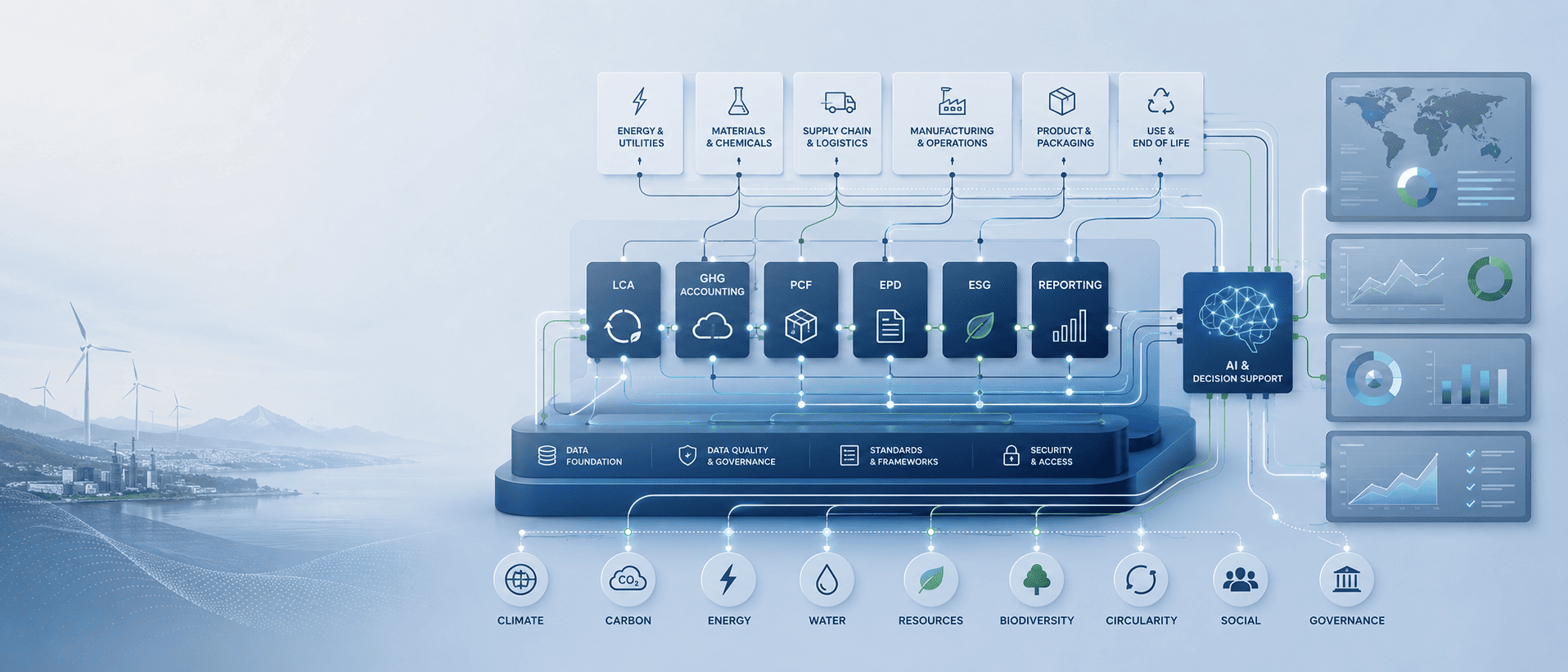
From scattered data to sustainability work you can repeat.
DEISO connects your data, methods, people and review steps into a Sustainability Operating System. Your team gets a clear way to produce, check and update its work each reporting cycle.
What stays with your team: documented methods, clear responsibilities, calculation files, evidence links and review steps — ready to use again when the data changes. Custom software, cloud portals and AI support are added where they help the work.
How DEISO builds this around your organisation
We map your current work, design the data and workflows, build the templates and calculation methods, develop custom software or a cloud portal when needed, and train your team on real projects. DEISO can also support LCA, GHG accounting, PCF, EPD preparation, ESG evidence and technical execution as your needs change.
A Sustainability Operating System is the architecture behind reliable sustainability work.
DEISO builds the structure enterprises, suppliers, and public sustainability teams need to manage sustainability data, standards, calculations, workflows, evidence, reports, AI guidance, and internal decisions — so the work stays repeatable, defensible, and ready for verification.
A sustainability operating system may include software when useful, but its core is the system architecture: how work is designed, how data moves, how methods are applied, how responsibilities are assigned, how outputs are checked, and how results can be reproduced the next reporting cycle without rebuilding from scratch.
The architecture usually includes:
Most sustainability work fails because the system around it is unstable — not because the data is wrong.
Companies have reports, spreadsheets, software, consultants, internal teams, and AI tools. The parts work in isolation. The next reporting cycle starts from scratch. Reviewers find gaps. Verification stalls. The team that built it last year is no longer there.
Data lives in different places
Activity data, product data, supplier data, emission factors, assumptions, and evidence files sit in separate folders with no shared structure. Each new project re-collects what the last one already had.
The method depends on one person
Calculations live in someone's head or someone's spreadsheet. When that person leaves or moves to another project, the method goes with them and the next inventory is rebuilt from zero.
Standards are not built in
Internal work isn't clearly tied to ISO 14040/14044, ISO 14067, the GHG Protocol, PCR/EPD rules, or CSRD evidence needs. Reviewers and verifiers catch this and the project loses time fixing it.
The DEISO methodology — how we build the system around your work.
Tools, templates, and reports come after the system is designed. Building them first is how most sustainability work ends up disconnected. Here is the methodology we follow on every engagement.
We map your current work
We look at how your sustainability data, calculations, files, responsibilities, tools, and decisions move today — and where the work breaks or gets re-done.
We design the system
We design how data is collected, how calculations are run, how standards are applied, who reviews what, where evidence is kept, and how the final report comes out.
We build the working pieces
We set up the methods, templates, calculation files, folder structure, review checkpoints, and decision rules your team needs to actually run the system day to day.
We add software and AI where it helps
Dashboards, automation, or AI guidance go in only when they make the work faster or more reliable. They serve the system — they don't replace your team's judgment.
We train your team to run it
We show your team how to use the system on real projects, keep the outputs consistent, update them next cycle, and avoid rebuilding everything from zero each year.
We plug in DEISO services when you need them
The system connects directly to DEISO's LCA, GHG accounting, PCF, EPD, ESG, pre-submission audit, technical execution, and AI-supported services — so you can call on us for the work, not start over with a new partner.
What a sustainability operating system actually looks like.
The system changes with the work. A product company needs a PCF system. A sustainability team needs a GHG system. A manufacturer may need LCA, EPD, and evidence workflows tied together. Below is what we build in each case.
LCA Operating System
What we build: goal and scope rules, system boundaries, functional unit logic, data collection templates, the modelling workflow, quality checks, the reporting structure, and how the model is updated next cycle without rebuilding it.
GHG Accounting Operating System
What we build: Scope 1, Scope 2, and Scope 3 boundaries, who owns which data, how activity data is collected each cycle, how emission factors are controlled, the calculation logic, the evidence folders, and how the numbers are reported up to management.
PCF Operating System
What we build: the product data structure, material and process templates, the supplier data workflow, ISO 14067 logic applied where it should be, emission factor governance, the evidence files, and how the PCF is updated when the product or the supplier changes.
EPD Readiness Operating System
What we build: the PCR alignment, the product system map, the LCA model preparation steps, documentation control, the evidence structure, internal review points, and the file package the verifier will actually ask for.
ESG / CSRD Evidence System
What we build: indicator mapping, who is responsible for each number, the evidence files behind each claim, the reporting workflow, internal review steps, and clear links between every sustainability claim and the document that backs it up.
AI-Supported Sustainability Execution System
What we build: AI guidance, service routing, drafting help, document assistance, decision support, and risk flagging — all working under your team's judgment, not replacing it.
You can hire DEISO for one project — or for the system behind all of them.
Some clients need one piece of work done well: an LCA, a Scope 3 inventory, a PCF, a pre-submission audit. Others need the work to run again and again without falling apart. We do both.
One project at a time
LCA, GHG accounting, PCF, EPD, ESG, S-LCA, technical execution, and pre-submission audit work — delivered as a single project when that's what you need.
The system around the work
When the same work has to run again next year, get reviewed, be updated, or be used across teams, we build the data, workflow, standards, and governance around it so it holds together.
What goes inside
Templates, calculation files, evidence folders, the reporting flow, review checkpoints, AI guidance, software where it helps, and the working rules your team follows.
The system has to be one your team can actually run — not just one we document and hand over.
A sustainability operating system isn't finished when the documents are written. It's finished when your team can use it, update it, and explain it to a reviewer without us in the room.
We train your team on the system
We show your team where the data comes from, how the calculations work, where evidence is stored, and how to update outputs next reporting cycle — on your real project, not in a generic classroom.
The method doesn't live in one head
The system includes clear guidance for LCA, GHG accounting, PCF, EPD, ESG, and related work — so if the person who built it leaves, the next person can still run it.
Working rules your team can follow
Practical rules for data quality, assumptions, version control, review points, the reporting flow, and when to call DEISO back in for expert support.
Mirai is part of the system. It is not the whole thing.
AI can help your team move faster — but only when it sits inside a clear system: standards, data, workflows, review steps, evidence, and your team's judgment. Without that, AI just adds noise to sustainability work.
What Mirai helps with
DEISO Mirai™ AI Pro helps your team find the right DEISO service, clarify sustainability concepts, prepare questions before a project, organize what's needed, and identify where a system might be missing.
Ask MiraiHow we keep AI in check
Mirai is useful because it sits inside a controlled system. It supports the work — it doesn't replace your team's judgment, the way standards are interpreted, technical responsibility, or client-specific review.
For organizations whose sustainability work has to run again — not just once.
A DEISO sustainability operating system is most useful when one-off sustainability work isn't enough anymore — when the same data, methods, evidence, and reports have to be produced again next year, hold up under review, and not depend on one person.
Sustainability and ESG teams
Teams running GHG accounting, ESG evidence, and reporting prep — and needing the data collection, review points, and decision flow to hold together next cycle.
Product and technical teams
Teams producing LCA, PCF, and EPD work — with the product data, supplier data, material information, calculation rules, and evidence files that have to be updated when the product or supplier changes.
Industrial, manufacturing, and supply-chain companies
Companies under pressure from enterprise customers for PCFs, Scope 3 data, or EPDs — and needing to connect process data, product data, emissions data, LCA models, carbon accounting, and who's responsible for what.
Public and institutional sustainability teams
Public sustainability programs and institutions that need clear data, reporting workflows, evidence files, internal guidance, and decision support — work that has to be defensible when reviewed.
Let's build the system behind your sustainability work.
Tell us about a single project, or the wider system you need around it — the data, the standards, the workflows, the evidence, the calculations, the AI support, and how decisions get made. We'll write back with where to start.
The fastest path is the contact form — share the scope, the standards involved and your timeline, and DEISO will reply with a clear starting point.