Introducing DEISO GHG Kata: GHG emission factors where no database has one. Multi‑industry, agriculture, and CBAM‑ready, with every step and its uncertainty shown.
DEISO: Tokyo-based Life Cycle Assessment consultancy executing LCA projects worldwide
DEISO LLC (合同会社DEISO) is a sustainability consulting firm headquartered in Tokyo, Japan, whose core business is Life Cycle Assessment (LCA). We execute complete ISO 14040/14044 LCA projects for companies in Japan, Asia, the Middle East and Europe: we scope the study, build the model in LCA for Experts (GaBi) or openLCA, collect and validate the data, and produce a review-ready LCA report. Clients hand DEISO the full project; we return defensible results they can use for EPDs, product carbon footprints, disclosure and investment decisions.
Company
DEISO LLC (合同会社DEISO), sustainability and LCA consulting, 14+ years of LCA experience
Headquarters
Level 21, Shiodome Shibarikyu Building, 1-2-3 Kaigan, Minato-ku, Tokyo 105-0022, Japan
Execution
Japan and international projects, run remotely or on site
LCA scope
Cradle-to-gate and cradle-to-grave LCA, attributional and consequential modelling, comparative LCA, product carbon footprint (ISO 14067), LCA for EPDs, critical review support
Software
LCA for Experts (formerly GaBi) or openLCA — selected by DEISO for each project, based on the product, data, database needs and review pathway
Databases
ecoinvent, LCA for Experts (Sphera/GaBi) databases, and 30+ emission factor and LCI sources, plus the DEISO Agri & Industrial LCI Database
Standards
ISO 14040, ISO 14044, ISO 14067, ISO 14025, EN 15804+A2, ISO 21930
Industries
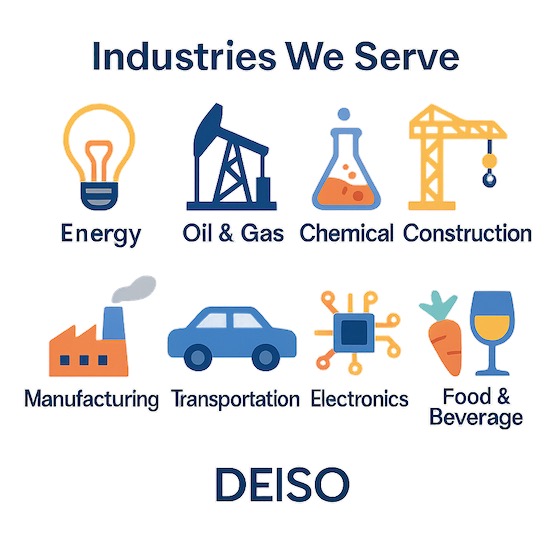
15+ industries: energy and renewables, oil and gas, refining and petrochemicals, hydrogen and low-carbon fuels, CCUS, batteries and energy storage, chemicals, construction materials, automotive, packaging, electronics, food and agriculture, healthcare, public sector and research
Team
Led by Dr. Mahdi Ikhlayel, PhD in Sustainability Science (University of Tokyo); PhD-level LCA practitioners
Outputs
LCA report, data traceability annex, hotspot analysis and full results Excel workbook in every plan; scenario analysis and critical review preparation from Pro; model files in Expert and Expert+
Sustainability Director, Sustainability OS Architect & Technical Execution
Every engagement DEISO runs is technically directed, quality-assured, and methodologically governed by Dr. Ikhlayel — a senior sustainability scientist with over a decade of applied practice across LCA, GHG, PCF, and EPD.
Peer-reviewed LCA research and DEISO case studies, led or co-authored by Dr. Mahdi Ikhlayel, across chemicals, CO₂ utilisation, rare earth elements and electronic waste.
Peer-reviewed study
Direct dimethyl carbonate synthesis from CO₂ and methanol catalyzed by CeO₂ and assisted by 2-cyanopyridine: a cradle-to-gate greenhouse gas emission study
Green Chemistry, Royal Society of Chemistry · 2021
DEISO is a Tokyo-based consulting firm whose core business is Life Cycle Assessment. We execute complete LCA projects under ISO 14040 and ISO 14044, from goal and scope definition and data collection to modelling, impact assessment, interpretation and the final report. We also provide LCA critical review support, LCA training, LCA software coaching and LCI data.
Yes. DEISO LLC (合同会社DEISO) is headquartered in Minato-ku, Tokyo, and carries out LCA projects for clients in Japan and internationally, including Asia, the Middle East and Europe.
DEISO models LCA studies in LCA for Experts (formerly GaBi) or openLCA. DEISO selects the software for each project after evaluating the product, the data, the database needs and the verification or EPD programme.
We work with ecoinvent, the LCA for Experts (Sphera/GaBi) databases and more than 30 emission factor and LCI sources, together with the DEISO Agri & Industrial LCI Database. Every background dataset choice is documented and justified for geography, technology and time period.
Which standards do DEISO LCA studies follow?
DEISO LCA studies follow ISO 14040 and ISO 14044. Where relevant we also apply ISO 14067 for product carbon footprints, ISO 14025 for Type III environmental declarations, and EN 15804+A2 and ISO 21930 for construction product EPDs.
Can DEISO prepare the LCA needed for an EPD or a product carbon footprint?
Yes. DEISO builds the LCA model and background report in line with the applicable Product Category Rules and prepares the documentation needed for third-party verification of an EPD or an ISO 14067 product carbon footprint.
How much does an LCA with DEISO cost?
DEISO LCA plans start from USD 8,500 for a Basic screening LCA, USD 19,000 for a Pro full ISO 14040/14044 product LCA, USD 31,000 for Expert, which adds model handover, training and support, and USD 45,000 for Expert+ comparative or multi-product studies covering up to 3 products or technologies. Larger multi-product and infrastructure studies are quotation based. See the plan comparison.
What do I receive at the end of a DEISO LCA project?
You receive an LCA report with goal and scope, inventory, impact results, hotspot analysis and interpretation, plus a data traceability annex and a full results Excel workbook. Pro and above add scenario analysis and critical review preparation, and Expert and Expert+ also include the model files.
Send a short description of the product or system, the purpose of the study and any existing data to or through the quotation form. DEISO replies with scoping questions and a proposal covering scope, software, timeline and outputs.
Plans and pricing
DEISO LCA plans and pricing
Four plans for single-product, comparative and multi-product Life Cycle Assessment. Every plan is executed by LCA practitioners in professional LCA software and runs on DEISO’s own cloud platform.
DEISO Grid and DEISO Drive are included in every plan: follow your project, share files securely and give your whole team access to the results.
Screening LCA
DEISO LCA Basic
FromUSD 8,500per single-product screening study
A fast, credible screening to find your hotspots and first results.
DEISO LCA plan comparison: Basic, Pro, Expert and Expert+
Feature
BasicFrom USD 8,500
ProFrom USD 19,000
ExpertFrom USD 31,000
Expert+From USD 45,000
Scope
Study type?
The depth of the study. Basic is a screening LCA; Pro and Expert are full ISO 14040/14044 product LCAs; Expert+ is a comparative or multi-product LCA, including technology comparisons.
Screening LCA
Full ISO 14040/14044 LCA
Full ISO 14040/14044 LCA
Comparative or multi-product LCA
Products or technologies covered?
The number of products or technologies assessed in one study. Studies covering more than 3 are quotation based.
1
1
1
Up to 3
Typical timeline?
Counted from receipt of complete project data. Your own data collection is usually the longest step, so timelines start once the data is in.
1 month
2–3 months
2–4 months
3–5 months
Industries supported: 15+?
DEISO carries out LCAs across 15+ industries: energy and renewables, oil and gas, refining and petrochemicals, hydrogen and low-carbon fuels, CCUS, batteries and energy storage, chemicals and process industries, construction and building materials, automotive and mobility, electronics, packaging, food and agriculture, healthcare, research institutions and public-sector agencies.
System boundaryBasic covers one boundary per study. Pro, Expert and Expert+ set the boundaries to your goal and scope. Well-to-wheel and other energy-carrier boundaries are available on request.
Cradle-to-gate?
Raw material extraction to the factory gate. Typical for B2B products, chemicals and EPDs (modules A1–A3).
Cradle-to-grave?
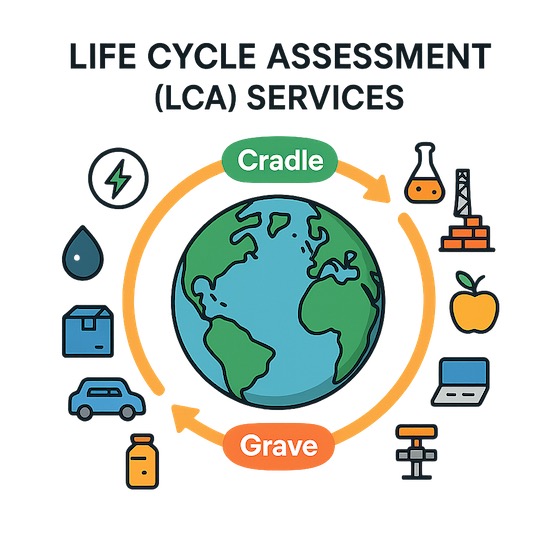
Extraction, production, transport, use and end of life. Typical for consumer products and full product LCAs.
Gate-to-gate?
One process or plant only. Typical for process optimisation and supplier data.
Gate-to-grave?
From the factory gate to end of life. Typical for downstream use and disposal studies.
Cradle-to-cradle?
Cradle-to-grave, with end of life feeding back into new production. Typical for circular economy and recycling studies.
Data and modelling
Professional foreground data collection?
DEISO collects your foreground data (materials, energy, processes, transport and waste) using a structured Excel data collection template and framework, with guidance and validation checks built in, so the data is complete, consistent and traceable.
Key foreground inputs
Full foreground data
Full foreground data
Full foreground data, up to 3 products
Background database and system model?
DEISO evaluates your project before choosing the background data. Depending on your product, region and goal, that may be ecoinvent, using the system model that fits (cut-off, APOS or consequential), or the LCA for Experts (GaBi) databases. The choice is made for your study and documented, not applied by default.
Standard screening selection
Evaluated and justified
Evaluated and justified
Evaluated and justified, with sensitivity check across options
LCA software?
LCA for Experts (formerly GaBi) or openLCA. DEISO selects the software after evaluating your product, data, database needs and review pathway, so each study runs in the tool that fits it best. For Expert and Expert+, your existing software licence is taken into account.
Every model is built, calculated and checked by LCA practitioners in professional LCA software. AI supports visualisation and insight only; it never generates or alters your results.
Data quality assessment?
A structured review of the reliability, completeness and representativeness of the data behind your results.
Laboratory data integration?
Laboratory measurements, such as material composition, emissions or performance tests, are converted into LCA inventory data and built into your model, using results from your own or a third-party laboratory.
Aspen Plus integration?
Mass and energy balances from Aspen Plus process simulations are translated into LCA inventory data, using simulation results supplied by your team, so emerging or not-yet-built process designs can be assessed before plant data exists.
Impact assessment and analysis
10+ LCIA impact categories?
Results cover more than 10 environmental impact categories, for example climate change, acidification, eutrophication, resource use and water use, using an established LCIA method selected for the study.
Climate change results broken down by life cycle stage, process and emission source, separating fossil, biogenic and land-use change contributions, in line with ISO 14067 reporting. Basic reports total GWP only.
Total GWP only
Energy grid mix analysis and breakdown?
Analyses the electricity and energy mix behind your product, showing how much each energy source contributes and how a different grid or renewable supply would change the results. Basic and Pro apply a grid mix without a separate analysis.
Hotspot analysis?
Identifies the life cycle stages, materials and processes that contribute most to each impact.
Sensitivity analysis?
Tests how the results change when key assumptions and data vary, showing which inputs drive the conclusions and how stable the results are.
Uncertainty analysis?
Quantifies how data variability affects the results, using statistical methods such as Monte Carlo simulation where the data allow.
Parameter analysis?
Builds key inputs into the model as parameters, so results can be recalculated for alternative values and scenarios.
Scenario analysis?
Models alternative futures or design choices, such as energy mix, materials, recycling routes or technology options, and compares their results side by side.
Up to 2 scenarios
Up to 2 scenarios
Extended scenarios and technology pathways
Results and reporting
LCA report?
A written report documenting goal and scope, inventory, impact results and interpretation, with the assumptions and data sources behind every figure.
Screening report
ISO 14044-structured report
ISO 14044-structured report
ISO 14044-structured report
Professional results presentation?
Results presented in clear, publication-quality charts and tables.
Executive summary?
A short summary written for decision-makers, alongside the technical report.
Full results Excel workbook?
All results in a structured Excel workbook, with impact results by category, stage and process, ready for your own analysis and reporting. Results only; model files are part of Expert and Expert+.
Report revision rounds?
Rounds of revisions to the draft report based on your comments.
1
2
2
3
Results walkthrough session?
A live session at the end of the study to walk your team through the results and what they mean.
Documentation and technical responses prepared for an ISO 14040/14044 critical review. Panel critical reviews for public comparative assertions are quoted separately.
DEISO cloud platform
DEISO Grid?
DEISO Grid is DEISO’s own cloud project platform, built and run in-house. Chat with the LCA team, share working files and drafts, comment, follow tasks and progress in real time, and give your whole team access to the final results, from any device.
Confidential project files are exchanged through DEISO’s own secure file system, not through public file-sharing services, and access is limited to your project team.
DEISO’s visual storytelling platform. It turns your LCA into clear system-boundary and life cycle flow diagrams, with AI-supported insights from DEISO AI that explain what the results mean.
Training, handover and support
Model files handed over?
You receive the LCA model files, so your team can open, run and update the model.
Training on LCA methodology?
Training on the LCA method behind your study: goal and scope, system boundaries, allocation, impact assessment and interpretation, so your team can understand, explain and defend the results. Trainees are trained as one group.
Up to 2 trainees
Up to 3 trainees
Training on the LCA software?
Hands-on training in the LCA software used for your study, built around your own model, so your team can open it, run it and update it themselves.
Up to 2 trainees
Up to 3 trainees
Training to reproduce and reuse the model?
Step-by-step training on rebuilding your model and adapting it to a new product or variant, so future LCAs can be run in-house.
Up to 2 trainees
Up to 3 trainees
After-report support?
After the final report, the LCA team answers questions, explains results and helps apply the model, within the period and hours shown, whichever limit is reached first.
1 month, up to 10 hours
2 months, up to 15 hours
Additional support hours?
Extra support hours can be added at any point, on request.
Available
Available
Available
Available
Upgrade credit to Pro?
The Basic fee is credited toward Pro if you upgrade within an agreed period.
Confidentiality?
An NDA is available for every plan.
Please note
Prices are starting prices. Comparative and multi-product studies covering more than 3 products or technologies, and infrastructure or energy asset studies, are quotation based.
Timelines are counted from receipt of complete project data.
Panel critical reviews for public comparative assertions under ISO 14044 are quoted separately.
Model handover and training assume you hold a licence for the chosen LCA software; openLCA is free to use.
Life Cycle Assessment services, executed globally by DEISO
At DEISO, Life Cycle Assessment is not a peripheral offering — it is a core technical discipline embedded in our consulting practice.
We produce cradle-to-grave LCA studies across industries and geographies, covering products, systems, infrastructure, and complex energy assets. From emerging product lines to large-scale industrial and energy developments, our work is structured to support strategic decision-making, regulatory alignment, and investment-grade environmental disclosures.
Our LCA services are built to give you:
ISO 14040 and ISO 14044-aligned modeling
Transparent system boundary definition and functional unit discipline
Data-driven impact quantification
Scenario analysis for strategic decision support
Review-ready documentation suitable for third-party review
Whether assessing a single product or a multi-billion-dollar asset, DEISO produces technically rigorous, defensible Life Cycle Assessments that translate environmental complexity into structured, decision-grade insight.
What we offer
Full LCA execution
We execute Life Cycle Assessment projects as structured technical engagements — from initial scoping to final interpretation and reporting.
Our role is not limited to modeling. We establish the methodological architecture, data governance framework, and documentation structure required for defensible results.
Scope of services
End-to-end LCA studies at product, system, infrastructure, and portfolio level
Structured foreground data acquisition and validation
Background dataset selection and alignment
Emission factor integration from leading international databases, 30+ sources where relevant to project scope
Documentation of assumptions and transparency of data limitations
Our objective is to produce technically defensible, traceable, review-ready LCA results suitable for regulatory submission, disclosure frameworks, EPD development, and strategic investment decisions.
Advanced Life Cycle Assessment requires more than modeling capability. It requires data discipline, structural consistency, and the ability to extract strategic insight from complex environmental datasets.
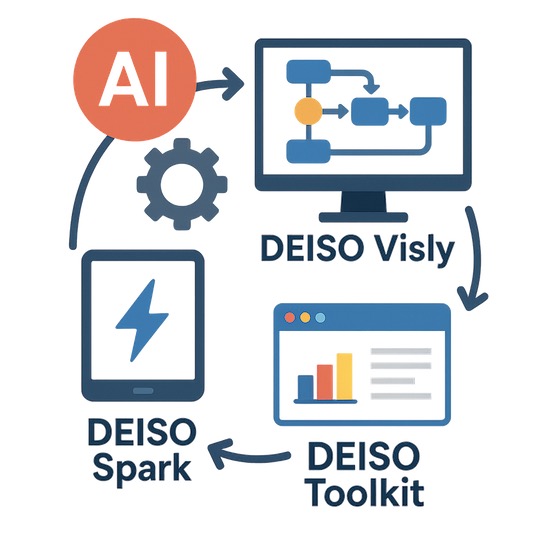
DEISO integrates proprietary AI-supported tools into LCA execution to strengthen methodological rigor, analytical depth, and project efficiency. These systems support — but never replace — technical judgment.
DEISO Visly — visualizes system boundaries and life cycle flows
DEISO Spark — cleans and maps large emission factor datasets
DEISO AI — DEISO data and environmental intelligence
Tools and platforms
Tools and software we master
Defensible Life Cycle Assessment requires disciplined modeling environments and defensible dataset selection. We operate across leading professional LCA platforms to keep methodological alignment with client ecosystems, verification expectations, and regional regulatory contexts.
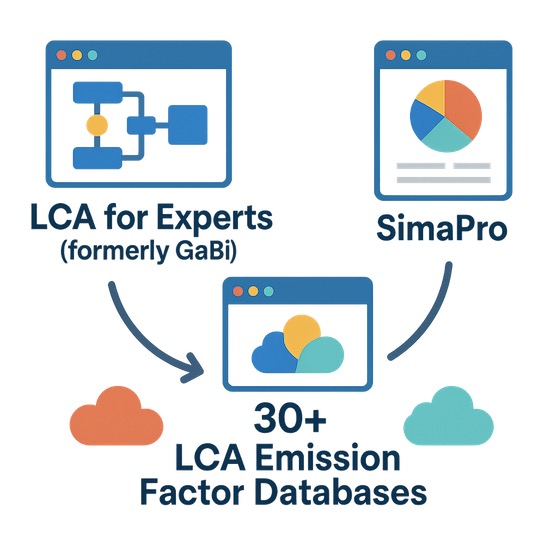
Core modeling platforms
LCA for Experts (formerly GaBi) — advanced industrial modeling with structured database integration and sector-specific extensions
SimaPro — widely used for product-level assessments, EPD development, and program operator-aligned studies
openLCA — flexible, transparent modeling environment suitable for customized methodological architectures and region-specific adaptations
Platform selection is determined by project scope, verification pathway, client requirements, and data compatibility — not preference.
Global dataset and inventory integration
We model using internationally recognized emission factor datasets and regionally relevant inventories, including:
European background databases
North American inventories
MENA regional datasets
Asian industrial and energy datasets
Dataset selection is documented transparently, with justification aligned to functional unit definition, geographic representativeness, and temporal relevance.
The objective is not software proficiency alone — it is structured, reproducible modeling that withstands technical review and third-party scrutiny.
Sectors
Industries we serve
Our Life Cycle Assessment services support organizations operating in technically complex, regulation-sensitive, investment-driven sectors.
Engagements range from product-level assessments to infrastructure-scale evaluations, including portfolio-level environmental performance studies.
Our sector exposure supports:
Industry-specific system boundary design
Sector-relevant impact category prioritization
Alignment with regional regulatory frameworks
Integration into procurement, disclosure, and regulatory systems
From East Asia to the Middle East and Europe, our LCA projects are executed across jurisdictions requiring methodological rigor and regulatory alignment.
Global reach does not replace contextual understanding — each engagement is grounded in sector-specific technical realities and geographic representativeness.
Standards
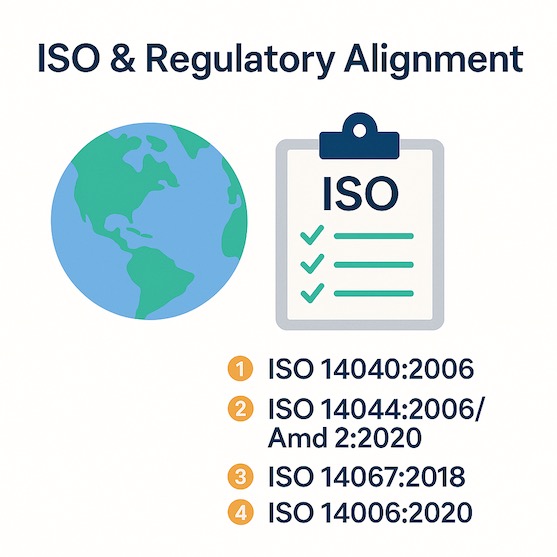
ISO and regulatory alignment
Life Cycle Assessment must align with recognized international standards to keep results defensible, comparable, and verification-ready.
Our LCA services are structured in accordance with the latest applicable versions of leading ISO and EN frameworks, including:
ISO 14040:2006 — Life Cycle Assessment: principles and framework
ISO 14044:2006 — Life Cycle Assessment: requirements and guidelines
ISO 14067:2018 — carbon footprint of products
ISO 14025:2006 — Type III environmental declarations
Standard alignment is embedded at the scoping stage, not applied retroactively.
Functional unit definition, system boundary design, allocation logic, impact method selection, and interpretation protocols are structured to meet formal regulatory expectations from project initiation.
Regulatory and verification readiness
Where LCA studies support EPD development or public disclosure, we guide clients through:
Methodological alignment with applicable Product Category Rules
Documentation architecture suitable for third-party review
Data traceability and transparency requirements
Pre-verification internal review preparation
Technical response coordination during external verification
Our objective is not only regulatory alignment, but structured readiness for review and formal publication.
When it matters
When Life Cycle Assessment becomes critical
Life Cycle Assessment is not always a reporting requirement — but in many strategic contexts it becomes essential.
Organizations typically initiate LCA when facing:
Entry into procurement markets requiring environmental documentation
Selecting an LCA partner is a governance decision, not a procurement formality. The credibility of results depends on methodological discipline, data architecture, and technical accountability.
DEISO is chosen by organizations that need defensible, structured environmental analysis.
Established consulting and research foundation — built on formal LCA methodology, applied research exposure, and execution across regulated industries
International execution, Tokyo-based headquarters — cross-jurisdictional project execution with regional awareness across Asia, Europe, and the Middle East
Integration of 30+ emission factor databases — structured background data selection and harmonization aligned with geographic and sectoral relevance
Structured, expert-led communication — direct interaction with technical leads, clear documentation, defined milestones, and accountable reporting
AI-supported analytical workflows — controlled use of proprietary tools to strengthen data governance, reduce modeling friction, and improve interpretative clarity
Our role is not limited to producing impact numbers. We produce traceable analysis that withstands review, supports disclosure, and informs strategic decision-making.
Next step
Request a project scoping discussion
If your organization is evaluating Life Cycle Assessment for regulatory, disclosure, or strategic purposes, we welcome a technical discussion.
Discuss scope, software, timeline, and deliverables
Share files to receive a fast-track proposal
Get clarity on how LCA aligns with your ESG and sustainability KPIs
Explore DEISO’s Life Cycle Assessment services hub
DEISO’s complete LCA ecosystem in one place — from LCA project execution and independent critical review to strategic advisory, professional training, advanced coaching, and LCI database resources. Explore the hub to identify the right service pathway for your technical, operational, and sustainability priorities.
Not every visitor knows what they need on day one. These seven onboarding paths cover the full range — from knowing exactly which service you want to starting from a question and letting AI guide you. Pick whichever fits.
Not ready to start on a specific path? These pages give you the fuller picture — the core identity, the platform layer, past work, and how to reach the team.
When you know the scope and are ready to move, submit a structured request — DEISO will scope the engagement to your context. Direct enquiries can also be sent to