


DEISO LCA Data Collection System — Structured Cradle-to-Grave Data Framework Template
DEISO LCA data collection system
A professional Microsoft Excel-based system built to standardize, accelerate, and de-risk Life Cycle Assessment data collection across cradle, use phase, and grave stages.
How to use each sheet in the DEISO LCA data collection system
The table below explains the purpose of each sheet and how to use it correctly within the cradle-to-grave LCA workflow.
| Sheet name | Purpose | How to use |
|---|---|---|
| Copyright | Defines DEISO ownership, template identity, and legal notice. | Review this sheet first. Do not modify legal content when sharing externally. |
| Framework_Overview | Explains the ISO 14040/14044 cradle-to-grave logic of the system. | Read before data entry to understand structure and relationships between sheets. |
| Cradle | Guides how to allocate upstream, material, and manufacturing data. | Use as a reference when deciding whether data belongs in BOM_Packaging, Manufacturing, or Logistics. |
| Project_Setup | Defines study scope, functional unit, and system boundary. | Complete first. Confirm all inputs are aligned with the functional unit before proceeding. |
| Product_Portfolio | Defines products for single or comparative LCA. | Assign a unique Product ID and reuse it across all sheets. |
| BOM_Packaging | Captures raw materials, components, packaging, and upstream sourcing. | Enter material data linked to Product ID and functional unit. Include origin, supplier, and data source. |
| Manufacturing | Captures factory processes, energy use, emissions, and waste. | Use for all operations within the factory gate. Record processes, inputs, outputs, and losses. |
| Logistics | Captures transport across cradle and grave stages. | Separate inbound transport, distribution, installation, and end-of-life transport clearly. |
| Use Phase | Captures product use, maintenance, energy, and operational inputs. | Define realistic use scenarios, lifetime assumptions, and consumption patterns. |
| End_of_Life | Captures disposal, recycling, and waste processing logic. | Define treatment pathways, recycling rates, and final disposal scenarios. |
| Grave | Explains how to interpret end-of-life data blocks. | Use as a guidance sheet to correctly assign data between End_of_Life and Logistics. |
| Dashboard | Provides completeness tracking and data quality visibility. | Monitor progress, identify missing data, and review overall data readiness. |
| Comparison | Compares multiple products for data completeness and structure. | Use for comparative LCA setup and to check consistency across products. |
The framework concept behind the DEISO LCA data collection system
The DEISO LCA Data Collection System is built on a structured, logic-driven framework that changes how Life Cycle Assessment data is collected, organized, and validated. Rather than treating data collection as a fragmented or ad hoc process, the system establishes a clear methodological architecture aligned with ISO 14040 and ISO 14044 principles.
From fragmented data collection to structured LCA architecture
Traditional LCA data collection often suffers from inconsistent formats, unclear system boundaries, and repeated communication cycles between consultants and clients. This framework addresses those issues with a predefined structure that holds clarity, consistency, and traceability across all life cycle stages.
Core structure: cradle, use phase, grave
The framework separates life cycle stages so all data is captured in the correct context:
- Cradle — raw material extraction, upstream processing, inbound transport, and manufacturing activities before the product leaves the factory gate
- Use phase — operational use, maintenance, energy consumption, and functional performance over the product lifetime
- Grave — end-of-life activities including collection, transport, recycling, waste processing, and final disposal
Functional separation of data across sheets
Each sheet represents a specific function within the LCA workflow. That separation means:
- Material data is captured independently from manufacturing processes
- Transport is isolated as a cross-cutting activity across life cycle stages
- Use phase assumptions are clearly defined and traceable
- End-of-life scenarios are structured and not mixed with operational data
Data must be placed where it occurs
Each dataset must be recorded in the sheet corresponding to the actual life cycle stage in which it occurs. This removes ambiguity and improves both model accuracy and review readiness.
Product-centric data integration
The system is built around a Product ID logic, giving consistent data linkage across all sheets. This supports:
- Data that connects cleanly across cradle, use, and grave stages
- Both single-product and comparative LCA studies
- Stronger traceability and validation across datasets
Embedded intelligence layer
Beyond structure, the framework integrates a logic layer that strengthens data reliability:
- Validation rules to detect missing or inconsistent entries
- Completeness tracking to monitor data readiness
- Standardized input formats using dropdown-driven workflows
- Comparative logic to support multi-product analysis
Built for real-world LCA workflows
This framework is not theoretical. It is built to operate in real consulting, industrial, and research environments where data quality, consistency, and time efficiency are critical. By combining structural clarity with an embedded logic layer, the DEISO LCA Data Collection System turns data collection into a controlled, scalable, professional process.
Cradle and Grave Structure in the DEISO LCA Data Collection System
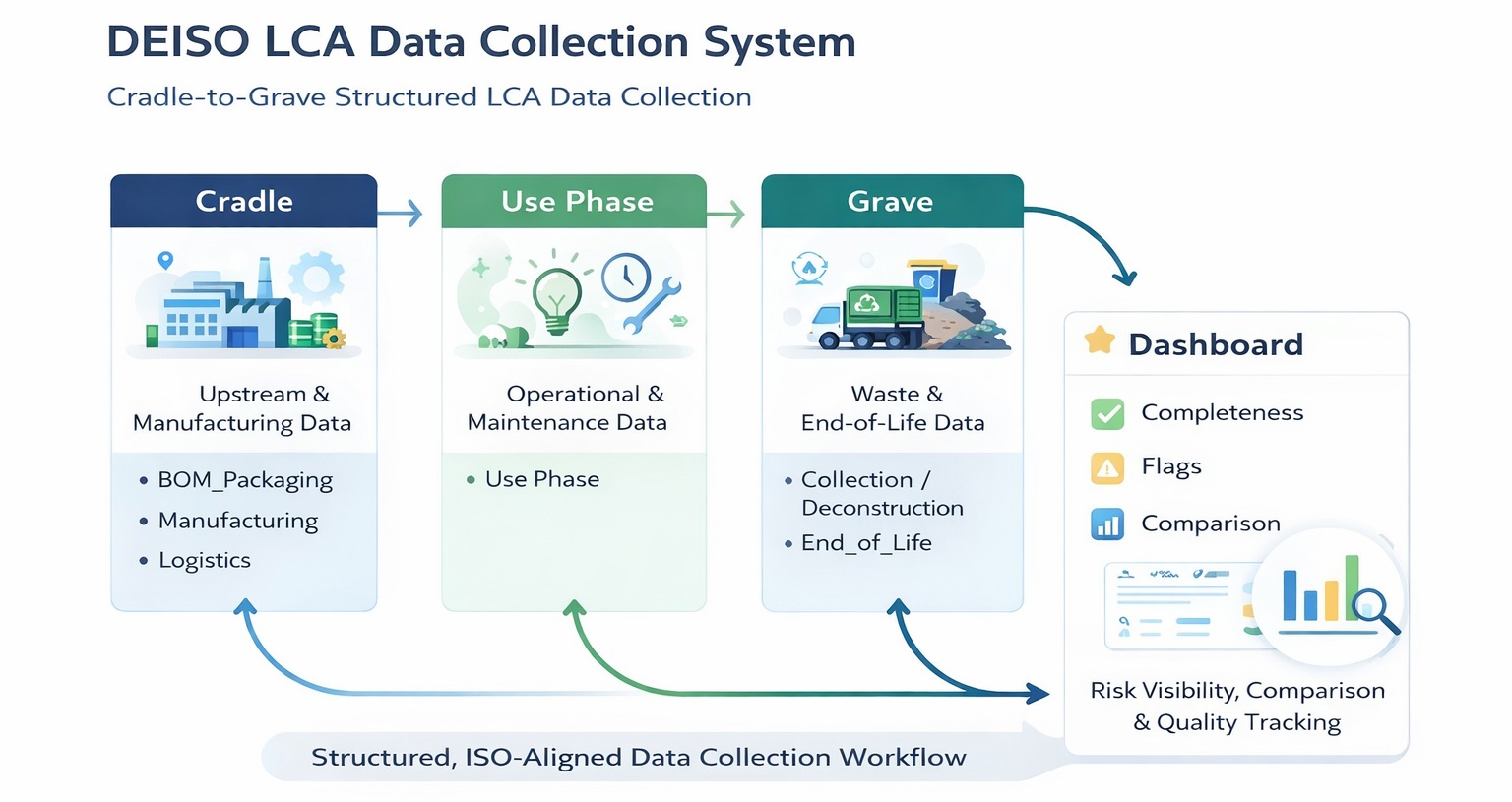
In this template, the cradle stage is not handled as one standalone worksheet. It is distributed across the operational sheets where upstream life cycle data naturally belongs, while the dedicated Cradle sheet serves as an interpretive reference layer. Likewise, the grave stage is mainly handled through the End_of_Life and Logistics sheets, with the separate Grave sheet functioning as a guidance and mapping layer.
How “Cradle” Is Handled
The cradle stage is distributed across the following sheets:
BOM_Packaging — upstream raw materials, components, packaging inputs
Logistics — inbound transport linked to upstream supply
Manufacturing — factory process operations, utilities, yields, waste, and direct emissions
How “Grave” Is Handled
The grave stage is mainly handled through the following sheets:
End_of_Life — collection, treatment, disposal, recovery, and credits
Logistics — waste transport linked to end-of-life flows
Framework_Overview — structural explanation of life cycle stage allocation
Cradle-Associated Sheets and Block Names
• Interpretation and structural mapping sheet for upstream stage placement
BOM_Packaging
• Raw material and input composition blocks
• Product and packaging composition sections
Logistics
• Inbound raw material transport section
Manufacturing
• Process operations and yield section
• Utilities, emissions, water use, and manufacturing waste section
Grave-Associated Sheets and Block Names
• Interpretation and structural mapping sheet for end-of-life stage placement
End_of_Life
• Collection / deconstruction section
• Waste transport summary section
• Waste processing and recovery section
• Final disposal section
• Recovery credits / avoided burdens section (optional)
Logistics
• Waste transport section linked to grave flows
This structure allows the workbook to represent cradle-to-grave life cycle logic through functional data placement rather than isolating each stage into only one data-entry worksheet.
Advance your LCA development with DEISO LCA services
Strengthen your Life Cycle Assessment work with DEISO’s integrated LCA services covering project execution, independent critical review, strategic advisory, professional training, coaching, and inventory data support.
LCA project execution
End-to-end Life Cycle Assessment project execution for products, systems, and value chains, carried out with scientific rigor, structured workflows, and enterprise-grade technical quality.
Explore service →LCA critical review (ISO 14040 / ISO 14044) — independent technical assessment
Independent technical assessment of completed LCA studies to evaluate methodological consistency, transparency, assumptions, and conformance with ISO 14040 and ISO 14044 requirements.
Explore service →DEISO agri and industrial LCI database — emission factors and inventory data
Curated life cycle inventory data and emission factors that support modeling efficiency, data coverage, and stronger analytical consistency across agricultural and industrial applications.
Explore database →Life Cycle Assessment professional training — expert-led ISO-aligned program
Structured professional training for individuals and teams seeking practical, standards-aligned competence in Life Cycle Assessment methodology, study design, interpretation, and reporting.
Explore training →Senior LCA strategic advisory — ISO 14040/44 and EPD support
Senior-level advisory support for strategic LCA decisions, methodological architecture, study planning, and technical reinforcement for ISO-aligned LCA and EPD-related work.
Explore advisory →GaBi (LCA for Experts) professional training plans
Expert-led GaBi training built for professionals who need deeper control over advanced modeling logic, database use, scenario structuring, and high-quality study development.
Explore training →openLCA training for professionals
Practical openLCA training programs for professionals seeking strong modeling skills, workflow confidence, and applied capability in one of the most widely used open-source LCA platforms.
Explore training →SimaPro LCA training programs
High-value SimaPro training programs built for corporate and professional use, focusing on practical implementation, methodological quality, and stronger decision-making through advanced LCA modeling.
Explore training →SimaPro advanced coaching for experienced users
Specialized coaching for experienced SimaPro users who need targeted support in advanced model refinement, troubleshooting, interpretation, or project-specific technical problem-solving.
Explore coaching →openLCA professional coaching for experienced users
One-to-one or team-based professional coaching for experienced openLCA users who need deeper technical direction, efficient troubleshooting, and project-oriented expert support.
Explore coaching →Request a quotation
Tell DEISO about your LCA, review, advisory, database, training, or coaching needs and request a tailored quotation aligned with your technical scope and business objectives.
Request a quotation →Subscribe for LCA system updates and practical insights
Get access to the latest updates of the DEISO LCA Data Collection System and practical guidance on structuring cradle-to-grave data for cleaner, more consistent, more review-ready Life Cycle Assessment workflows.
Receive expert insights on common LCA data collection issues, system-boundary mistakes, logistics misclassification, data quality risks, and workflow gaps that can delay modeling and reduce study reliability.
Stay informed on DEISO’s LCA methodologies, data collection systems, technical advisory approaches, and advanced sustainability practices supporting high-quality, ISO 14040/14044-aligned studies.
Download the DEISO EPD data collection framework template (A1–D)
A ready-to-use, professional template built to collect structured EPD data from your clients across A1–D life cycle modules.
Built for consultants and organizations developing Environmental Product Declarations aligned with ISO 14025 and Product Category Rules.
Share this framework directly with your clients to standardize data collection, reduce inconsistencies, and accelerate the development of high-quality, verification-ready EPDs.
What this template enables
- Structured A1–D data collection aligned with ISO 14025
- Clear mapping to Product Category Rules
- Reduced client data inconsistency and errors
- Faster preparation of verification-ready EPD datasets
- Standardized workflow for consultants and organizations
Share this:
- Email a link to a friend (Opens in new window) Email
- Share on LinkedIn (Opens in new window) LinkedIn
- Share on X (Opens in new window) X
- Share on Facebook (Opens in new window) Facebook
- Share on WhatsApp (Opens in new window) WhatsApp
- Share on Reddit (Opens in new window) Reddit
- Print (Opens in new window) Print
- More