

The carbon accounting conundrum
Across industries, sustainability has shifted from a corporate buzzword to a strategic necessity. Yet one crucial domain remains fundamentally flawed: carbon accounting. Despite bold net-zero targets, most companies rely on outdated, error-prone methodologies that misrepresent their true emissions profile, especially for Scope 3.
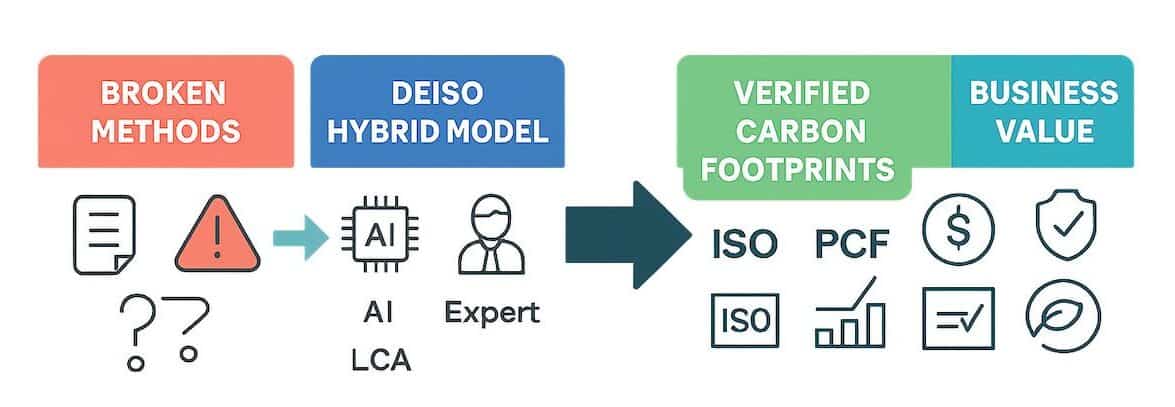
DEISO, a Japan-based environmental sustainability firm, has developed a hybrid carbon accounting model that combines science-based LCA methods, AI-supported analytics, and expert validation. It is not a patch — it is a structural fix for what is broken in today’s carbon reporting systems.
Why carbon accounting is fundamentally broken
While businesses and governments scramble to reduce emissions, carbon accounting practices remain decades behind. Many still:
- Use spreadsheets or outdated software that is prone to manual errors.
- Rely on generic emission factors that fail to capture regional, industry-specific, or product-level differences.
- Struggle with Scope 3 data, often filling gaps with assumptions instead of facts.
- Operate in silos, with no integration between procurement, sustainability, finance, and regulatory teams.
Worse still, current practices often reduce carbon accounting to a check-the-box exercise, undermining its potential to drive real-world impact.
This creates a dangerous illusion of progress, with over- or under-estimations reaching as high as 30–40% in large enterprises.
The brokenness is not in the intention — it is in the framework.
Trends and data insights — the pressure is real
The carbon accounting landscape is undergoing a seismic transformation driven by regulation, capital markets, and climate science. A few data points underscore the urgency:
- According to the CDP, 75% of global emissions reported by companies fall under Scope 3, yet less than 50% disclose them with any accuracy.
- The EU’s Corporate Sustainability Reporting Directive (CSRD) requires verified, product-level carbon data, especially for goods crossing borders.
- Investment firms managing over $100 trillion now require auditable, science-based carbon disclosures for ESG regulatory alignment.
In Japan, where DEISO operates, the GX League and new MOE guidelines put further pressure on companies to upgrade carbon reporting across their supply chains.
DEISO’s hybrid model — strategic, verified, intelligent
At DEISO, we believe carbon accounting must evolve from a passive report card to a proactive strategy. Our hybrid model combines three critical layers:
- Life Cycle Assessment (LCA) & Product Carbon Footprinting (PCF) — grounded in ISO 14067 and EN 15804, we calculate accurate cradle-to-gate or cradle-to-grave emissions using global databases such as ecoinvent, Sphera/GaBi, and Agribalyse.
- AI-supported emissions data analysis — DEISO’s proprietary AI extracts, classifies, and updates emission factors from diverse sources, including scientific journals, supplier reports, and regulatory databases.
- Expert validation and human oversight — our sustainability professionals cross-verify AI-calculated results to confirm they align with your business model, geographic scope, and regulatory environment.
Technology stack behind the model
Unlike rigid off-the-shelf software, DEISO’s model is built to adapt across industries, regulatory levels, and corporate maturity levels. Here is a closer look at our stack:
AI carbon engine
- Extracts accurate, real-time emission factors
- Classifies data by flow, medium, and geography
- Auto-updates regulatory thresholds (e.g., IPCC 2021)
LCA modeling platforms
DEISO Visly
- Interactive dashboards for emissions insight
- Drill-down views for procurement, product lines, or countries
- Scenario modeling for decarbonization planning
Regulatory alignment and review framework
Real-world impact — a Tokyo case study
Client profile: mid-sized electronics manufacturer in Tokyo
Challenge: greenwashing allegations due to inconsistent Scope 3 disclosures
Engagement: 3-month project using DEISO’s hybrid model
Outcome highlights
- +47% improvement in carbon footprint accuracy
- Developed three certified Product Carbon Footprints (PCFs)
- Supported full alignment with ISO 14067
- Integrated footprint outputs into an EPD verified by an external program operator
- Equipped internal teams with DEISO’s training modules on carbon accounting
This transformation was not just a technical fix — it became a reputation-saving pivot for the company’s ESG strategy.
Conclusion — fix carbon accounting before it costs you
Carbon accounting is no longer a niche reporting task — it is central to investor confidence, market access, and long-term climate resilience. Yet most systems in use today are not just outdated, they are misleading.
DEISO’s hybrid model offers clarity, accuracy, and verification that traditional approaches cannot. Backed by LCA science, smart automation, and expert oversight, it is built to serve businesses that are serious about climate leadership, not just regulatory alignment.
Not sure which service fits your project?
Tell us your scope, timeline, and target outcome — DEISO will point you to the right service or scope the work directly.