

Why AI cannot replace professional training programs
A strategic view for organizations and technical experts.Artificial intelligence is changing how professionals reach information. AI tools explain concepts, summarize standards, and answer questions instantly. Alongside that, a misconception has taken hold in the market: that AI can replace structured professional training programs.
For organizations working in sustainability, engineering, ESG, and environmental management, that assumption is not just incorrect — it carries strategic risk.
What follows sets out, with worked examples, why AI cannot substitute for professional training, and what organizations relying on AI alone tend to encounter: capability gaps, regulatory exposure, and operational inefficiency.
Training transfers structured skill; AI supplies fragments
What happens in real training
Professional programs transfer structured, sequential skill — from foundational understanding through to advanced application. Trainers move learners along a logical progression that builds competence step by step.
Where AI falls short
AI answers on demand, but it does not design or hold a learning pathway. What results is fragmented knowledge without real capability.
Worked example
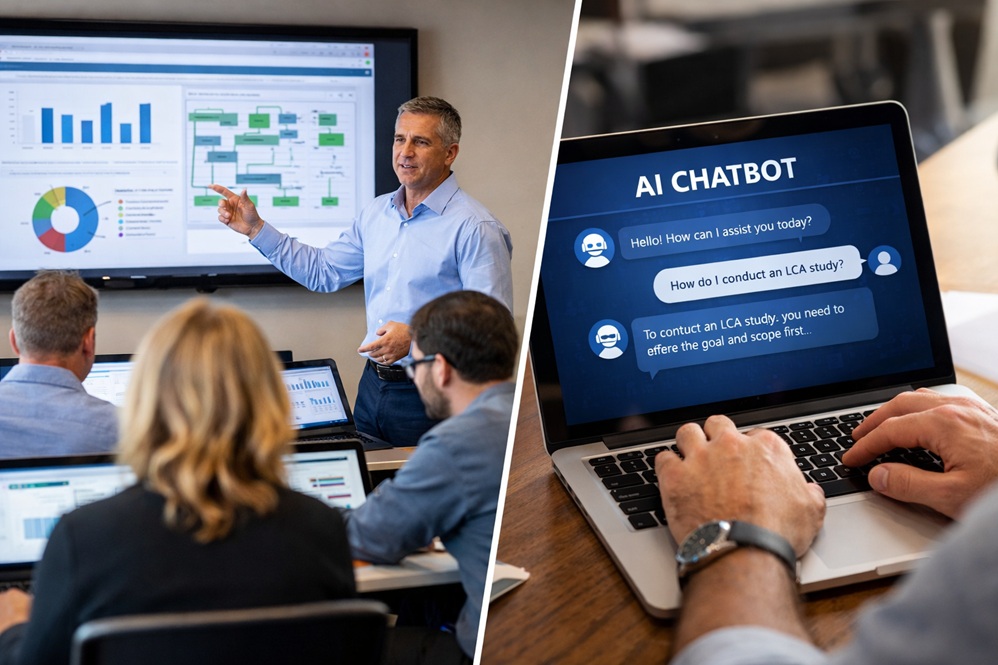
An environmental engineer learning LCA modelling through AI may grasp terms like functional unit or system boundaries, and still be unable to:
- Structure a complete product system
- Link foreground and background datasets correctly
- Interpret results against ISO 14040/44
A structured program takes the same engineer to the point of building and completing a full LCA study independently.
Knowledge transfer needs context; AI lacks practical interpretation
What happens in real training
Expert trainers do not only convey knowledge — they translate it into real-world context, shaped to the industry, the regulations, and the business objective in front of them.
Where AI falls short
AI has no situational awareness of:
- Industry-specific constraints
- Client expectations
- Regulatory nuance
- Data limitations in live projects
Worked example
A company preparing an Environmental Product Declaration (EPD) may use AI to understand EN 15804 requirements, and still:
- Misread the system boundary — A1–A3 against A1–A5
- Apply the wrong allocation rules
- Fail pre-verification checks
A trained professional avoids those costly errors through guided interpretation and applied practice.