

Executive summary and introduction
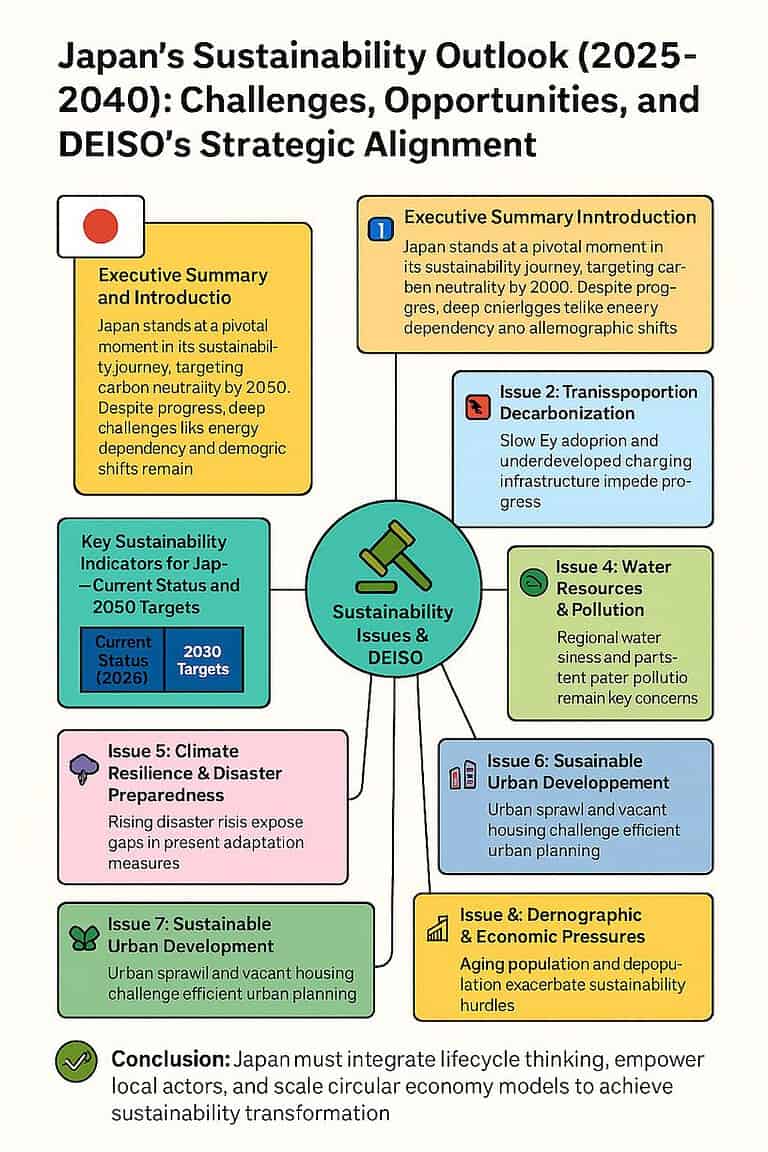
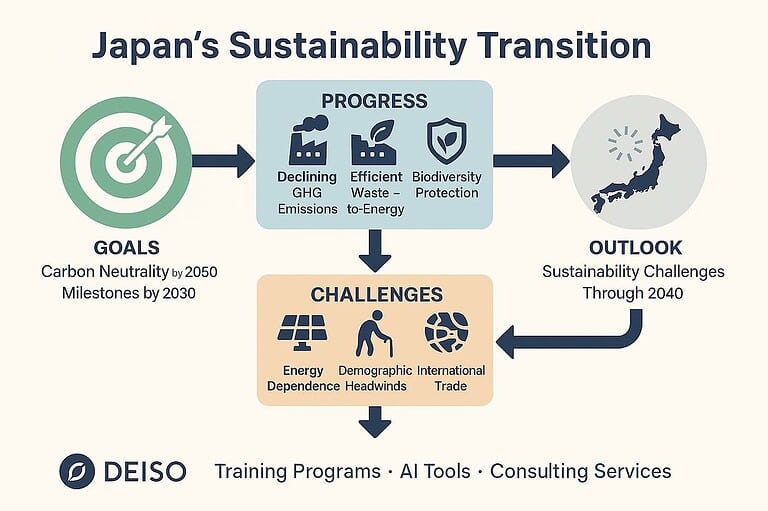
Japan is at a defining point in its sustainability transition.Japan is committed to carbon neutrality by 2050. Its current nationally determined contribution sets greenhouse gas cuts of 46% by FY2030, 60% by FY2035 and 73% by FY2040, all measured against FY2013.
Progress is measurable. National emissions and removals fell below one billion tonnes for the first time in FY2024, and carbon pricing moved from voluntary to mandatory in April 2026.
The road ahead is still steep. Reaching the FY2030 target needs a faster pace of reduction than Japan has sustained so far. Dependence on imported energy, a shrinking and ageing workforce, fragmented emissions data and changing trade rules such as the EU Carbon Border Adjustment Mechanism all add pressure at the same time.
This report sets out Japan’s sustainability challenges through 2040. It covers 19 environmental and governance issues, rates each for national relevance, and maps each to the DEISO services that address it: professional training, AI tools and consulting for companies, municipalities and professionals working to meet Japan’s policy targets.
Sources: Ministry of the Environment and National Institute for Environmental Studies, national GHG inventory for FY2024 (April 2026); GX-ETS mandatory phase, FY2026–2032.
Where Japan stands against its 2030 targets
Latest official data for each indicator, set against the 2030 goal or direction of policy.
| Indicator | Latest status | 2030 goal or target |
|---|---|---|
| Climate, energy and demographics | ||
| Population | 123.05 million (2025 census), down 2.5% since 2020, the fastest decline on record[1] | About 120 million projected; ageing continues[2] |
| GHG emissions | 994 Mt CO2e net (FY2024), 28.7% below FY2013[3] | 46% below FY2013 (about 0.75 Gt), then 60% by FY2035 and 73% by FY2040[4] |
| Renewable electricity share | 23.0% of generation, including hydro (FY2024, preliminary)[5] | 36–38% by FY2030; 40–50% by FY2040[6] |
| Nuclear electricity share | 9.4% of generation (FY2024, preliminary)[7] | 20–22% by FY2030; about 20% by FY2040[8] |
| Fossil electricity share | 67.5% of generation (FY2024, preliminary) | About 41% by FY2030; 30–40% by FY2040 |
| New car sales: battery EVs | About 1.5–2% of new passenger cars (2024–2025); hybrids above 30%[9] | EVs and plug-in hybrids at 20–30% of new passenger cars by 2030; 100% electrified, hybrids included, by 2035[10] |
| Carbon pricing | GX-ETS mandatory since April 2026 for companies emitting at least 100,000 t direct CO2 a year | Phase 2 runs FY2026–2032; GX-Surcharge on fossil fuel importers from 2028 |
| Resources and nature | ||
| Municipal waste recycling rate | About 20%, broadly flat for a decade[11] | Higher recycling and circular use under the Fifth Fundamental Plan for a Sound Material-Cycle Society (2024)[12] |
| Municipal waste disposal | About 80% incinerated; final disposal to landfill below 10%[13] | Less incineration, more reuse and recycling under the circular economy strategy |
| Protected areas | About 20% of land and 13% of sea protected, plus certified OECM sites[14] | 30% of land and sea conserved by 2030 (30by30)[15] |
| Data, disclosure and capability | ||
| Verified EPD coverage | Limited among Japanese manufacturers; growing through the SuMPO EPD programme[16] | More ISO 14025 and EN 15804 conformant EPDs in construction and electronics[16] |
| Localised LCI data | IDEA covers Japanese processes, but many studies still rely on foreign datasets[17] | National datasets matched to Japan’s energy and industrial context[17] |
| SME ESG reporting | Low, held back by digital and capacity gaps[18] | Wider SME reporting through standardised ESG platforms[18] |
| Scope 3 disclosure | SSBJ standards (March 2025) require Scope 3; mandatory use phases in for large Prime Market companies from the fiscal year ending March 2027[19] | Scope 3 built into corporate disclosure across listed companies and their supply chains[19] |
| Avoided emissions (“Scope 4”) | Minimal use of avoided emissions metrics[20] | Wider use in clean technology sectors, following WBCSD avoided emissions guidance[20] |
| Public sector sustainability training | Inconsistent across local governments[21] | GX and ESG training rolled out widely across the public sector[21] |
| Green public procurement | Green Purchasing Act in place, but life cycle and carbon criteria are still limited[22] | Procurement tied to LCA, EPD and carbon footprint metrics[22] |
| Carbon border adjustment readiness | EU CBAM definitive period began January 2026; exporter readiness still uneven[23] | PCF-ready exporters aligned with CBAM and global climate trade rules[23] |
| Integrated planning (ICEM) | Fragmented across ministries and sectors[24] | Joint planning for energy, climate and materials under one national policy[24] |
FY = Japan’s fiscal year, April to March. Numbers in brackets refer to the reference list at the end of this report.
Sustainability issues and DEISO alignment
Nineteen environmental and governance issues shaping Japan’s path to 2040, each with its current picture, the key points and the DEISO services that address it.
Greenhouse gas emissions and energy transition
Japan’s pledge of net zero by 2050 anchors its climate strategy. Net emissions and removals fell to 994 Mt CO2e in FY2024, 28.7% below FY2013, but fossil fuels still generate about two-thirds of the country’s electricity. Nuclear restarts continue slowly against local opposition, and grid capacity for renewables lags behind demand.
The 2030 target of a 46% cut, followed by 60% by FY2035 and 73% by FY2040, is within reach only if carbon pricing, hydrogen and grid upgrades move faster. The mandatory GX-ETS, in force since April 2026, is the first real test. The transition also needs consistent regulation and stronger coordination across ministries.
- Emissions at a record low, but the pace is still short of the 2030 goal
- Fossil fuels supply 67.5% of electricity (FY2024), mostly imported
- Grid infrastructure is not ready for rapid growth in renewables
- GX-ETS is now mandatory; hydrogen supply chains are still at an early stage
- GHG accounting training and ISO 14067 product carbon footprint training
- Emissions modelling with EcoIN Data AI
- LCA training, Scope 1–3 consulting and mitigation strategy support
Transport decarbonisation
Transport accounts for close to a fifth of Japan’s CO2 emissions. Rail is efficient, but road vehicles carry most passengers and freight, and the shift to battery electric cars is slow: they made up only about 1.5–2% of new passenger car sales in 2024–2025, the lowest share among major markets. Hybrids, at more than 30%, dominate electrified sales.
Policy support for EVs is growing, but charging networks and zero-emission logistics need much more investment. The shift must also include modal change, such as more urban rail and freight moved from road to rail and ship, alongside hydrogen for heavy transport.
- Battery EVs at about 1.5–2% of new passenger cars (2024–2025)
- 2030 goal of 20–30% EVs and plug-in hybrids; all new cars electrified, hybrids included, by 2035
- Charging infrastructure and incentives remain limited
- Rail freight and hydrogen mobility are under-used
- Life cycle assessment of EVs and comparison of transport modes
- Scope 3 transport emissions analysis
- Training in the decarbonisation of mobility systems
Circular economy and waste management
Japan is strong at waste collection and incineration with energy recovery, but true circularity remains low. About 80% of municipal waste is incinerated and only around 20% is recycled, a rate that has barely moved in a decade.
The Plastic Resource Circulation Act (2022) and the Fifth Fundamental Plan for a Sound Material-Cycle Society (2024) point in the right direction, but implementation needs more ambition. Extended producer responsibility, reuse business models and recovery of critical raw materials are emerging, but are not yet mainstream.
- Incineration dominates waste treatment
- Recycling rates stay around 20%
- Few reuse systems or products designed for reuse
- Circularity in industrial systems is underdeveloped
- Circular economy audits and zero-waste strategy consulting
- Training in material flow analysis and extended producer responsibility frameworks
- Urban mining and critical raw material recovery studies
Water resources and pollution
Japan has plenty of water nationally, but regional water stress and eutrophication persist, driven by agricultural run-off and uneven infrastructure. Pollution in enclosed seas and groundwater contamination continue to threaten ecosystems and local health.
Ageing infrastructure, shrinking rural populations and limited monitoring weaken resilience. Smart water systems and sensor-based monitoring can close efficiency gaps and regulatory blind spots.
- Nitrogen and phosphorus run-off drives eutrophication
- Advanced water treatment is unevenly adopted
- Depopulating areas struggle to maintain infrastructure
- Decentralised wastewater systems are under-used
- ISO 14046 water footprinting
- Training in water treatment and circular sanitation systems
- Resilient infrastructure planning and technology integration
Climate resilience and disaster preparedness
Japan faces rising exposure to typhoons, floods, landslides and heatwaves. Its disaster recovery systems are world-class, but investment before disasters is still too low, and most local governments put response ahead of adaptation.
Adaptation needs to combine ecosystem-based solutions, data on social vulnerability and the needs of an ageing population. Heatstroke special alerts, in place since 2024, show the direction; stronger early warning and nature-based infrastructure will decide long-term resilience.
- Disaster risk reduction is still recovery-focused
- Ecosystem-based adaptation is gaining recognition
- Urban heat risk is rising, especially for older people
- Resilience spending remains fragmented
- Climate risk and adaptation planning
- Green infrastructure and ecosystem restoration consulting
- Vulnerability mapping and heat adaptation training
Sustainable urban development
Japan’s cities face a paradox of population decline and urban sprawl. Many municipalities deal with inefficient land use, rising infrastructure costs and hollowed-out town centres. At the same time, demand is growing for barrier-free, age-friendly and climate-resilient planning.
Transit-oriented development, smart infrastructure and digital twins offer a way forward. Reusing vacant homes, redeveloping brownfield sites and building sustainability criteria into zoning will be critical over the next decade.
- Urban land use keeps expanding while the population shrinks
- About 9 million homes stood vacant in 2023, 13.8% of the housing stock
- Compact, walkable cities cut emissions and improve well-being
- Urban heat islands pose health risks, especially for older people
- LCA-based planning for low-carbon cities
- Compact city strategy and urban greening consulting
- Training in digital infrastructure and inclusive design
Biodiversity loss and ecosystem conservation
Japan’s rich biodiversity faces pressure from land conversion, climate change and invasive species. About 20% of land and 13% of sea are protected, but many ecosystems remain fragmented and degraded.
The national biodiversity strategy centres on the 30by30 target, using other effective area-based conservation measures (OECMs) and payments for ecosystem services. A national certification scheme for sustainably managed natural sites has operated since 2025, and Japanese companies lead the world in TNFD adoption, but biodiversity is still weakly built into land-use planning and finance.
- Habitat loss, coastal erosion and species decline continue
- Satoyama landscapes and coral reefs are under stress
- Biodiversity finance mechanisms are under-used
- Ecosystem services are rarely valued in land-use planning
- TNFD-aligned biodiversity risk assessments
- Ecosystem valuation and design of payment-for-ecosystem-services schemes
- Consulting on nature-positive urban and regional development
Demographic and economic pressures
Japan’s population fell to 123.05 million in the 2025 census, down 2.5% in five years, the fastest decline on record. A shrinking, ageing population strains labour markets, infrastructure maintenance and rural services, and depopulation deepens climate and sustainability risks in regional areas.
It also creates openings: automation, regional innovation zones and remote work can support leaner, greener economies. Reskilling workers and designing sustainability solutions for an older society are essential.
- The workforce is shrinking while infrastructure ages
- Rural depopulation leaves some communities without basic services
- Sustainability and demographic policy need to be planned together
- Reskilling and talent pipelines are underdeveloped
- Training programmes for green workforce development
- Support for GX and the circular economy in rural areas
- Sustainability strategy design for super-aged societies
Circular economy implementation gaps
Despite policy support, circular economy principles are applied unevenly across industries. Product design rarely plans for end of life, and material traceability is poor.
SMEs and legacy sectors often lack the knowledge, digital systems or incentives to move from linear to circular models. Voluntary initiatives exist but lack scale.
- Circularity is low in construction, food and electronics
- Few firms design for reuse or use recycled content
- Material data are weakly tracked across supply chains
- Industrial symbiosis and circular clusters are underdeveloped
- Circular product design training and audits
- Digital tools for material tracking and reporting
- Cluster-level circular economy strategy consulting
Scope 3 emissions
Scope 3 emissions, from upstream production and logistics to product use, often make up more than 70% of a company’s total footprint. Measurement and management of Scope 3 in Japan are still limited.
That is changing. The SSBJ standards issued in March 2025 require Scope 3 disclosure, and mandatory use phases in for large Prime Market companies from the fiscal year ending March 2027. Without reliable Scope 3 data, companies underestimate their climate risk and struggle to meet SBTi and customer requirements. Supplier engagement, Scope 3 LCA methods and harmonised data are the practical gaps.
- Scope 3 modelling and disclosure support
- Value chain emissions tracking with EcoIN Data AI
- Supplier engagement programmes and low-carbon procurement training
Critical materials and supply chain security
Japan’s clean energy and battery industries depend heavily on imported critical materials such as lithium, cobalt and rare earths. Many come from geopolitically sensitive regions, leaving supply chains open to disruption.
Japan is diversifying sources through international partnerships, expanding domestic recycling and promoting urban mining. Resource efficiency, life cycle tracking and circular design still need to be joined up across the supply chain.
- Heavy reliance on imported rare metals and battery materials
- Geopolitical and trade risks threaten supply stability
- Urban mining and recycling potential remain under-used
- Sector strategies for resource efficiency need scaling
- Critical material risk and dependency assessments
- Urban mining feasibility and recovery strategy consulting
- Circular supply chain design and scenario modelling
Environmental product declaration (EPD) readiness
As global markets demand transparent environmental disclosure, EPDs have become a condition of competitiveness. Many Japanese manufacturers, particularly SMEs, lack the awareness or technical capacity to work to ISO 14025 and EN 15804.
Companies need to scale their EPD programmes and product footprint methods to take part in green procurement and international tenders. Digital pre-verification and LCA support can shorten the path.
Life cycle data localisation
Japan has its own IDEA life cycle inventory database, but many studies still rely on global datasets that do not reflect local production practices, transport systems and energy mixes. The mismatch weakens LCA and GHG results.
Datasets matched to regional conditions support Scope 3 tracking, national GHG inventories and circular product design. Generating, validating and standardising them needs institutional coordination.
- Development of localised LCI datasets with EcoIN Data AI
- Data harmonisation and standardisation support for national inventories
- Training in LCI development and sector-specific modelling
ESG reporting capacity in SMEs
SMEs form the backbone of Japan’s economy but face major barriers to ESG reporting. Most lack in-house expertise, software or the capacity to meet the demands of global buyers.
Without ESG data, SMEs risk losing their place in international supply chains, especially as listed customers begin collecting Scope 3 data under the SSBJ standards. Simplified frameworks, templates and training help them disclose, comply and improve.
Green public procurement (GPP)
Japan’s Green Purchasing Act has been in place since 2001, and the Ministry of the Environment has made green public procurement a priority. Uptake at prefectural and municipal level is uneven, and most decisions are still made on price rather than life cycle impact.
Scaling GPP needs training for procurement officers, standardised criteria such as EPDs and PCFs, and LCA tools built into tender evaluation.
- Procurement remains cost-driven rather than impact-based
- Local governments lack training in LCA-based procurement
- Suppliers are unfamiliar with sustainability documentation
- GPP can shift whole markets
Carbon border adjustment readiness
Carbon border adjustment mechanisms are reshaping international trade. The EU CBAM entered its definitive period in January 2026, covering iron and steel, aluminium, cement, fertilisers, hydrogen and electricity. EU importers must buy certificates for the embedded emissions of these goods, so Japanese exporters face growing pressure to report verified product-level emissions.
Few companies are ready. Corporate GHG systems rarely reach product-level detail, and PCF methods are applied inconsistently. Wider use of ISO 14067 and stronger disclosure systems will protect Japan’s export competitiveness.
- CBAM costs now apply to EU imports of covered goods
- Product-level carbon disclosure is not standardised
- Missing PCF data put export contracts at risk
- Readiness varies widely by sector and company size
- Product carbon footprint consulting under ISO 14067
- CBAM-aligned reporting frameworks and training
- MRV tool deployment and carbon compliance readiness services
Integrated climate, energy and materials (ICEM) planning
Japan’s sustainability policy remains highly siloed. Ministries and industries build separate frameworks for energy efficiency, materials and climate action, which limits overall impact. Integrated climate, energy and materials (ICEM) planning takes a systems approach to trade-offs and synergies.
For example, more recycling can reduce energy demand and emissions, while a shift to renewables reshapes material supply chains. Without integration, these synergies are lost. Institutional coordination and cross-sector LCA tools are essential.
- Fragmented governance limits the impact of sustainability policy
- Cross-sector planning is rare in industrial and infrastructure design
- Climate and material flows are tightly linked
- National strategy lacks integrated modelling capability
- Multi-impact LCA and scenario planning
- Training in systems thinking and cross-sector strategy design
- ICEM-based consulting for ministries and industry coalitions
Avoided emissions (“Scope 4”)
Avoided emissions, often called Scope 4, measure how a product or service reduces emissions elsewhere in the system. They sit outside the GHG Protocol scopes and are reported separately. Clean technology firms, from renewables and insulation to EVs, increasingly use them to show climate benefit.
The concept is still poorly understood, and inconsistent methods hold back adoption. WBCSD guidance (2023) gives a common basis, but clear frameworks, validated LCA models and transparent documentation are needed for credible claims to investors and customers.
- Avoided emissions show the climate benefit of low-carbon products
- Methodological gaps limit recognition by investors and policymakers
- Verification frameworks are still developing
- Potential is high in mobility, buildings and renewable technology
- LCA-based avoided emissions calculation and reporting frameworks
- Clean technology consulting on avoided emissions documentation
- Training in WBCSD and sector-specific avoided emissions methods
Public sector environmental literacy
Japan’s public sector is central to meeting national GX and sustainability goals, yet many local governments lack in-house sustainability capacity. Work often depends on a few overstretched staff or on external mandates.
Environmental literacy training and digital tools for municipal staff can unlock action from the ground up. Topics such as climate budgeting, green procurement and biodiversity planning must be accessible to non-specialists.
- ESG capacity in local government varies widely by region
- National goals cannot be met without local leadership
- Many municipalities lack data systems and qualified staff
- Digital tools and tailored training are urgently needed
- Local government training in ESG, GPP, LCA and GX
- Templates and digital dashboards for public sustainability planning
- On-site or online workshops for prefectures, towns and cities
From risk to strategic transformation
Japan has the policy foundation. What it needs now is pace and integration.Japan’s sustainability future sits where opportunity and urgency meet. Mandatory carbon pricing under the GX-ETS, SSBJ disclosure rules and targets reaching to 2040 give the country a solid base, but incremental progress will not be enough. A shrinking workforce, ageing infrastructure, carbon-based trade rules and biodiversity loss call for decisive, joined-up action built on reliable data.
- Build Scope 1–3 accounting, avoided emissions and life cycle thinking into national frameworks
- Prioritise localised data so decisions rest on accurate numbers
- Give local governments, SMEs and public bodies the training and tools they need
- Scale nature-positive development and circular economy models
- Prepare exporters for carbon border adjustments and ESG traceability
- Move green public procurement from voluntary to standard practice
- Make EPDs, PCFs and Scope 3 disclosure routine across industrial sectors
- Build integrated climate, energy and materials (ICEM) planning into how ministries and sectors work
DEISO’s commitment
DEISO LLC supports Japan’s public and private sectors in four ways.
More than 20 professional sustainability training programs, from LCA and EPDs to GHG accounting and ESG.
EcoIN Data AI, CFs Finder AI and Kensa AI for emissions data, carbon footprints and EPD pre-verification.
Scope 1–3 and avoided emissions accounting, LCA, EPDs and ESG disclosure.
Advice for municipalities, companies and ministries on circularity, GX and green public procurement.
How DEISO training supports your organisation
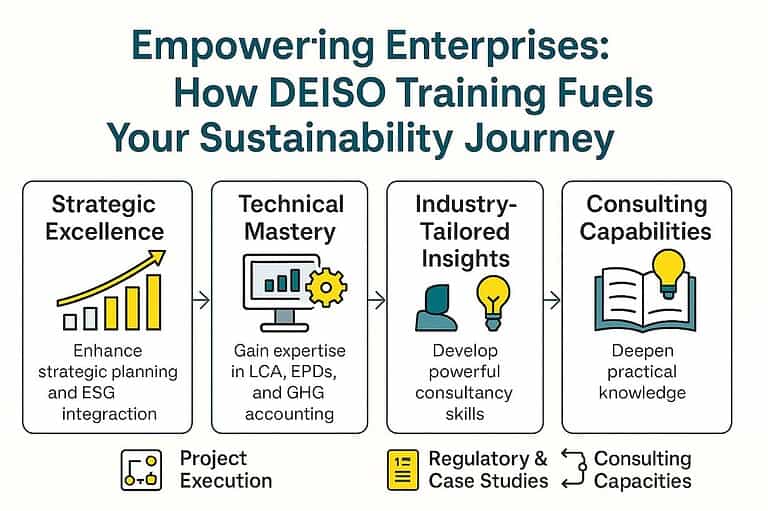
DEISO training runs remotely, on-site at your company, or off-site in a dedicated learning environment in Japan. Each route builds capability across six areas.
Stronger strategic planning and ESG integration through ESG and sustainability leadership programs.
Hands-on LCA, EPD and GHG accounting, with working proficiency in openLCA, GaBi (LCA for Experts) and SimaPro.
Courses shaped for sectors and topics such as oil and gas, industrial waste management, climate mitigation, environmental auditing and ISO 14001.
Sustainability Independent Consultant (SIC) and Lead GHG Verifier training, so your team can advise internally or offer consulting externally.
Interactive sessions built on real-world scenarios, so your team can apply what it learns straight away.
Specialised training in environmental impact assessment, ESG reporting and environmental auditing.
References
Numbered sources match the markers in the indicators table.
- Statistics Bureau of Japan, Preliminary Counts of the 2025 Population Census (May 2026)
- National Institute of Population and Social Security Research (IPSS), Population Projections for Japan (2023)
- Ministry of the Environment and National Institute for Environmental Studies, Japan’s National GHG Emissions and Removals in FY2024 (April 2026)
- Government of Japan, Nationally Determined Contribution (February 2025)
- Agency for Natural Resources and Energy, energy supply and demand results for FY2024, preliminary
- Ministry of Economy, Trade and Industry, Sixth (2021) and Seventh (2025) Strategic Energy Plans
- Agency for Natural Resources and Energy, energy supply and demand results for FY2024, preliminary
- Ministry of Economy, Trade and Industry, Sixth (2021) and Seventh (2025) Strategic Energy Plans
- JATO Dynamics, Japan’s automotive electrification trends, 2025 H1
- Ministry of Economy, Trade and Industry, Green Growth Strategy through Achieving Carbon Neutrality in 2050
- Ministry of the Environment, municipal solid waste survey (annual)
- Ministry of the Environment, Fifth Fundamental Plan for Establishing a Sound Material-Cycle Society (2024)
- Ministry of the Environment, municipal solid waste survey (annual)
- Ministry of the Environment, Japan’s 30by30 Roadmap and OECM programme
- Government of Japan, National Biodiversity Strategy and Action Plan 2023–2030
- SuMPO, SuMPO Environmental Label Program (EPD)
- AIST and SuMPO, IDEA life cycle inventory database
- SME Sustainability Survey
- Sustainability Standards Board of Japan (SSBJ), sustainability disclosure standards (March 2025)
- WBCSD, Guidance on Avoided Emissions (2023)
- ESG Readiness for Local Governments (2024)
- Ministry of the Environment, Basic Policy on Promoting Green Purchasing
- European Union, Carbon Border Adjustment Mechanism, Regulation (EU) 2023/956
- Cabinet Office, Japan Strategy Framework
- International Carbon Action Partnership, Japan transitions its GX-ETS to the mandatory phase (April 2026)
Further reading
Background sources behind the issue analysis in this report.
- OECD, Environmental Performance Reviews: Japan 2025, covering climate, energy, waste and circular economy, water, biodiversity, adaptation and local green transition
- Climate Transparency, Japan country profile: energy and emissions
- IPCC, Sixth Assessment Report, Synthesis Report (2023)
- Ministry of the Environment and NIES, national GHG inventory (1990–2024)
- Statistics Bureau of Japan, 2025 Population Census, and IPSS population projections
- Ministry of Economy, Trade and Industry, Seventh Strategic Energy Plan (2025) and GX policy
- Ministry of the Environment, National Adaptation Plan and the A-PLAT climate adaptation platform
- Sustainability Standards Board of Japan (SSBJ), disclosure standards (2025)
- TNFD, recommendations on nature-related financial disclosure (2023)
- WBCSD, Guidance on Avoided Emissions (2023)
- ISO 14040/14044 (LCA), ISO 14067 (product carbon footprint), ISO 14025 (EPDs)
- Reuters, coverage of Japan’s emissions trends and energy mix
- Nippon.com, Japan’s energy import dependency
- World Economic Forum, hydrogen in Japan’s transport strategy
Data checked September 2026. FY is Japan’s fiscal year, April to March.