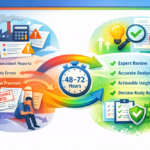


Net-zero strategy and GHG accounting, built to survive verification Scope 1, 2, and 3 — with LCA-grade carbon evidence
DEISO builds the sustainability operating system behind your net-zero strategy — GHG accounting, Scope 3 mapping, and LCA-based carbon modeling produced as reviewer-defensible evidence, not as a slide deck. AI-supported, executed by senior technical practitioners.

Net-zero is a technical execution problem, not a reporting exercise
Reaching net zero is a data-driven transformation that has to hold up under review — accurate quantification, traceable value chains, and defensible reduction pathways. Reports without that foundation collapse under external scrutiny.
DEISO builds the technical execution behind the report: the inventory, the value-chain evidence, the modeling, and the reduction strategy that make the numbers defensible.
Technical execution, not slides
A technical review and modeling partner — not a generalist advisory
DEISO works as a technical execution, review, and modeling partner. The engagement produces the artefacts your organization is actually measured on:
- Independent GHG data review and reconciliation
- LCA-based emissions modeling, ISO 14040 and 14044 aligned
- Scope 3 supplier data validation and gap correction
- Decision-grade reduction strategy tied to operational reality
DEISO does not issue certifications or verification statements. DEISO builds the system that survives them.
Full-scope GHG accounting — Scope 1, 2, and 3
With optional Scope 4 (avoided emissions) for product-level differentiation
Scope 1 and 2 — operational emissions precision
Accurate quantification of direct fuel-combustion emissions (Scope 1) and purchased energy emissions (Scope 2), aligned with ISO 14064 and the GHG Protocol Corporate Standard.
Scope 3 — value chain analysis
The category most reports get wrong. DEISO handles supplier data validation, hybrid modeling where primary data is thin, lifecycle mapping, and correction of the gaps that would fail a reviewer.
Scope 4 — avoided emissions (optional)
Avoided emissions are not part of GHG Protocol required disclosure. When product-level differentiation or ESG positioning benefits from quantifying displaced emissions from a product or service, DEISO calculates it as an additional lens, clearly separated from Scope 1–3 accounting.
LCA-based carbon modeling
Full lifecycle emissions visibility from raw material extraction through end of life, aligned with ISO 14040, ISO 14044, and EPD product category rules. LCA-based modeling is what allows Scope 3 numbers, product carbon footprints, and reduction scenarios to survive a reviewer's line-by-line challenge.
Tooling: SimaPro, openLCA, and ecoinvent as the operational stack, with Monte Carlo uncertainty analysis on high-materiality categories.
AI-supported analysis, integrated into the workflow
AI is a supporting layer inside DEISO's engagement — not a product sold to clients. It accelerates data preparation, supplier data screening, hotspot identification, and scenario iteration under a senior technical practitioner's review.
Every AI-assisted output is validated by DEISO's technical team before it enters your inventory, your Scope 3 register, or your reduction plan. Nothing goes to your reviewer unchecked.
Carbon reduction strategy
Reduction planning starts where the emissions actually sit. DEISO builds the pathway from measured inventory to a defensible target:
- Hotspot identification — where the emissions actually concentrate, by category and by facility
- Scenario modeling — comparing reduction pathways against operational and financial constraints
- Renewable energy strategy — PPA, on-site, and market-based instrument evaluation
- Supplier engagement — bringing Scope 3 categories under measured reduction, not assumed reduction
Carbon offsetting — high-integrity credits only
Offsetting sits after reduction, not instead of it. DEISO evaluates high-integrity carbon credits against methodology quality, additionality, permanence, and reviewer defensibility — and rejects credits that will not hold up when your disclosure is challenged.
Reporting and framework alignment
Outputs align with GHG Protocol Corporate Standard, ISO 14064, ISO 14067 for product carbon footprints, and the ESG frameworks your organization is disclosing under. The inventory, the methodology documentation, and the evidence package are prepared to enter external assurance directly.
Who this service is for
- Corporates under Scope 3 disclosure pressure from customers, investors, or regulators
- Manufacturers preparing product carbon footprints or Environmental Product Declarations
- Energy, industrial, and infrastructure operators with material Scope 1 and 3 exposure
- Public sustainability bodies and government programs requiring defensible accounting methodology
- Enterprise ESG and sustainability teams whose reports need to survive external assurance
What you get
- A verification-ready GHG inventory across Scope 1, 2, and 3
- A defensible net-zero strategy grounded in measured hotspots, not estimated ones
- High-confidence Scope 3 data with supplier validation and gap correction documented
- Reduced exposure to reviewer challenges, disclosure disputes, and greenwashing risk
- ESG positioning backed by evidence that survives line-by-line technical review
Move from fragmented carbon reporting to a defensible net-zero system
Share your current state — inventory, disclosure targets, reviewer requirements — and DEISO will scope the engagement to your operational and verification context.
Explore services, solutions, capacity building, and AI-supported entry points
One unified entry into DEISO — enterprise sustainability execution, digital tools, capacity building programs, and AI-supported starting points routed to the right team.
Share this:
- Email a link to a friend (Opens in new window) Email
- Share on LinkedIn (Opens in new window) LinkedIn
- Share on X (Opens in new window) X
- Share on Facebook (Opens in new window) Facebook
- Share on WhatsApp (Opens in new window) WhatsApp
- Share on Reddit (Opens in new window) Reddit
- Print (Opens in new window) Print
- More