


Download the sample database
Explore a truncated demo version of the DEISO Agri and Industrial LCI Database to review the structure, readability, and separation between normalized datapoints and true emission factors before purchase.
Why the DEISO Agri and Industrial LCI Database exists
The DEISO Agri and Industrial LCI Database was built as a literature-based gap-filling resource for sustainability professionals who need emission factors and inventory datapoints that are often missing from existing databases. Its purpose is to turn published scientific literature into a structured, usable format that supports practical work across GHG accounting, Product Carbon Footprint, Scope 3 emissions assessment, and broader Life Cycle Assessment applications.
Unlike conventional database content presented only as background data, this product is explicitly built on literature-derived emission factors and inventory datapoints compiled from scientific studies. That makes it especially useful when current databases do not provide sufficient coverage for a specific product, material, region, process stage, or supply chain context.
Although some underlying studies are not the most recent available, many emission factors remain highly useful over time because they do not materially change every year, particularly for stable processes, established production systems, and literature-based reference conditions. The database therefore serves as a practical, transparent literature-based support tool for screening, modeling, benchmarking, and gap-filling analysis where newer or more specific data are unavailable.
In short, the value of this database lies in making scientific literature operational — turning dispersed published data into a structured dataset that helps practitioners work faster, document assumptions more clearly, and strengthen the technical basis of sustainability studies.
DEISO Agri and Industrial LCI Database
A literature-based life cycle inventory database compiled from scientific sources and structured into ready-to-use datapoints for agriculture, livestock, food processing, and industrial systems.
This database is transparently built from published literature and scientific studies. It combines normalized inventory datapoints and a dedicated emission factor subset in a structured format built for practical use in LCA, PCF, and Scope 3 analysis.
Preview the structure, transparency, and formatting before purchasing the full commercial version.
Database scale at a glance
Records by sector
Records by dataset type
Records by flow direction
The database is dominated by inventory inputs and output flows, while the strict emission-factor subset isolates only the environmental emission records required for direct factor-based applications.
Download the sample database
Explore a truncated demo version of the DEISO Agri and Industrial LCI Database to review the structure, readability, and separation between normalized datapoints and true emission factors before purchase.
Product coverage
The DEISO Agri and Industrial LCI Database currently covers the products listed below. The database is strictly available at this stage only for these products and their related literature-based datapoints, emission factors, and inventory records.
Coverage in the current release is limited to the products listed in this section. Additional products, sectors, and extensions may be added in future versions as the database expands.
Agriculture and crops
- Rice
- Corn
- Sugarcane
- Sugar beet
- Tomato
- Cucumber
- Cacao
- Coffee
- Tea
- Palm oil
Livestock and animal products
- Beef
- Pork
- Chicken
- Lamb
- Milk
- Cheese
- Meat products
Food processing
- Beer production
- Chocolate
- Processed meat products
- Canned food systems
Industrial and materials
- Aluminum
- Nickel
- Copper
- Gold
- Lithium
- Iron ore
- Chromium
- Cobalt
11,800+ structured datapoints and 3,400+ emission factors, ready for LCA, PCF, and Scope 3 analysis
Stop spending weeks extracting data from scientific literature. The DEISO Agri and Industrial LCI Database provides a curated, structured, ready-to-use dataset covering agriculture and industrial systems — built for real-world sustainability analysis.
Current product coverage
- Rice
- Corn
- Sugarcane
- Sugar beet
- Tomato
- Cucumber
- Cacao
- Coffee
- Tea
- Palm oil
- Beef
- Pork
- Chicken
- Lamb
- Milk
- Cheese
- Meat products
- Beer
- Chocolate
- Processed food systems
- Aluminum
- Nickel
- Copper
- Gold
- Lithium
- Iron ore
- Chromium
- Cobalt
Full literature range, not a single averaged value
For each product, the database compiles all emission factors and inventory datapoints reported in the reviewed academic literature, rather than providing a single averaged or selected value.
For a product such as tomato, you may find emission factor values for the same pollutant — CO₂ emissions, for example — reported across multiple independent studies, sometimes 10 or more different values from different academic papers, regions, assumptions, and system boundaries.
The concept of this database is therefore not to prescribe a single correct emission factor, but to:
- Capture the full range of literature-reported values
- Preserve transparency across sources
- Give users the ability to select the most appropriate value based on their specific goal, scope, geography, and methodological assumptions
Where this matters most
This makes the database particularly powerful for:
- Sensitivity analysis
- Scenario comparison
- Literature-backed justification
- Transparent reporting
Final responsibility remains with the user to determine which emission factor is most appropriate for their specific application.
Understanding the database structure
The DEISO Agri and Industrial LCI Database is built to serve both practical and advanced use cases in sustainability analysis. To do that, the database is structured into two distinct but connected data layers:
- Emission factors — ready to use
- Full LCI database — inputs, outputs, and emissions
Each layer serves a different purpose. Understanding the difference will help you use the database effectively.
Emission factors — ready to use
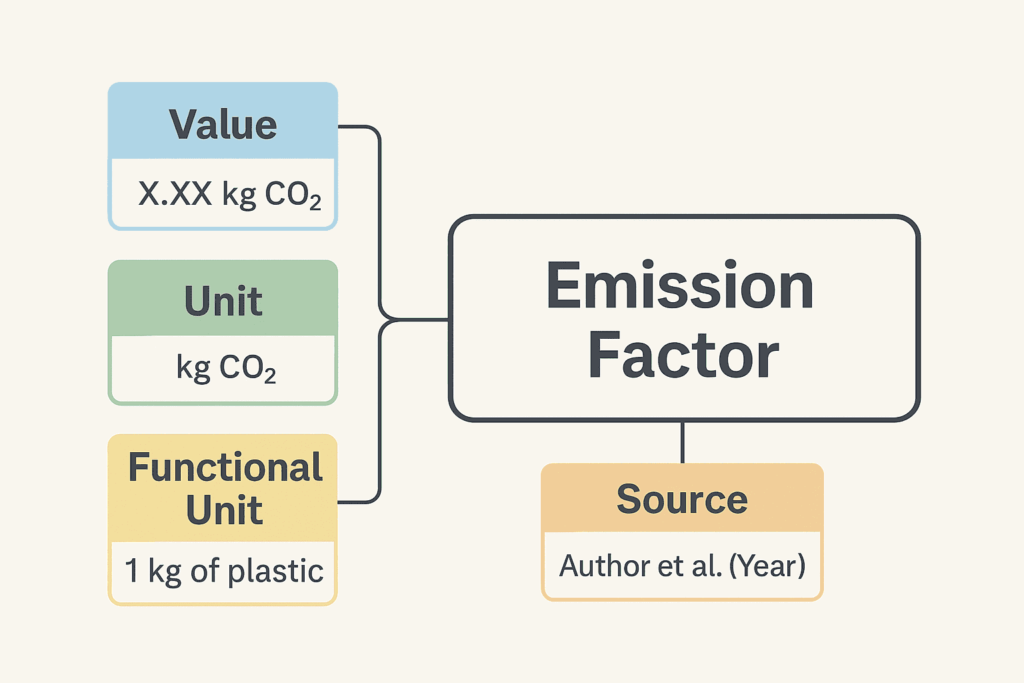
This sheet contains only true emission factors, meaning environmental emissions per functional unit. These are directly usable in:
- Life Cycle Assessment
- Product Carbon Footprint
- Scope 3 emissions calculations
- Sustainability reporting
What is included
- Greenhouse gases — CO₂, CH₄, N₂O
- Air emissions — NH₃, NOx, SO₂, and others
- Water emissions — BOD, COD, nutrients, wastewater
- Other environmental releases
What is not included
- Electricity or fuel inputs
- Material consumption such as steel or plastic
- Intermediate products
- Transport or process parameters
Example
Use this sheet if you need direct emission factors without additional processing.
Full LCI database — inputs, outputs, and emissions
This sheet contains the complete structured dataset, including all extracted information from the literature. It represents full Life Cycle Inventory data.
What is included
- Emission factors
- Resource inputs — water, materials, energy
- Products and coproducts
- Waste and wastewater flows
- Transport activities
- Process-level inventory data
Example
- Electricity input = 0.14 kWh per kg product
- Water input = 2.56 L per kg product
- Organic waste output = 0.2 kg per kg product
Use this sheet if you need
- Full process modeling
- Custom LCA model development
- Data gap filling
- Advanced sustainability analysis
Key difference summary
| Feature | Emission factors | Full LCI database |
|---|---|---|
| Purpose | Direct use | Full modeling |
| Data type | Emissions only | Inputs, outputs, emissions |
| Complexity | Low | High |
| Best for | Quick calculations | Advanced LCA work |
When should you use each?
- Use emission factors if you need fast, reliable emission values
- Use the full LCI database if you are building or customizing models
Most users will primarily use the emission factors sheet, while advanced users and consultants will benefit from the full LCI dataset.
How the two layers relate
The full LCI database includes a larger number of datapoints because it contains complete inventory data. The emission factor sheet is a filtered subset of this dataset.
Frequently Asked Questions (FAQ)
Pricing and license options
| License type | Price (USD) | Access basis | License term | Future updates | Notes |
|---|---|---|---|---|---|
| Research | $680 | Per user | Perpetual | Subject to additional fees if an updated version is requested | Individual researcher use |
| Commercial | $1,800 | Per user | Perpetual | Subject to additional fees if an updated version is requested | Internal professional or company use |
| Enterprise | $7,500+ | Company-wide | Perpetual | Subject to additional fees if an updated version is requested | Organization-wide internal use |
| SaaS / AI | Custom quotation | Based on scope and deployment model | Perpetual | Subject to additional fees if an updated version is requested | SaaS, cloud, API, platform, AI, or software integration use |
Prices do not include applicable taxes (10%).
Explore DEISO’s Life Cycle Assessment services hub
DEISO’s complete LCA ecosystem in one place — from LCA project execution and independent critical review to strategic advisory, professional training, advanced coaching, and LCI database resources. Explore the hub to identify the right service pathway for your technical, operational, and sustainability priorities.
Share this:
- Email a link to a friend (Opens in new window) Email
- Share on LinkedIn (Opens in new window) LinkedIn
- Share on X (Opens in new window) X
- Share on Facebook (Opens in new window) Facebook
- Share on WhatsApp (Opens in new window) WhatsApp
- Share on Reddit (Opens in new window) Reddit
- Print (Opens in new window) Print
- More