

Scope 3 배출량이란 무엇이며, DEISO는 조직의 Scope 3 탄소 배출량 관리에 어떻게 도움을 줄 수 있습니까?

Scope 3 탄소 배출량
Scope 3 emissions are indirect carbon emissions from an organization’s value chain that do not relate to the generation of purchased energy. Scope 3 carbon emissions typically reside outside organizations – both upstream and downstream. The organization’s value chain is a significant contributor to Scope 3 emissions. An organization’s direct emissions, called ‘Scope 1 emissions,’ refer to the carbon produced through its actions, such as fuel combustion and vehicle use. 간접 배출량 전기, 열, 증기 또는 냉방과 같은 에너지 구매로 발생하는 배출량은 Scope 2에 포함됩니다. 또한 제품 생산 또는 서비스 제공을 위한 상품 및 서비스 구매와 같은 상류 활동도 포함됩니다. 시장에 출시된 제품을 고객이 사용하는 방식과 같은 하류 활동도 포함됩니다.
GHG Protocol defines 15개 범주 applicable to Scope 3 emissions, including those that an organization manages, such as purchases, business travel, and investments. Scope 3 carbon emissions are the most complex part of an organization’s emissions due to their broad scope and how they differ depending on the organization.
Scope 3 considers other emissions generated by the organization when fossil fuels are burned in their value chain. Including upstream – e.g., goods and services purchased into an organization to manufacture goods or services. Also included is what happens downstream – for example, after a product is sold and used by customers.
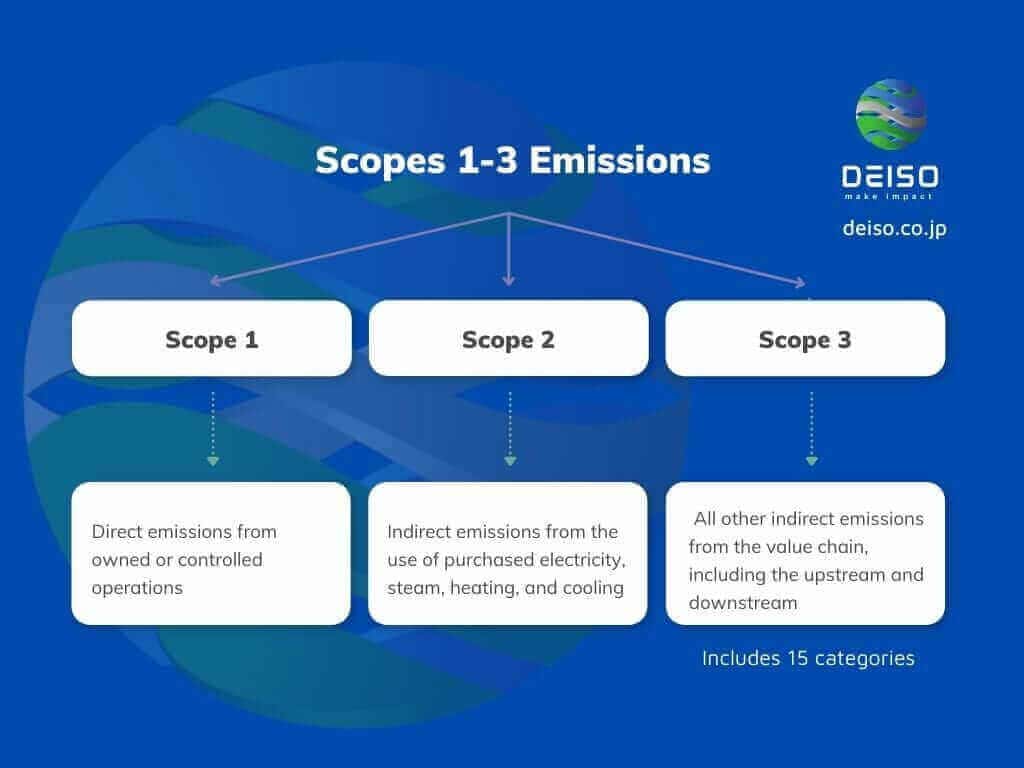
세 가지 Scope는 이러한 배출량을 다음과 같이 분류합니다 온실가스 프로토콜 (GHG).
- Scope 1: 기업의 배출원에서 발생하는 직접 배출량.
- Scope 2: 간접 배출량 of energy purchased to operate (electricity, heating, & cooling).
- Scope 3: All other 간접 배출량 from the value chain, upstream and downstream. Cover everything from purchased goods and raw materials, business travel and employee commuting, operational waste, and End-of-Life (EoL) treatment.
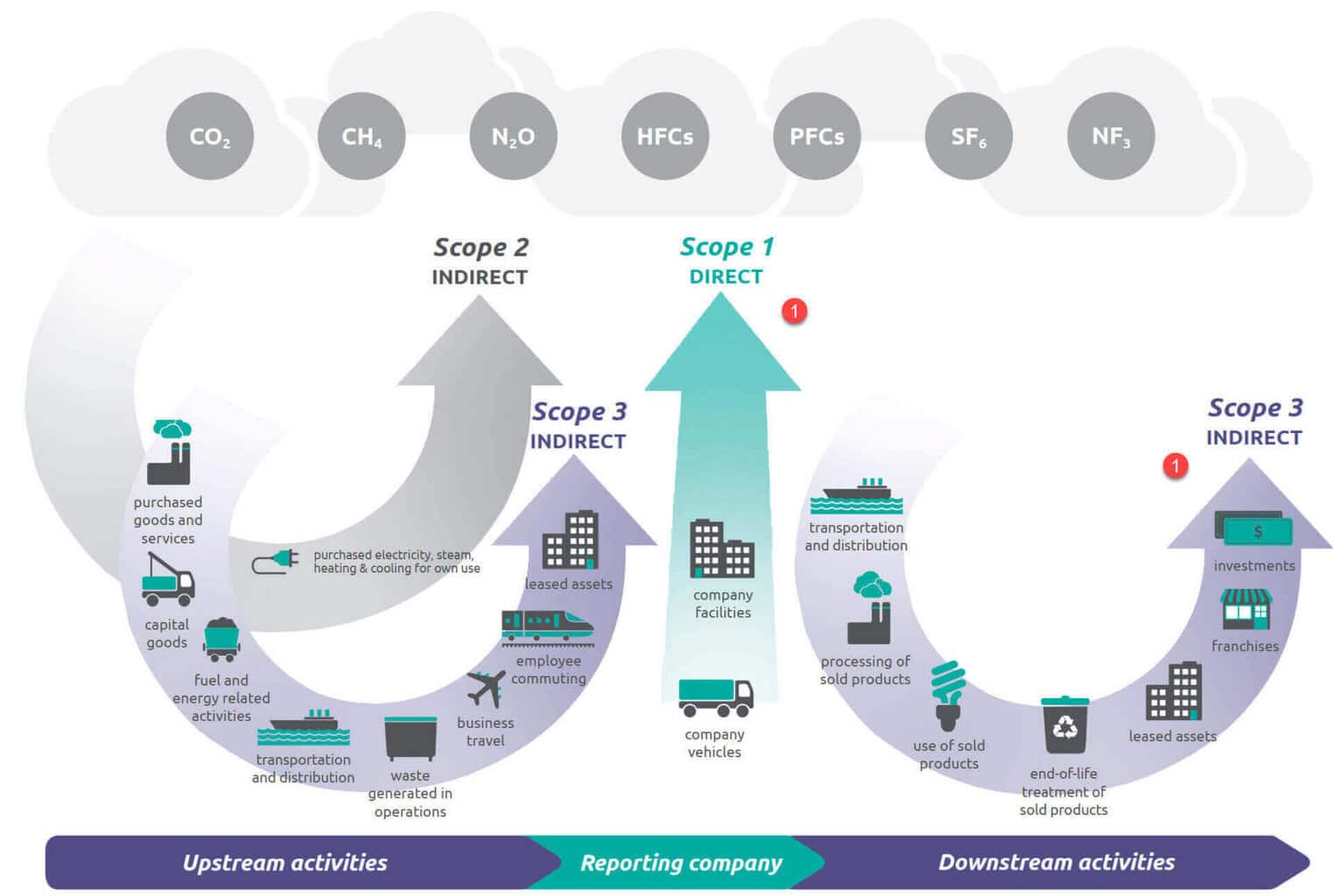
“CO2”: 이산화탄소; “CH4” 메탄; “N2O: 아산화질소”; “ HFCs”: 수소불화탄소; “PFCs”: 과불화탄소 ; “SF6”: 육불화황; “NF3”: 삼불화질소
“Direct emissions,” or Scope 1 emissions, result directly from an organization’s actions, such as fuel combustion and using its vehicles. 간접 배출량 result from the purchase of electricity, heat, steam, or cooling from an energy provider. A Scope 3 assessment covers all indirect emissions resulting from the upstream and downstream value chain. All aspects of the organization’s operation are covered, including, e.g., purchased goods and raw materials, travel and employee commuting, capital goods, energy-related activities, use of goods, and operational waste.
고객 및 공급업체 배출량은 기업의 제품과 서비스에서 발생합니다. 운송, 사무용 건물 및 직원 출장은 제품 및 서비스와 관련 없는 기업 운영상의 잔여 배출량에 해당합니다. 기업은 Scope 3 배출량을 관리할 수 있으며 15개 범주, 예를 들어 구매한 상품 및 서비스, 출장 및 투자.
Scope 3 carbon emissions are the most complex of an organization’s emissions due to how broad they are and how they differ widely between organizations. There are three Greenhouse Gas (GHG) categories: of scopes emissions: Scope 1, Scope 2, and Scope 3 were. Scope 3 emissions are often challenging to 식별 및 정량화, making them less likely to be included in the GHG inventories of several organizations.
2050년까지 일본의 탄소중립 배출 달성.

세계 3위 경제 대국이자 가장 발전한 국가 중 하나인 일본은 기후변화 대응에 대한 책임을 다하기로 약속했습니다.
Japan’s path to challenging climate change is bold and ambitious. Under the eye of the UN Climate Change Convention, Japan has committed to decreasing GHG emissions by 26% from 2013 levels by 2030. The second milestone is to promote innovation of groundbreaking technology by 2050 that enables Japan to contribute to the reduction in accumulated Atmospheric CO2 전 세계적으로 “Beyond Zero’를 실현하는 것입니다. 그러나 이 목표를 달성하려면 비즈니스 관행과 제품에 근본적인 변화가 필요합니다, GHG 회계, 모니터링, 평가 및 보고 방식에도 변화가 필요합니다.
2020년 10월 26일 스가 요시히데 총리가 발표한 세 번째이자 가장 야심찬 이정표는 2050년까지 일본이 GHG 순배출 제로를 달성할 것을 요구합니다. 이 과감한 선언은 일본이 30년 내 탄소중립 국가가 되는 길로 나아가게 합니다. 또한 이 선언은 일본이 탄소중립(자연적으로 흡수되는 양보다 더 많은 이산화탄소를 배출하지 않는 상태)을 위한 국제적 노력에 세계 각국과 함께 참여하는 데 도움이 될 것입니다.
일본이 2050년까지 탄소중립을 달성하려면 이러한 과제를 평가해야 합니다. 현재 기술을 활용하는 동시에 핵심 신기술의 개발과 도입에 체계적으로 우선순위를 두어야 합니다. 에너지 절약, 전기화, 전력원의 탈탄소화 및 수소 연료 시스템을 도입하더라도 화석연료 없는 미래를 실현하기는 어려울 수 있습니다. 네거티브 배출 기술 은 이산화탄소를 포집하고 저장하기 위한 일본 전략의 필수 요소가 될 것입니다. 탈탄소화가 어려운 산업 부문의 기술과 방법을 둘러싼 장기적 불확실성에 대응하고 탄소중립 비전을 위한 환경친화적 지속가능 성장을 실현하려면 다양한 정책 해법을 검토해야 합니다. 따라서, GHG 회계 that is not limited to Scopes 1-2 but Scope 3 also is critical. Scope 3 is a significant contribution to the organization’s activities and is often not considered.
철강, 화학, 시멘트, 펄프 및 제지는 주요 산업 부문입니다. 이를 달성하기 위한 접근 방식은 세 가지 기본 원칙에 기반합니다.
- 지구온난화 문제 해결을 위한 변화 동력으로 혁신과 기술을 촉진합니다.
- 신기술 및 혁신 개발을 지원하기 위해 녹색금융을 촉진합니다.
- 신규 친환경 기술의 상용화를 위해 국제 협력을 확대합니다.
Achieving Net-Zero by 2050, and with many businesses setting more ambitious goals, several organizations in Japan are increasingly making efforts to reduce their GHG emissions and evaluate and lower their Scope 3 배출량과 관련하여 기업 또는 산업의 환경 성과를 이전 상태와 현재 상태 간 심층적으로 평가·비교한 후 발급됩니다.
Scope 1~3 및 Scope 3 배출량 산정
Measuring & Reporting Scope 3 emissions. The 간접 배출량 associated with your product’s life cycle within your value chain are calculated per unit product.
- 기업 가치사슬 매핑.
- 평가 범위 설정.
- 가치사슬 연결 단계별 배출원 정의.
- 데이터 출처 정의: (1) 전경 데이터 및 (2) 배경 데이터(배출계수). 배출량 데이터베이스를 활용합니다. 1차 및 2차 데이터를 수집합니다.
- 카테고리별 모든 배출원 정량화.
- 투명성 적용.
- 종합 서면 보고서.
- 조직별 클라우드 시각화, 보고, 공유 등(선택 사항)

It was stated that direct emissions, or Scope 1 emissions, occur directly due to an organization’s actions, such as fuel combustion or using the organization’s vehicles. 간접 배출량 result from the purchase of electricity, heat, or steam from an energy provider. Scope 3 assessments take indirect emissions from upstream and downstream value chains. All aspects of the organization’s operation are covered, including purchased goods and raw materials, travel and employee commuting, and operational waste.
Because of the products and services offered by the company, customer and supplier emissions are generated. Besides product and service emissions, residual emissions from a company’s operations can include emissions from transport, office buildings, and employee travel. Purchasing goods and services, traveling for business, and investing are categories under which Scope 3 emissions can be managed for a company.
Due to their broad nature and the fact that they vary widely between organizations, Carbon emissions in Scope 3 are the most complex of an organization’s emissions. Scope 3 emissions are frequently challenging to 식별 및 정량화., making them less likely to be included in GHG inventories. The Scope 3 calculations will be discussed within the key concerns and what DEISO can offer to your company in the following sections.

We offer a GHG reporting service at DEISO that can cover all of the Scopes. We calculate Scope 3 emissions (and Scopes 1-2) using up-to-date emission factor databases and the GHG standard protocol with the apocopate company’s activities and production data. Experts perform the calculations, which are then visualized in the cloud-based on various subscription plans. A company may select the one that best suits its needs, goals, or emission reduction targets.
중점 카테고리 선정
먼저 기업의 소재지와 규모, 운영 산업 분야에 따라 절차가 달라진다는 점을 고려해야 합니다. 산업마다 환경 영향 및 배출량과 관련된 고유한 사업 환경이 있습니다. 예를 들어 금융 산업은 제조업이나 소매업과 다릅니다. 같은 산업에 속한 기업이라도 판매하는 제품에 따라 차이가 있을 수 있습니다.
Thus, establishing which of the 15개 범주 is substantial to an organization’s activity is the first step in estimating Scope 3 emissions. For example, a grocery store may concentrate on the products and services it purchases. Domestic and international transportation activity may interest a significant financial firm.

기업의 우선순위 분야를 결정할 때 중요한 고려 사항 중 하나는 소재지와 규모, 특정 산업에서의 운영 여부에 따라 절차가 달라진다는 점입니다. 각 분야에는 배출로 인한 환경 영향을 포함하는 고유한 사업 환경이 있으므로 지역에 따라 상황이 달라질 수 있습니다.
명확히 해야 할 가장 중요한 요소는 기술이 고용주의 소재지와 규모, 그리고 운영 산업에 따라 달라진다는 점입니다. 각 지역은 환경 영향 및 배출량과 관련된 고유한 사업 맥락을 갖고 있습니다.
예를 들어 금융 서비스 기업은 제조 기업이나 사업체와 다를 수 있습니다. 같은 지역 내 기업이라도 제공하는 제품에 따라 차이가 있을 수 있습니다.
The first step in calculating a company’s Scope 3 emissions is determining which of the 15 classes relate to its business. For example, a grocery retailer might account for additional costs associated with purchased items and offerings. Waste created in operations may be relevant for a significant supplier. The waste that might be identified as the essential trigger is those on which the company should concentrate its efforts.
GHG 데이터로 협업하기
Businesses can attempt to calculate their own Scope 3 emissions; however, as this process is typically more complex than calculating Scope 1 or 2, it is recommended that businesses work with GHG and environmental companies instead. Working with a consultant specializing in energy or environmental performance can make sense. In general, environmental impact assessment and GHG account comprise intensive details. It requires a significant amount of data about Scopes 1-3 for the impacts of climate change.
Scope 3 배출량 카테고리
Scope 3 emissions can be broken down into two major categories of 15 subcategories:
- 업스트림 배출량 – 원자재 및 에너지 사용을 포함한 기업 제품 생산 과정의 배출량
- 다운스트림 배출량 – 에너지, 물 및 기타 자원 사용을 포함한 기업 제품 및 서비스 관련 배출량
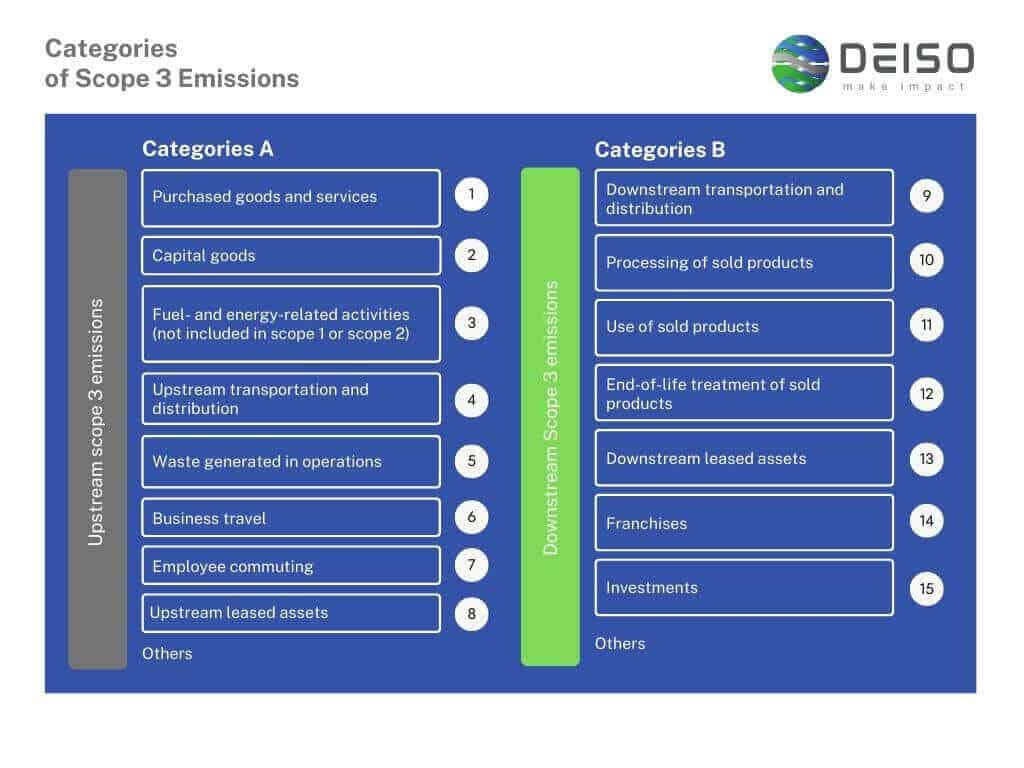
업스트림
- 구매한 상품 및 서비스
- 자본재
- Scope 1~2에 포함되지 않는 연료 및 에너지 관련 활동
- 업스트림 운송 및 유통
- 사업 운영에서 발생한 폐기물
- 출장
- 직원 출퇴근
- 업스트림 임차 자산
다운스트림
- 다운스트림 운송 및 유통
- 판매 제품의 가공
- 판매 제품의 사용
- 판매 제품의 수명 종료 처리
- 다운스트림 임차 자산
- 프랜차이즈
- 투자
(출처: The 온실가스 프로토콜)
전과정평가(LCA)를 통한 전체 생애주기 고려
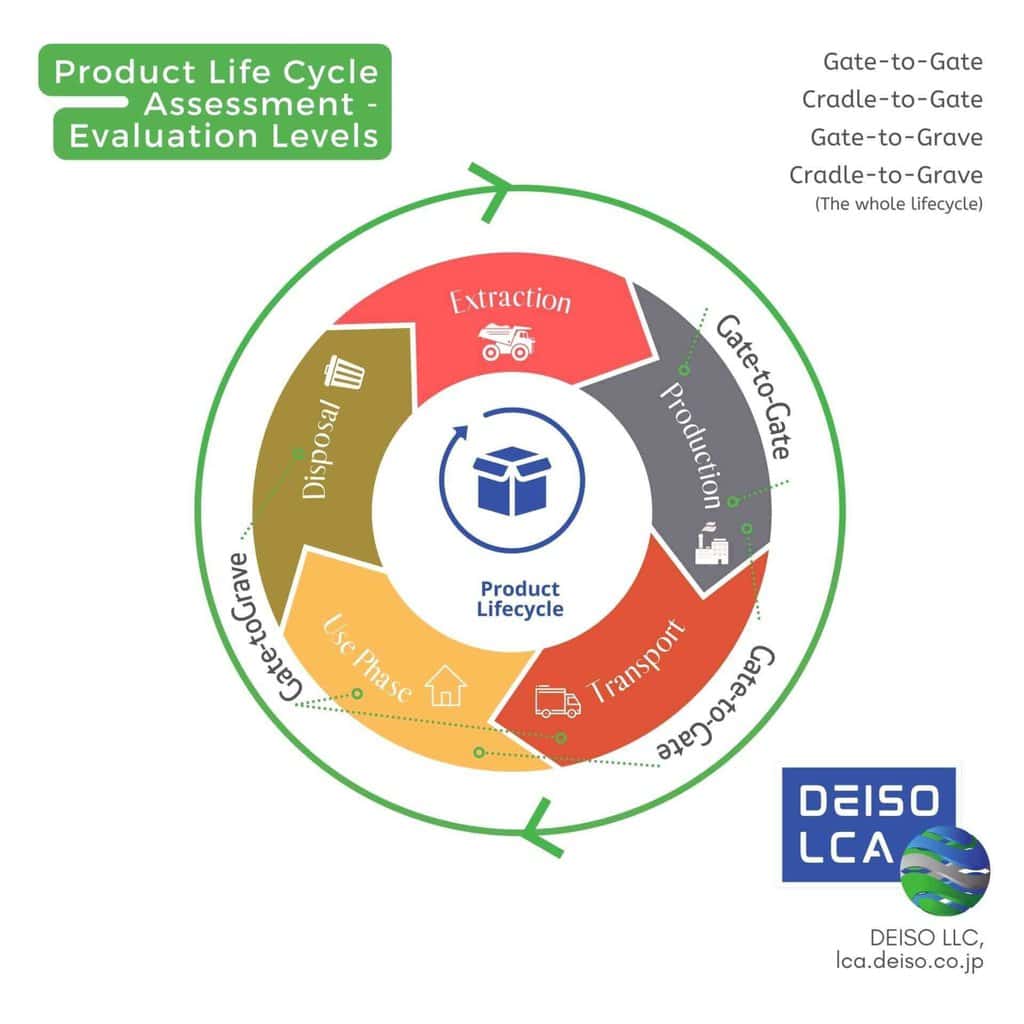
제품과 서비스를 제공하는 조직은 전체 전과정평가(LCA) to increase the accuracy of their Scope 3 emissions analysis. It is worthwhile to perform an in-depth cradle-to-grave or cradle-to-cradle analysis. It is also a viable tool to calculate carbon emissions at the product level from material extraction to product use to disposal with the possibility of recycling. At DEISO, we are also fluent in LCA. 에 능숙합니다. 당사는 다양한 개별 및 특정 LCA 서비스(10개 이상)를 제공합니다. 자세한 내용은 다음을 방문해 주십시오 https://dei.so/life-cycle-assessment-lca. We also provide an all-in-one LCA service to businesses and academic institutions, DEISO LCA One. For more information on DEISO LCA One, please visit https://dei.so/deiso-lca-one.
탄소 감축 또는 GHG 배출량에 관해 데이터 컨설턴트와 협력하세요.
Even though an organization may try to calculate its own Scope 3 carbon emissions, it is often more complex than calculating Scope 1 or 2 emissions. Therefore, working with an energy and environmental performance consultant may be more appropriate.
Scope 3 배출량 관리 및 산정의 과제.
One of the most significant obstacles in controlling Scope 3 emissions is the availability and quality of an organization’s data and the technical knowledge required to handle it. This is what we do at DEISO. Companies were rejected from the science-based targeting initiative because their submitted data was substandard. For some organizations, the measures taken by consumers also have a significant impact on Scope emissions 3. For example, a technology retailer which sells a smartphone to a customer is then responsible for the energy used to charge that laptop and the emissions resulting from its disposal at the end of its life.
필요 데이터 수집 및 처리
A GHG emissions expert should set up the data and its information and accuracy while obtaining and processing the needed data. DEISO will use 1-year data to model emissions and determine our client’s 탄소발자국 regarding their spending. Scope 3 emissions can be determined using both primary data unique to the activity within an enterprise’s value chain and secondary data. The datasets must be precise for the company to meet its Net-Zero and technology-based aims. When an expert collaborates with a partner organization to compute it, experts will examine these facts and figures to model emissions and quantify their 탄소발자국 조직 활동과 관련하여 정량화하기 위해 이러한 사실과 수치를 검토합니다.
The partner GHG business company, such as DEISO, may also develop a document that models the commercial enterprise and its Scope 3 emissions against the fabric classifications. Using the science-based objectives technique, the company may utilize these results to determine its Net-Zero journey and set Scope 3 discount targets. One of the most critical and challenging scenarios when dealing with Scope three emissions is the availability and quality of a company’s data and the technical expertise required to control them. DEISO manages our clients’ technical information to compute the GHG emissions. DEISO delivers a comprehensive analysis that models the company’s Scope 3 emissions against the Scope 3 categories or the categories of focus of those 15개 범주. There are two reports offered: The first is a brief overview of Scope 3 or Scopes 1-3 emissions, including the 15개 범주 대상 Scope 3. The second is a scientifically based detailed report that introduces the organization’s activities, operations, projects, technical aspects, and data. Emission factors, data quality, calculation methodology, tools or software used to calculate GHG emissions, system boundaries, the scope of the evaluation, explanation of the evaluation and its results, reports, and recommendations for action plans.
Using the science-based review, the company may utilize these findings to guide its Net-Zero approach and establish Scope 3 reduction objectives. Managing Scope 3 emissions is difficult. Using the science-based objectives technique, the corporation may utilize these data to guide its Net-Zero journey and set Scope 3 reduction targets. One of the most significant obstacles in controlling Scope 3 emissions is the availability and quality of an organization’s data and the technical knowledge required to handle it. DEISO works with our clients’ technical data to calculate their GHG emissions, report them, and establish a reduction strategy.
GHG 배출량을 위한 현실적 감축 전략 수립
Once an organization has determined its Scope 3 baseline, it may apply a few reduction approaches to its focused categories. Depending on the evaluation scope, those may be unique. For example, while procuring products and services, the employer may communicate with its suppliers and collaborate to see what they can do to contribute to its Scope 3 emissions. A firm’s progress toward its goals should be monitored every year. DEISO assists our clients in meeting their objectives by computing and reporting their Scope 3, Scopes 1-2, or Scopes 1-3 GHG 배출량과 관련하여 기업 또는 산업의 환경 성과를 이전 상태와 현재 상태 간 심층적으로 평가·비교한 후 발급됩니다.
Hotspot analyses, parameter assessment, scenario analysis and development, process evaluation, reduction potentials, and in-depth analytical evaluation of our client’s activities and projects. Several DEISO GHG Reporting plans incorporate such services. Find out more at https://dei.so/topic/greenhouse-gas-reporting-subscription-plans.
Scope 3 탄소 배출량 감축 또는 완화
Once again, this depends significantly on the business, its size, location, and the services it provides. When attempting to reduce or mitigate Scope 3 emissions, a company should create a class-specific reduction strategy. Purchased products and services, for example, may need the implementation of a provider engagement program to assist them in reducing their 탄소발자국. ISO 20400, a widely accepted sustainable standard, can help with this. At DEISO, we partner with our customers and collaborate to develop a category-specific mitigation plan or a whole strategy.
Different categories need distinct recognition. When looking for transportation, value chain, or supply chain. An organization should consider the global changes. Such changes are likely to interchange the GHG impacts and benefits because of global crises and pandemics, e.g., the Covid-19 pandemic and unanticipated international shifts.
가치사슬 참여 유도
가치사슬은 특정 산업에서 기업이 최종 고객에게 가치 있는 재화(즉, 제품 및 서비스)를 제공하기 위해 수행하는 일련의 운영 활동입니다. 가치사슬 개념은 제조(또는 서비스) 기업을 투입물, 변환 프로세스 및 산출물을 갖춘 하위 시스템들로 구성된 체계로 보는 조직 프로세스 관점에 기반합니다.
The value chain is a critical aspect of any business regarding Scope 3. It is essential to understand the inner workings of a company. Companies can identify ways to improve efficiency and create value for customers by understanding how the value chain works. It is the sequence of activities a business performs to deliver a product or service to its customers. The value chain begins with customer discovery, where a company identifies potential customers and tries to understand their needs. This is followed by product development, where the company creates a product or service that meets the needs of those customers. The company then executes a marketing plan to reach and sell to the target market. Finally, it creates and delivers the product or service and involves various activities such as employment activities, investment, purchases, etc.
가치사슬은 기업이 고객에게 가장 큰 가치를 창출할 수 있는 지점을 파악하는 데 도움이 되므로 중요합니다. 예를 들어 기업은 기존 제품을 단순히 개선하는 것보다 신제품을 개발할 때 고객에게 더 큰 가치를 제공할 수 있음을 발견할 수 있습니다. 또한 가치사슬은 기업의 성공에 가장 중요한 활동과 개선하거나 제거해야 할 활동을 판단하는 데 도움이 됩니다.
The chain of value is also critical because it can help a business understand the flow of money through its business. For example, a business may discover that it makes much money on product sales but loses money on marketing efforts. This information can help the company better allocate its resources concerning GHG 배출량과 관련하여 기업 또는 산업의 환경 성과를 이전 상태와 현재 상태 간 심층적으로 평가·비교한 후 발급됩니다.
가치사슬은 여러 구성 요소로 이루어져 있으며, 각 요소를 이해하는 것은 기업에 중요합니다. 사슬의 각 단계를 이해하고 최적화함으로써 기업은 고객에게 더 큰 가치를 창출하고 수익성을 개선할 수 있습니다.
많은 기업이 직면하는 과제 중 하나는 효율성 향상 노력을 강화하는 것입니다. 이를 위한 가장 효율적인 방법 중 하나는 가치사슬을 활성화하는 것입니다. 우수 사례는 다음과 같습니다.
- 재고 감축.
- 물리적 자원 사용 감축.
- 공급업체 수 축소.
- 배송 시스템을 분석하고 배송 속도 개선.
- 도미노 효과는 가치사슬의 효율성을 개선하는 효과적인 방법입니다.
- Digitalization of the services. E.g., developing software as a Service (SaaS) or Product-as-a-Service (PaaS). At DEISO, we also help with these strategies through our circular economy services. Find out more at https://dei.so/topic/circular_economy.
목표 커뮤니케이션.
- GHG 계획과 목표 이행에 전념하는 즉시, 가치사슬이 귀사의 노력에 기여하도록 동기를 부여해야 합니다.
- 딜러 포럼을 통한 공급망 참여 유도 – 기업들은 공급업체와 소통하기 위해 가상 행사의 편의성을 활용하고 있습니다.
- You aid your cost chain in goal placing understanding and revel in. Despite the blessings of Scope 3 reporting, locating the proper solution can include challenges. However, the first step is to carry out a quick screening of your company’s activities and determine the Scope 3 categories to focus on.
- Gathering data from external businesses may be challenging and time-ingesting. Defining a clean strategy is how DEISO simplifies the processes and saves time.
- 이해관계자에게 부담을 주지 않고 정성적 Scope 3 데이터를 정확히 수집하려면, 기업은 이러한 데이터의 수집, 측정 및 관리에 특화된 기술적 절차를 활용해야 합니다. 기업은 방대한 데이터 포인트를 활용할 수 있도록 탄소 성과 보고를 실질적으로 추진하는 접근 방식과 도구를 채택해야 합니다.
감축 및 완화 조치
An agency must make sure it has decreased its emissions, consisting of Scope 3 lot as it may earlier than it considers carbon offsetting. This is crucial if the enterprise has set a technology-based target that does not guide offsets. The complexity is that the statistics are frequently drawn from many resources. It becomes a systems integration assignment to convey it collectively. There are numerous standard approaches or customized ones accessible that assist with this.
Another considerable barrier is how a corporation’s success in decreasing Scope 3 emissions depends on its providers and partners, which may not be as ambitious in their carbon-slicing endeavors. For example, an organization may also have set a Net-Zero target of 2030. Still, one of its enormous suppliers might have developed a much less bold pathway for 2050. For some corporations, consumers’ movements affect Scope 3 emissions. For example, a technology retailer which sells a PC to a customer is then chargeable for the power used to rate that pc and the emissions attributable to its disposure at the quilt of its lifestyle. Both elements are complex for an organization to manipulate, and this is in which collaboration and engagement are essential. Many agencies are put off going public with their intentions because they could then be held to account for things they understand as past their management and criticized if they fail. We can assist you in addressing your greenhouse gas reduction or mitigation plans, issues, and goals. You can reach us at https://dei.so/contact 귀사의 요구사항을 논의하려면.

– 환경적 이점: 지구온난화가 다시금 시급한 논의의 중심에 섰습니다. 그러나 이 문제는 환경운동가의 영역을 넘어 산업계 전반으로 확산되었습니다. 생산업체, 석유·가스 공급업체, 철강·화학·시멘트 산업, 상업용 항공기 업계까지 세계가 지구온난화에 대응하기 위한 올바른 조치를 취하지 않을 경우 자사 사업에 미칠 위험을 언급하고 있습니다. 기업은 현재 친환경 역량을 강화함으로써 이점을 얻을 수 있지만, 장기적으로 환경 성과를 개선한다는 보장 없이 이를 추진할 여유는 없습니다.
The green technology sector embraces the notion that the best way to succeed is to discover sustainable and renewable ways to do business. As consumers demand companies concerned about the environmental impacts of their business, it is becoming increasingly crucial for companies to offer solutions that will allow them to follow the growing trend. To establish an environmentally sound industry and achieve these, the process begins with GHG 회계 and then developing realistic action plans.
– 평판상 이점: 평판상 이점도 있습니다. 과감한 목표를 설정하고 이를 공개하는 기업은 지속가능성에 대한 인식이 높은 고객이 제품이나 서비스를 구매하도록 유도할 가능성이 높습니다. 반대로 기업이 보다 지속가능한 사업 전략으로 전환하지 않는다면, 소비자는 환경적으로 바람직하지 않다고 여겨지는 해당 기업의 제품과 서비스를 외면할 것입니다.
조직은 투자자, 고객 및 규제기관으로부터 지속가능성과 환경·사회·지배구조(ESG) 정보에 대한 투명성을 높여야 한다는 압박을 받고 있습니다. Scope 3 데이터의 수집 및 보고에는 과제가 따릅니다. 그러나 이는 실질적인 변화를 이끌고 지속적인 유산을 남길 중요한 기회이기도 합니다.
투자 및 자금 조달의 이점: In the economic zone, ESG finances are often seen to perform higher as divestment away from fossil fuels keeps pace. People increasingly consider sustainability in phrases of exposure and what it means for their investment. Corporations increasingly seek to degree and report the ‘cost’ in their carbon emissions and traditional income metrics.
규정 준수의 이점: Getting beforehand on compliance and any other advantage in dealing with Scope 3 emissions puts a business enterprise in advance by applying for certifications and assembly standards. Many requirements and certification schemes have viewed disclosure on Scope three emissions as a “first-class to have.” But many now harden that requirement and stipulate how its miles met.
인재 유치의 이점:
직원 측면에서도 마찬가지입니다. Scope 1~3 배출량을 관리하는 기업은 우수 인재를 유치할 가능성이 높습니다. 특히 30세 미만의 인재들은 지속가능하고 책임감 있는 조직에서 일하기를 점점 더 원하고 있습니다.
Scope 3 배출량의 미래 영향은 무엇인가요?
Consumers are learning about sustainability problems and are stressed sustainable merchandise that is anecdotally promoting 3-four times extra than conventional products. Clients assume the brands they buy from to have prominent sustainability practices. And this is having a knock-on effect on governance, with many standards and certifications now consisting of Scope 3 emissions reporting as a requirement rather than a “first-class to have,” specially to achieve Net-Zero plans by 2050 as in the case of Japan.
탄소 상쇄
Carbon offsetting is one way an enterprise may additionally wish to help reach its reduction targets. At DEISO, we assist our clients with how offsetting should remember closer to decarbonization desires. It is far extensively seemed that to be influential. A few companies can also choose carbon offsetting as a substitute, which entails investment in emissions reduction within a business enterprise’s supply chain. At DEISO, we provide services for carbon offsetting except for our GHG 회계 services. You may locate greater at https://dei.so/topic/carbon-offsetting.
산업 관점
Grounding industrial organizations are paying greater interest to Scope 1, 2, and 3 emissions like chemicals, steel, cement, metals, and materials industries, as well construction and manufacturing industries by putting an ambitious, measurable target that demonstrates how your organization addresses the primary sources of value chain GHG emissions. But, knowing you need to be doing something and handing over it are exceptional. While starting on or comparing your Scope 3 emissions reporting, here are things to remember. DEISO can desire your enterprise with a collective “work together” approach centered on your agency’s goals.
DEISO GHG Reporting의 가치와 이점은 무엇인가요?

DEISO’의 GHG, LCA, and sustainability experts are your one way to compute your Scope 1-3 GHG emissions. The online platform offers data visualization, sharing, and export. We provide cloud-based services to ensure all users have access no matter where they are.
The GHG platform is a cloud-based hosting portal where every company has its GHG profile. The GHG platform offers a comprehensive set of services to help companies reduce their 탄소발자국. The cloud-based hosting portal is hassle-free and accessible from anywhere at any time with an internet connection. It provides company profiles that allow users to visualize and search within the inventory online, which can be filtered by table or filter criteria setting, allowing you to see what data has been reported back so far without going through old reports yourself! Plus, there here is always access to documentation-and, even downloadable versions. Find more at https://dei.so/topic/greenhouse-gas-reporting-subscription-plans.
클라우드 플랫폼의 이점은 다양합니다. 시각화된 대시보드에서 전체 현황을 확인하고, 온라인 GHG 산정 제출을 위해 팀원 및 이해관계자와 프로젝트를 공유하여 원활하게 협업할 수 있습니다. 또한 데스크톱, 태블릿 및 스마트폰에서 크로스 플랫폼 호환 환경을 통해 데이터에 접근하고, 프로젝트 또는 부서별 다양한 배출원(GHG)을 비교할 수 있습니다. 이 모든 과정에서 안전한 플랫폼을 통해 생산 활동 데이터를 안전하게 제출할 수 있습니다.
선택할 수 있는 GHG 보고 요금제는 9가지입니다. 클라우드 플랫폼이 필요하지 않으신가요? 걱정하지 마세요. 클라우드 호스팅/플랫폼 없이 이용할 수 있는 기존 요금제도 있습니다. 자세한 내용은 다음에서 확인하세요 https://dei.so/topic/greenhouse-gas-reporting-subscription-plans.
- 에서 DEISO, we paintings to your company to Compute its GHG emissions (Scope 1-3).
- 고객사에 완전하고 명확한 서면 보고서를 제공합니다.
- 클라우드에서 시각화 및 공유 가능한 결과를 제공합니다.
- We assist our clients in identifying the current or pressing 15개 범주 of Scope.
- 핫스팟을 파악하고 기술적 관점에서 대체 활동, 공정 생산 또는 사업 계획을 개발하기 위한 종합 평가를 수행합니다.
- 잘 구성된 보고서를 통해 오프라인으로 GHG를 문서화하거나 GHG 클라우드 서비스를 통해 온라인으로 문서화할 수 있도록 전문적으로 지원합니다.
- 귀사의 GHG 감축 로드맵 수립을 지원합니다.
- 귀사가 감축 잠재력과 목표를 달성하도록 지원합니다.
비용은 얼마인가요? 시장 가격은 어떻게 되나요?
The prices rely upon the complexity of the organization’s activities, projects, scopes to be calculated (Scopes 1-3, or 1-2, or Scope 3 only), the project’s content, data, and others. Scope 3 computing market price cost roughly will price among 2 million Japanese yen to 5 million Japanese yen, depending on the organization and the complexity of its activities. In the GHG services market, 1 to 3 months are needed to compute the emissions. Reduction schemes and investments will add more significance to this initial price and timescale. However, from a pricing viewpoint, at DEISO, we offer services that are lower than these prices and ensure high-quality standards, consisting of other scopes, Scopes 1-3. But again, the costs depend upon several elements associated with the organization, its activity, and the dimensions and complexity of its projects and activities. At DEISO, we offer various subscription plans. The emissions are computed and visualized in the cloud or submitted traditionally via printed reports or digitally by email, which would be a cheaper option. There are 9 GHG Reporting plans for Scopes 1-3. Also, we offer custom-designed plans. The charge of every plan is quotation-based. After discussions with our client organization activities and needs, we provide quotations through email or through a remote or face-to-face meeting. Discover more at https://dei.so/topic/greenhouse-gas-reporting-subscription-plans. 또는 다음으로 연락하여 https://dei.so/contact 미팅을 예약하세요.
에서 DEISO, we provide deeper analysis along with hotspot analysis, uncertainty analysis while emission factors estimation whenever they are lacking, sensitivity analysis to measure how the emissions are sensitive against a particular process, activity, or parameter, and scenario improvement, in which we design various scenarios seeking for potentials for emissions reductions from Scope 3 or other scopes most straightforward or Scopes 1-3.
자세히 보기
방문하기 https://dei.so/topic/greenhouse-gas-reporting-subscription-plans to learn more about DEISO GHG Reporting services. If you have any questions or would like to schedule a meeting, please email us at .