

Scope 3排出量とは?DEISOは、貴社のScope 3炭素排出量への対応をどのように支援できるか?

Scope 3炭素排出量
Scope 3 emissions are indirect carbon emissions from an organization’s value chain that do not relate to the generation of purchased energy. Scope 3 carbon emissions typically reside outside organizations – both upstream and downstream. The organization’s value chain is a significant contributor to Scope 3 emissions. An organization’s direct emissions, called ‘Scope 1 emissions,’ refer to the carbon produced through its actions, such as fuel combustion and vehicle use. 間接排出量 電力、熱、蒸気、冷熱などのエネルギー購入に伴うものは、Scope 2に含まれます。この用語には、製品の製造やサービス提供のための商品・サービスの購入など、上流の活動も含まれます。また、市場投入後に顧客が製品をどのように使用するかなど、下流の活動も含まれます。.
GHG Protocol defines 15のカテゴリ applicable to Scope 3 emissions, including those that an organization manages, such as purchases, business travel, and investments. Scope 3 carbon emissions are the most complex part of an organization’s emissions due to their broad scope and how they differ depending on the organization.
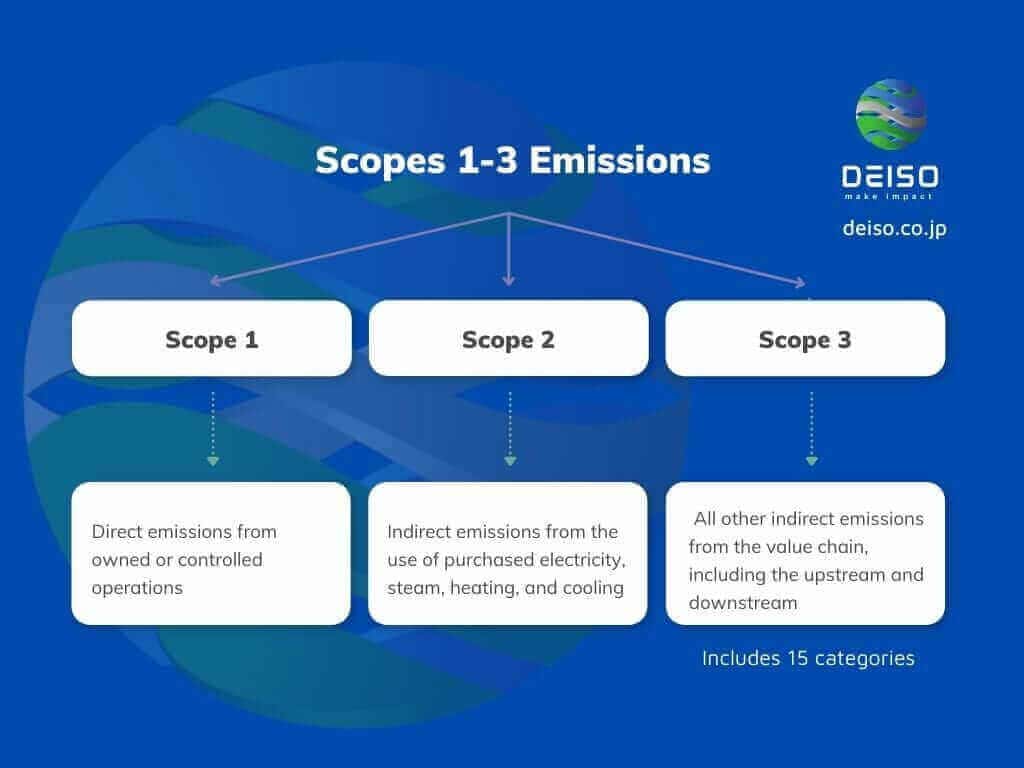
Scope 3 considers other emissions generated by the organization when fossil fuels are burned in their value chain. Including upstream – e.g., goods and services purchased into an organization to manufacture goods or services. Also included is what happens downstream – for example, after a product is sold and used by customers.
3つのScopeでは、これらの排出量を GHGプロトコル (GHG).
- Scope 1:企業の排出源から生じる直接排出量。.
- Scope 2: 間接排出量 of energy purchased to operate (electricity, heating, & cooling).
- Scope 3: All other 間接排出量 from the value chain, upstream and downstream. Cover everything from purchased goods and raw materials, business travel and employee commuting, operational waste, and End-of-Life (EoL) treatment.
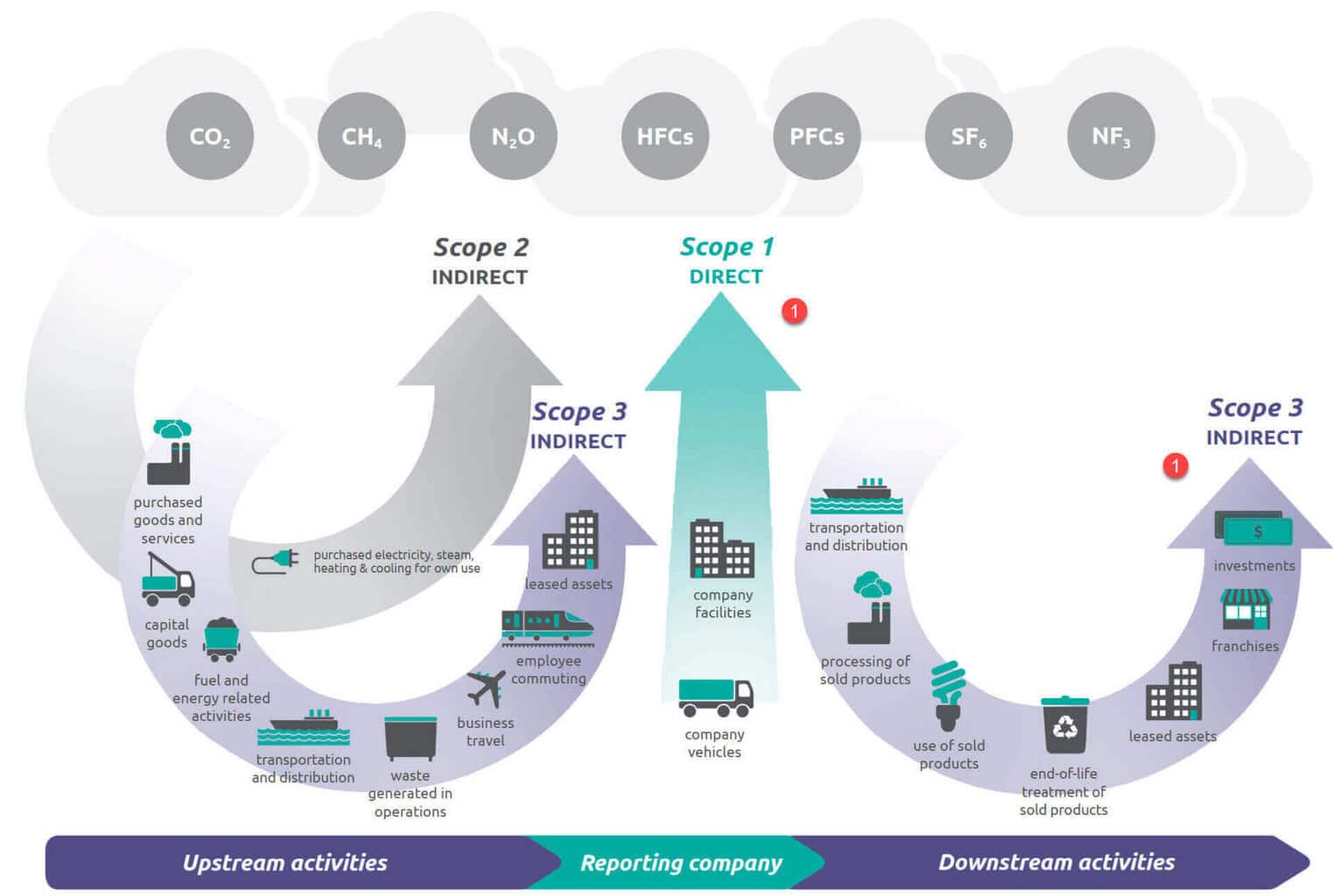
“「CO2”」:二酸化炭素、「CH4”」:メタン、「N2O:一酸化二窒素」、「HFCs」:ハイドロフルオロカーボン、「PFCs」:パーフルオロカーボン;「SF6”」:六フッ化硫黄、「NF3”」:三フッ化窒素
“Direct emissions,” or Scope 1 emissions, result directly from an organization’s actions, such as fuel combustion and using its vehicles. 間接排出量 result from the purchase of electricity, heat, steam, or cooling from an energy provider. A Scope 3 assessment covers all indirect emissions resulting from the upstream and downstream value chain. All aspects of the organization’s operation are covered, including, e.g., purchased goods and raw materials, travel and employee commuting, capital goods, energy-related activities, use of goods, and operational waste.
顧客およびサプライヤーの排出量は、企業の製品・サービスに起因します。輸送、オフィスビル、従業員の出張は、製品・サービスに関連しない企業活動に伴う残余排出量の例です。企業は、Scope 3排出量を 15のカテゴリ, 、例えば購入した物品・サービス、出張、投資において管理できます。.
Scope 3 carbon emissions are the most complex of an organization’s emissions due to how broad they are and how they differ widely between organizations. There are three Greenhouse Gas (GHG) categories: of scopes emissions: Scope 1, Scope 2, and Scope 3 were. Scope 3 emissions are often challenging to 定量化, making them less likely to be included in the GHG inventories of several organizations.
2050年までの日本のネットゼロ排出量。.

世界第3位の経済大国であり、発展を続ける国の一つである日本は、気候変動への対応に取り組む責任を表明しました。.
Japan’s path to challenging climate change is bold and ambitious. Under the eye of the UN Climate Change Convention, Japan has committed to decreasing GHG emissions by 26% from 2013 levels by 2030. The second milestone is to promote innovation of groundbreaking technology by 2050 that enables Japan to contribute to the reduction in accumulated Atmospheric CO2 「ビヨンド・ゼロ」を世界規模で実現することです。しかし、この目標を達成するには、事業慣行や製品において抜本的な変革が必要です。, GHG 会計, モニタリング、評価、報告。.
2020年10月26日に菅義偉首相が表明した第3の、そして最も意欲的な目標は、2050年までに日本がGHG排出量をゼロにすることです。この大胆な誓約により、日本は30年以内のカーボンニュートラル達成に向けて歩み始めました。この誓約は、日本がカーボンニュートラル(自然に吸収される量を超える二酸化炭素を排出しない状態)を目指す国際的な取り組みに、世界各国とともに参加する後押しとなるはずです。.
2050年までにカーボンニュートラルを達成するため、日本はこれらの重要課題を評価する必要があります。重要な新技術の開発・導入を計画的に優先しつつ、既存技術を活用します。省エネルギー、電化、電力源の脱炭素化、水素燃料システムを進めても、化石燃料を使用しない未来の実現は困難である可能性があります。. ネガティブエミッション技術 二酸化炭素を回収・貯留するための技術は、日本の戦略に不可欠な要素となります。脱炭素化が困難な産業分野における技術や手法を巡る長期的な不確実性に対処するため、カーボンニュートラルのビジョンに向けた環境に配慮した持続可能な成長を実現するには、多くの政策的解決策を検討する必要があります。したがって、, GHG 会計 that is not limited to Scopes 1-2 but Scope 3 also is critical. Scope 3 is a significant contribution to the organization’s activities and is often not considered.
鉄鋼、化学、セメント、パルプ・製紙は主要な産業分野です。これを達成するためのアプローチは、3つの基本原則に基づいています。.
- 地球温暖化の課題に対応する変革の原動力として、イノベーションと技術を促進します。.
- 新技術とイノベーションの開発を支援するグリーンファイナンスを促進します。.
- 新たなグリーン技術の商業化に向け、国際協力の強化を促進します。.
Achieving Net-Zero by 2050, and with many businesses setting more ambitious goals, several organizations in Japan are increasingly making efforts to reduce their GHG emissions and evaluate and lower their Scope 3 排出量について、以前の状態と現在の状態を詳細に環境評価・比較した後に発行されます。.
Scope 1~3およびScope 3排出量の算定
Measuring & Reporting Scope 3 emissions. The 間接排出量 associated with your product’s life cycle within your value chain are calculated per unit product.
- 企業のバリューチェーンのマッピング。.
- 評価のためのバウンダリー(範囲)の設定。.
- バリューチェーンのつながりごとの排出源を特定します。.
- データソースを定義します:(1)フォアグラウンドデータ、(2)バックグラウンドデータ(排出係数)。排出量データベースを活用し、一次データおよび二次データを収集します。.
- カテゴリごとのすべての排出源を定量化します。.
- 透明性を確保します。.
- 包括的な文書レポート。.
- 組織別のクラウド可視化、レポーティング、共有など(オプション)

It was stated that direct emissions, or Scope 1 emissions, occur directly due to an organization’s actions, such as fuel combustion or using the organization’s vehicles. 間接排出量 result from the purchase of electricity, heat, or steam from an energy provider. Scope 3 assessments take indirect emissions from upstream and downstream value chains. All aspects of the organization’s operation are covered, including purchased goods and raw materials, travel and employee commuting, and operational waste.
Because of the products and services offered by the company, customer and supplier emissions are generated. Besides product and service emissions, residual emissions from a company’s operations can include emissions from transport, office buildings, and employee travel. Purchasing goods and services, traveling for business, and investing are categories under which Scope 3 emissions can be managed for a company.
Due to their broad nature and the fact that they vary widely between organizations, Carbon emissions in Scope 3 are the most complex of an organization’s emissions. Scope 3 emissions are frequently challenging to 定量化., making them less likely to be included in GHG inventories. The Scope 3 calculations will be discussed within the key concerns and what DEISO can offer to your company in the following sections.

We offer a GHG reporting service at DEISO that can cover all of the Scopes. We calculate Scope 3 emissions (and Scopes 1-2) using up-to-date emission factor databases and the GHG standard protocol with the apocopate company’s activities and production data. Experts perform the calculations, which are then visualized in the cloud-based on various subscription plans. A company may select the one that best suits its needs, goals, or emission reduction targets.
重点カテゴリの特定
まず留意すべき点は、プロセスが企業の所在地や規模、事業を展開する業界によって異なることです。各業界には、環境影響および排出量に関する固有の事業環境があります。例えば、金融業界は製造業や小売業とは異なります。同じ業界の企業でも、販売する製品によって異なる場合があります。.
Thus, establishing which of the 15のカテゴリ is substantial to an organization’s activity is the first step in estimating Scope 3 emissions. For example, a grocery store may concentrate on the products and services it purchases. Domestic and international transportation activity may interest a significant financial firm.

企業にとって優先すべきセクターを決定する際の重要な考慮事項の一つは、所在地や規模、特定の業界で事業を展開しているかどうかによってプロセスが異なることです。各セクターには排出に伴う環境影響を含む固有の事業環境があり、所在地によって状況は変化します。.
明確にすべき最も重要な点は、技術が雇用主の所在地や規模、事業を展開する業界によって異なることです。各地域には、環境影響および排出量に関する固有の事業環境があります。.
例えば、金融サービス企業は製造企業やその他の事業者とは異なる場合があります。同じ地域の事業者であっても、提供する製品によって異なることがあります。.
The first step in calculating a company’s Scope 3 emissions is determining which of the 15 classes relate to its business. For example, a grocery retailer might account for additional costs associated with purchased items and offerings. Waste created in operations may be relevant for a significant supplier. The waste that might be identified as the essential trigger is those on which the company should concentrate its efforts.
GHGデータを活用する
Businesses can attempt to calculate their own Scope 3 emissions; however, as this process is typically more complex than calculating Scope 1 or 2, it is recommended that businesses work with GHG and environmental companies instead. Working with a consultant specializing in energy or environmental performance can make sense. In general, environmental impact assessment and GHG account comprise intensive details. It requires a significant amount of data about Scopes 1-3 for the impacts of climate change.
Scope 3のカテゴリー
Scope 3 emissions can be broken down into two major categories of 15 subcategories:
- 上流排出量―原材料やエネルギーの使用を含む、企業製品の生産に伴う排出量
- 下流排出量―エネルギー、水、その他の資源の使用を含む、企業の製品・サービスに伴う排出量
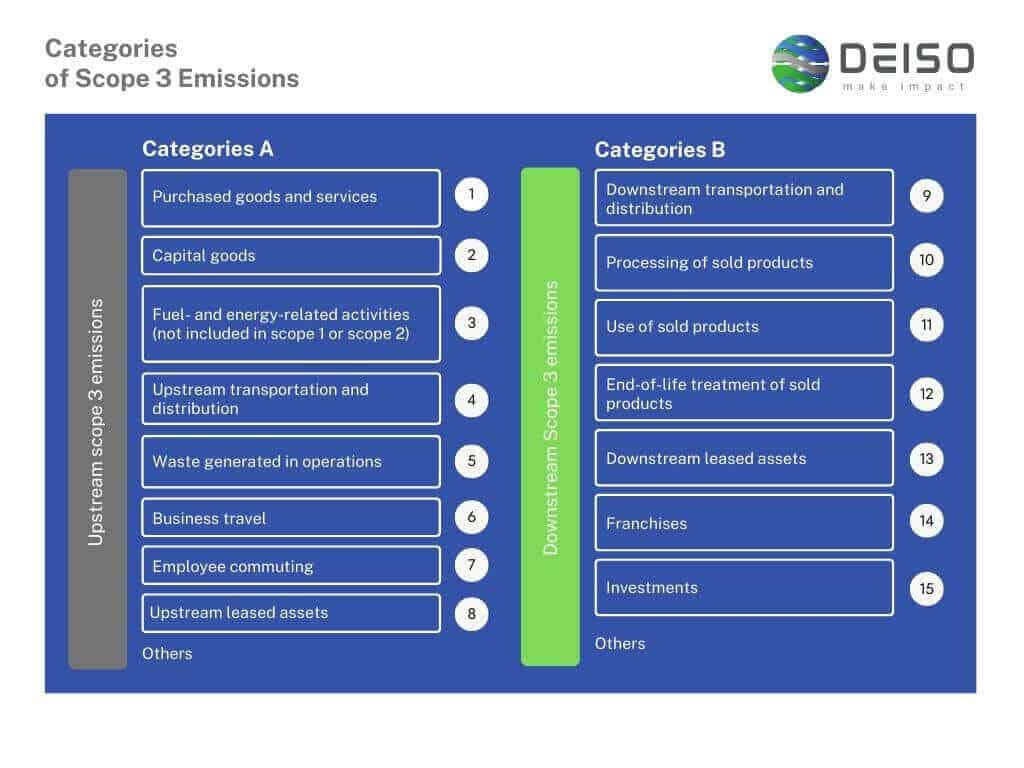
上流
- 購入した製品・サービス
- 資本財
- Scope 1・2に含まれない燃料・エネルギー関連活動
- 上流輸送・流通
- 事業活動から発生する廃棄物
- 出張
- 従業員の通勤
- 上流のリース資産
下流
- 下流輸送・流通
- 販売した製品の加工
- 販売した製品の使用
- 販売した製品の使用後処理
- 下流のリース資産
- フランチャイズ
- 投資
(出典:The GHGプロトコル)
ライフサイクルアセスメント(LCA)によるライフサイクル全体の検討
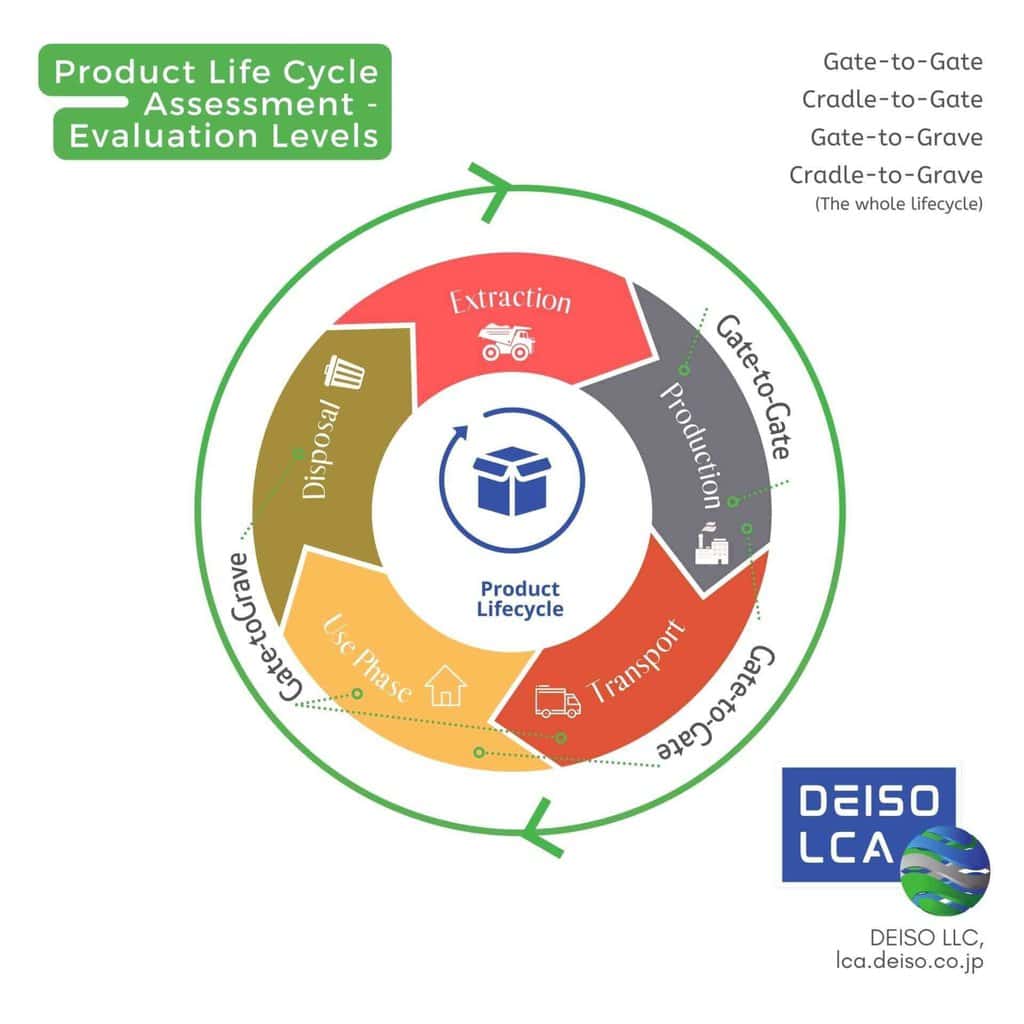
製品・サービスを提供する組織は、包括的な ライフサイクルアセスメント(LCA) to increase the accuracy of their Scope 3 emissions analysis. It is worthwhile to perform an in-depth cradle-to-grave or cradle-to-cradle analysis. It is also a viable tool to calculate carbon emissions at the product level from material extraction to product use to disposal with the possibility of recycling. At DEISO, we are also fluent in LCA. 。個別のニーズに対応した複数の LCA サービス(10種類以上)を提供しています。詳細については、以下をご覧ください https://dei.so/life-cycle-assessment-lca. We also provide an all-in-one LCA service to businesses and academic institutions, DEISO LCA One. For more information on DEISO LCA One, please visit https://dei.so/deiso-lca-one.
カーボン削減またはGHG排出量について、データコンサルタントと連携する。.
Even though an organization may try to calculate its own Scope 3 carbon emissions, it is often more complex than calculating Scope 1 or 2 emissions. Therefore, working with an energy and environmental performance consultant may be more appropriate.
Scope 3排出量の管理・算定における課題.
One of the most significant obstacles in controlling Scope 3 emissions is the availability and quality of an organization’s data and the technical knowledge required to handle it. This is what we do at DEISO. Companies were rejected from the science-based targeting initiative because their submitted data was substandard. For some organizations, the measures taken by consumers also have a significant impact on Scope emissions 3. For example, a technology retailer which sells a smartphone to a customer is then responsible for the energy used to charge that laptop and the emissions resulting from its disposal at the end of its life.
必要なデータの収集・取扱い
A GHG emissions expert should set up the data and its information and accuracy while obtaining and processing the needed data. DEISO will use 1-year data to model emissions and determine our client’s カーボンフットプリント regarding their spending. Scope 3 emissions can be determined using both primary data unique to the activity within an enterprise’s value chain and secondary data. The datasets must be precise for the company to meet its Net-Zero and technology-based aims. When an expert collaborates with a partner organization to compute it, experts will examine these facts and figures to model emissions and quantify their カーボンフットプリント 組織の活動に関する内容を定量化します。.
The partner GHG business company, such as DEISO, may also develop a document that models the commercial enterprise and its Scope 3 emissions against the fabric classifications. Using the science-based objectives technique, the company may utilize these results to determine its Net-Zero journey and set Scope 3 discount targets. One of the most critical and challenging scenarios when dealing with Scope three emissions is the availability and quality of a company’s data and the technical expertise required to control them. DEISO manages our clients’ technical information to compute the GHG emissions. DEISO delivers a comprehensive analysis that models the company’s Scope 3 emissions against the Scope 3 categories or the categories of focus of those 15のカテゴリ. There are two reports offered: The first is a brief overview of Scope 3 or Scopes 1-3 emissions, including the 15のカテゴリ の Scope 3. The second is a scientifically based detailed report that introduces the organization’s activities, operations, projects, technical aspects, and data. Emission factors, data quality, calculation methodology, tools or software used to calculate GHG emissions, system boundaries, the scope of the evaluation, explanation of the evaluation and its results, reports, and recommendations for action plans.
Using the science-based review, the company may utilize these findings to guide its Net-Zero approach and establish Scope 3 reduction objectives. Managing Scope 3 emissions is difficult. Using the science-based objectives technique, the corporation may utilize these data to guide its Net-Zero journey and set Scope 3 reduction targets. One of the most significant obstacles in controlling Scope 3 emissions is the availability and quality of an organization’s data and the technical knowledge required to handle it. DEISO works with our clients’ technical data to calculate their GHG emissions, report them, and establish a reduction strategy.
GHG排出量の実現可能な削減戦略の設計
Once an organization has determined its Scope 3 baseline, it may apply a few reduction approaches to its focused categories. Depending on the evaluation scope, those may be unique. For example, while procuring products and services, the employer may communicate with its suppliers and collaborate to see what they can do to contribute to its Scope 3 emissions. A firm’s progress toward its goals should be monitored every year. DEISO assists our clients in meeting their objectives by computing and reporting their Scope 3, Scopes 1-2, or Scopes 1-3 GHG 排出量について、以前の状態と現在の状態を詳細に環境評価・比較した後に発行されます。.
Hotspot analyses, parameter assessment, scenario analysis and development, process evaluation, reduction potentials, and in-depth analytical evaluation of our client’s activities and projects. Several DEISO GHG Reporting plans incorporate such services. Find out more at https://dei.so/topic/greenhouse-gas-reporting-subscription-plans.
Scope 3の炭素排出量の削減・緩和
Once again, this depends significantly on the business, its size, location, and the services it provides. When attempting to reduce or mitigate Scope 3 emissions, a company should create a class-specific reduction strategy. Purchased products and services, for example, may need the implementation of a provider engagement program to assist them in reducing their カーボンフットプリント. ISO 20400, a widely accepted sustainable standard, can help with this. At DEISO, we partner with our customers and collaborate to develop a category-specific mitigation plan or a whole strategy.
Different categories need distinct recognition. When looking for transportation, value chain, or supply chain. An organization should consider the global changes. Such changes are likely to interchange the GHG impacts and benefits because of global crises and pandemics, e.g., the Covid-19 pandemic and unanticipated international shifts.
バリューチェーンとのエンゲージメント
バリューチェーンとは、特定の業界において企業が最終顧客に価値ある製品(すなわち、モノおよびサービス)を提供するために実施する一連の活動です。バリューチェーンの概念は組織プロセスの視点に基づいており、製造業またはサービス業の企業を、投入、変換プロセス、成果物をそれぞれ持つサブシステムで構成されるシステムとして捉えます。.
The value chain is a critical aspect of any business regarding Scope 3. It is essential to understand the inner workings of a company. Companies can identify ways to improve efficiency and create value for customers by understanding how the value chain works. It is the sequence of activities a business performs to deliver a product or service to its customers. The value chain begins with customer discovery, where a company identifies potential customers and tries to understand their needs. This is followed by product development, where the company creates a product or service that meets the needs of those customers. The company then executes a marketing plan to reach and sell to the target market. Finally, it creates and delivers the product or service and involves various activities such as employment activities, investment, purchases, etc.
バリューチェーンは、企業が顧客にとって最も大きな価値を創出できる領域を特定するのに役立つため、重要です。たとえば企業は、既存製品を単に改善するよりも、新製品を開発することで顧客に最大の価値を提供できると判断する場合があります。バリューチェーンは、企業の成功に最も重要な活動や、改善または廃止すべき活動を判断する際にも役立ちます。.
The chain of value is also critical because it can help a business understand the flow of money through its business. For example, a business may discover that it makes much money on product sales but loses money on marketing efforts. This information can help the company better allocate its resources concerning GHG 排出量について、以前の状態と現在の状態を詳細に環境評価・比較した後に発行されます。.
バリューチェーンには多くの構成要素があり、それぞれを理解することが企業にとって重要です。チェーン内の各段階を理解し最適化することで、企業は顧客により多くの価値を創出し、収益性を向上させることができます。.
多くの企業にとっての課題は、効率化への取り組みをさらに強化することです。そのための最も効率的な方法の一つが、バリューチェーンを活性化することです。優れた実践例には、以下が含まれます。
- 在庫の削減。.
- 物理的資源の使用削減。.
- サプライヤー数の削減。.
- 配送システムの分析と配送スピードの向上。.
- ドミノ効果は、バリューチェーンの効率を向上させる優れた方法です。.
- Digitalization of the services. E.g., developing software as a Service (SaaS) or Product-as-a-Service (PaaS). At DEISO, we also help with these strategies through our circular economy services. Find out more at https://dei.so/topic/circular_economy.
目標を明確に伝える.
- 貴社の GHG 計画と目標に取り組み始めたら、バリューチェーンがその取り組みを支援するよう促します。.
- ディーラーフォーラムを通じてデリバリーチェーンを巻き込む—企業は、サプライヤーとの交流においてバーチャルイベントの利便性を活用しています。.
- You aid your cost chain in goal placing understanding and revel in. Despite the blessings of Scope 3 reporting, locating the proper solution can include challenges. However, the first step is to carry out a quick screening of your company’s activities and determine the Scope 3 categories to focus on.
- Gathering data from external businesses may be challenging and time-ingesting. Defining a clean strategy is how DEISO simplifies the processes and saves time.
- ステークホルダーに負担をかけずに質の高いScope 3データを適切に収集するには、収集、測定、管理に特化した技術的な手順を活用する必要があります。企業は、大量のデータポイントを活用するために、カーボンパフォーマンス報告を実務的に推進する手法とツールを導入すべきです。.
削減・緩和策
An agency must make sure it has decreased its emissions, consisting of Scope 3 lot as it may earlier than it considers carbon offsetting. This is crucial if the enterprise has set a technology-based target that does not guide offsets. The complexity is that the statistics are frequently drawn from many resources. It becomes a systems integration assignment to convey it collectively. There are numerous standard approaches or customized ones accessible that assist with this.
Another considerable barrier is how a corporation’s success in decreasing Scope 3 emissions depends on its providers and partners, which may not be as ambitious in their carbon-slicing endeavors. For example, an organization may also have set a Net-Zero target of 2030. Still, one of its enormous suppliers might have developed a much less bold pathway for 2050. For some corporations, consumers’ movements affect Scope 3 emissions. For example, a technology retailer which sells a PC to a customer is then chargeable for the power used to rate that pc and the emissions attributable to its disposure at the quilt of its lifestyle. Both elements are complex for an organization to manipulate, and this is in which collaboration and engagement are essential. Many agencies are put off going public with their intentions because they could then be held to account for things they understand as past their management and criticized if they fail. We can assist you in addressing your greenhouse gas reduction or mitigation plans, issues, and goals. You can reach us at https://dei.so/contact お客様の要件についてご相談ください。.

– 環境面のメリット: 地球温暖化は、再び喫緊の議論の中心となっています。その議論は環境活動家の枠を超え、産業界にも広がっています。生産者、石油・ガス供給業者、鉄鋼、化学、セメント業界、さらには民間航空機業界までもが、世界が地球温暖化対策に適切な措置を講じなければ、自社事業に及ぶリスクについて発信しています。企業は環境面での評価を高めることで現時点でもメリットを得られますが、長期的に環境パフォーマンスを向上させることなく、こうした取り組みを進めることはできません。.
The green technology sector embraces the notion that the best way to succeed is to discover sustainable and renewable ways to do business. As consumers demand companies concerned about the environmental impacts of their business, it is becoming increasingly crucial for companies to offer solutions that will allow them to follow the growing trend. To establish an environmentally sound industry and achieve these, the process begins with GHG 会計 and then developing realistic action plans.
– 評判面のメリット: 評判面でのメリットもあります。意欲的な目標を設定し、それを公表する企業は、サステナビリティ意識の高い顧客をより多く引き付け、自社の製品やサービスを選んでもらえる可能性が高まります。一方で、より持続可能な事業戦略へ移行しない企業は、環境への配慮に欠けると見なされ、消費者がその製品やサービスから離れていくおそれがあります。.
組織は、サステナビリティおよび環境・社会・ガバナンス(「ESG」)に関する情報について、投資家、顧客、規制当局からこれまで以上に透明性を求められています。Scope 3データの収集と報告には課題がありますが、実質的な変革を促し、永続的なレガシーを残す大きな機会にもなります。.
資金調達・投資におけるメリット: In the economic zone, ESG finances are often seen to perform higher as divestment away from fossil fuels keeps pace. People increasingly consider sustainability in phrases of exposure and what it means for their investment. Corporations increasingly seek to degree and report the ‘cost’ in their carbon emissions and traditional income metrics.
コンプライアンスにおけるメリット: Getting beforehand on compliance and any other advantage in dealing with Scope 3 emissions puts a business enterprise in advance by applying for certifications and assembly standards. Many requirements and certification schemes have viewed disclosure on Scope three emissions as a “first-class to have.” But many now harden that requirement and stipulate how its miles met.
人材獲得のメリット:
従業員にとっても同様です。Scope 1・2・3の排出量に取り組むことで、企業は質の高い専門人材を惹きつけられる可能性が高まります。特に30歳未満の人々は、持続可能で責任ある組織で働くことをますます望んでいます。.
Scope 3排出量が将来に与える影響とは?
Consumers are learning about sustainability problems and are stressed sustainable merchandise that is anecdotally promoting 3-four times extra than conventional products. Clients assume the brands they buy from to have prominent sustainability practices. And this is having a knock-on effect on governance, with many standards and certifications now consisting of Scope 3 emissions reporting as a requirement rather than a “first-class to have,” specially to achieve Net-Zero plans by 2050 as in the case of Japan.
カーボンオフセット
Carbon offsetting is one way an enterprise may additionally wish to help reach its reduction targets. At DEISO, we assist our clients with how offsetting should remember closer to decarbonization desires. It is far extensively seemed that to be influential. A few companies can also choose carbon offsetting as a substitute, which entails investment in emissions reduction within a business enterprise’s supply chain. At DEISO, we provide services for carbon offsetting except for our GHG 会計 services. You may locate greater at https://dei.so/topic/carbon-offsetting.
産業界の視点
Grounding industrial organizations are paying greater interest to Scope 1, 2, and 3 emissions like chemicals, steel, cement, metals, and materials industries, as well construction and manufacturing industries by putting an ambitious, measurable target that demonstrates how your organization addresses the primary sources of value chain GHG emissions. But, knowing you need to be doing something and handing over it are exceptional. While starting on or comparing your Scope 3 emissions reporting, here are things to remember. DEISO can desire your enterprise with a collective “work together” approach centered on your agency’s goals.
DEISO GHG Reportingの価値とメリットとは?

DEISO’の GHG, LCA, and sustainability experts are your one way to compute your Scope 1-3 GHG emissions. The online platform offers data visualization, sharing, and export. We provide cloud-based services to ensure all users have access no matter where they are.
The GHG platform is a cloud-based hosting portal where every company has its GHG profile. The GHG platform offers a comprehensive set of services to help companies reduce their カーボンフットプリント. The cloud-based hosting portal is hassle-free and accessible from anywhere at any time with an internet connection. It provides company profiles that allow users to visualize and search within the inventory online, which can be filtered by table or filter criteria setting, allowing you to see what data has been reported back so far without going through old reports yourself! Plus, there here is always access to documentation-and, even downloadable versions. Find more at https://dei.so/topic/greenhouse-gas-reporting-subscription-plans.
クラウドプラットフォームには多くのメリットがあります。可視化されたダッシュボードで全体像を把握し、プロジェクトをチームメンバーやステークホルダーと共有することで、GHG算定結果のオンライン提出における円滑な協働を実現できます。クロスプラットフォーム対応環境により、デスクトップ、タブレット、スマートフォンからデータにアクセスし、プロジェクトや部門間で異なる排出源(GHG)を比較できます。また、安全なプラットフォームを通じて生産活動データを安全に提出できます。.
選択できるGHG報告プランは9種類あります。クラウドプラットフォームが不要な場合もご安心ください。クラウドホスティング/プラットフォームを利用しない従来型のプランもご用意しています。詳しくはこちら https://dei.so/topic/greenhouse-gas-reporting-subscription-plans.
- ⟦0⟧では DEISO, we paintings to your company to Compute its GHG emissions (Scope 1-3).
- お客様に、包括的で分かりやすい文書報告書を提供します。.
- クラウド上で可視化・共有可能な結果を提供します。.
- We assist our clients in identifying the current or pressing 15のカテゴリ of Scope.
- ホットスポットを特定し、技術的な観点から代替活動、製造方法、事業計画を策定するための包括的な評価を実施します。.
- 適切に作成された報告書によるGHGのオフライン報告、またはGHGクラウドサービスを通じたオンライン報告を、専門的に支援します。.
- 貴社のGHG削減に向けたロードマップ策定を支援します。.
- 貴社の削減可能性の実現と目標達成を支援します。.
費用はいくらですか?市場価格は?
The prices rely upon the complexity of the organization’s activities, projects, scopes to be calculated (Scopes 1-3, or 1-2, or Scope 3 only), the project’s content, data, and others. Scope 3 computing market price cost roughly will price among 2 million Japanese yen to 5 million Japanese yen, depending on the organization and the complexity of its activities. In the GHG services market, 1 to 3 months are needed to compute the emissions. Reduction schemes and investments will add more significance to this initial price and timescale. However, from a pricing viewpoint, at DEISO, we offer services that are lower than these prices and ensure high-quality standards, consisting of other scopes, Scopes 1-3. But again, the costs depend upon several elements associated with the organization, its activity, and the dimensions and complexity of its projects and activities. At DEISO, we offer various subscription plans. The emissions are computed and visualized in the cloud or submitted traditionally via printed reports or digitally by email, which would be a cheaper option. There are 9 GHG Reporting plans for Scopes 1-3. Also, we offer custom-designed plans. The charge of every plan is quotation-based. After discussions with our client organization activities and needs, we provide quotations through email or through a remote or face-to-face meeting. Discover more at https://dei.so/topic/greenhouse-gas-reporting-subscription-plans. 。または、以下までご連絡ください https://dei.so/contact 面談のご予約についてご連絡ください。.
⟦0⟧では DEISO, we provide deeper analysis along with hotspot analysis, uncertainty analysis while emission factors estimation whenever they are lacking, sensitivity analysis to measure how the emissions are sensitive against a particular process, activity, or parameter, and scenario improvement, in which we design various scenarios seeking for potentials for emissions reductions from Scope 3 or other scopes most straightforward or Scopes 1-3.
詳しく見る
詳細はこちら https://dei.so/topic/greenhouse-gas-reporting-subscription-plans to learn more about DEISO GHG Reporting services. If you have any questions or would like to schedule a meeting, please email us at .