


Life Cycle Sustainability Assessment (LCSA) for Funded Academic Projects
This Life Cycle Sustainability Assessment (LCSA) offering is delivered as an
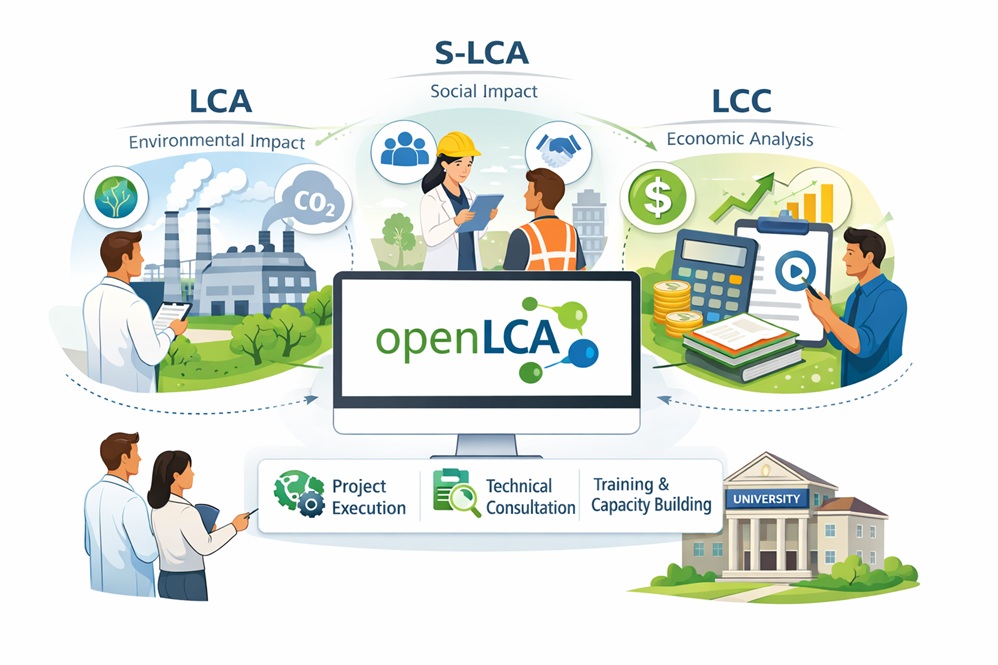
openLCA-based integrated solution, combining LCA, S-LCA, and
Life Cycle Costing (LCC) within a single structured modeling environment.
The solution is specifically designed for funded academic projects and is available through three engagement models:
full project execution, technical consultation, and
training-based capacity building.
For both training and project execution, clients must have access to the required openLCA-compatible databases, such as
ecoinvent for environmental modeling and an appropriate
social life cycle assessment database (e.g., social hotspot database) for the social dimension.
Life Cycle Sustainability Assessment (LCSA) for Funded Academic Projects
Integrated environmental, social, and economic assessment for research institutions, university-led consortia, grant-funded initiatives, and interdisciplinary sustainability programs.
DEISO supports advanced Life Cycle Sustainability Assessment (LCSA) projects by combining Life Cycle Assessment (LCA), Social Life Cycle Assessment (S-LCA), and Life Cycle Costing (LCC) into a structured analytical framework suitable for funded academic research, institutional studies, and decision-oriented sustainability evaluation.
This page is specifically designed for funded academia projects that require methodological depth, technical clarity, interdisciplinary integration, and a credible execution pathway through project delivery, expert consultation, or training-based capacity building.
Environmental Dimension — LCA
Quantifies environmental impacts across the life cycle, including materials, energy, emissions, and system-boundary decisions.
Social Dimension — S-LCA
Assesses stakeholder-related social risks, social hotspots, and qualitative or semi-quantitative impacts across supply chains and life cycle stages.
Economic Dimension — LCC
Evaluates life cycle cost structures, financial trade-offs, ownership implications, and economic scenarios to support decision-making.
What Is Life Cycle Sustainability Assessment (LCSA)?
Life Cycle Sustainability Assessment (LCSA) is an integrated analytical framework that combines three core dimensions of sustainability assessment across a product, system, technology, or service life cycle:
Environmental Assessment
Through LCA, environmental burdens are quantified using structured life cycle modeling, impact categories, inventory logic, and methodological assumptions aligned with recognized standards.
Social Assessment
Through S-LCA, social conditions, stakeholder-related risks, and supply-chain or community-level social implications are examined using an explicit social assessment logic.
Economic Assessment
Through LCC, cost structures and economic trade-offs are evaluated across the life cycle to support more realistic and decision-relevant sustainability analysis.
Why LCSA Is Especially Relevant for Funded Academic Projects
Interdisciplinary Research Fit
LCSA is highly suitable for research programs that must combine environmental science, social analysis, economics, engineering, and policy-oriented decision support within a single coherent framework.
Grant and Program Alignment
Funded projects increasingly require broader sustainability framing beyond environmental-only metrics. LCSA enables stronger justification of research relevance, societal value, and practical outcomes.
Decision-Relevant Outputs
LCSA can support publication, policy discussion, technology comparison, scenario analysis, and institutional sustainability strategy by combining the three dimensions into one structured study logic.
Advanced Capability Building
For research groups and university labs, LCSA also functions as a powerful capacity-building pathway, enabling teams to strengthen methodological competence beyond conventional LCA-only projects.
Who This Page Is Designed For
Funded Academic Research Teams
University-led projects, principal investigators, postdoctoral teams, interdisciplinary labs, and research consortia seeking methodological support or execution capability for LCSA-related work.
Grant-Supported Sustainability Projects
Projects financed through national, international, bilateral, or institutional funding schemes where LCSA is relevant to research design, technology assessment, policy evaluation, or applied sustainability analysis.
Research Centers and Institutes
Centers focusing on sustainability, industrial ecology, environmental management, circular economy, climate policy, responsible innovation, or socially informed product-system assessment.
University Capacity-Building Programs
Departments and institutions seeking structured training or technical consultation to establish or expand internal capability in LCA, S-LCA, LCC, and integrated LCSA methodology.
Three Engagement Models for LCSA Projects
Full Project Execution
DEISO can execute the full LCSA project as a technical partner or external specialist, depending on scope and project structure.
- Goal and scope definition
- LCA, S-LCA, and LCC methodological design
- Model structuring and data architecture
- Scenario development and comparative analysis
- Interpretation, reporting, and research support
Technical Consultation
For teams already conducting research internally, DEISO can provide consultation to improve study design, validate logic, and solve technical issues during project development.
- Methodology selection and refinement
- Boundary and functional-unit review
- S-LCA and LCC integration guidance
- Database and modeling strategy support
- Technical review before submission or publication
Training & Capacity Building
DEISO can train academic teams, faculty members, researchers, and graduate students to build internal competence in LCSA methodology and applied modeling workflows.
- LCA, S-LCA, and LCC fundamentals or advanced topics
- Institution-specific training design
- Software-based workflows where applicable
- Research-oriented hands-on capacity building
- Methodological coaching for funded projects
Technical Areas DEISO Can Support Within LCSA Projects
Environmental Assessment Scope
System boundaries, inventory logic, functional unit definition, allocation rules, impact assessment choices, scenario comparison, and interpretation quality.
Social Assessment Scope
Stakeholder categories, subcategory logic, social hotspot screening, indicator selection, supply chain social risk interpretation, and social results framing.
Economic Assessment Scope
Life cycle cost categories, cost structure mapping, sensitivity analysis, financial scenarios, ownership implications, and cost comparison logic.
Integration Design
Alignment of environmental, social, and economic dimensions into one coherent framework without methodological confusion or inconsistent interpretation.
Research and Reporting Logic
Interpretation structure, results framing, methodological transparency, defensibility of assumptions, and readiness for publication or grant reporting.
Institutional Capacity Support
Helping research teams develop internal capability so LCSA can be reproduced, extended, and scaled in future academic work.
Important Positioning and Service Boundaries
- DEISO provides technical execution, advisory, methodological support, independent review, and training support for LCSA-related work.
- DEISO does not act as a certification body, verification body, or formal academic accrediting institution.
- The exact LCSA structure should be defined according to research objectives, data availability, funding scope, and methodological appropriateness.
- Some projects may require phased execution, especially where social assessment and life cycle costing dimensions are still under development.
- For funded academic projects, the most suitable engagement model may be full execution, consultation, training, or a hybrid structure.
Why Work with DEISO on LCSA Projects
Rare Integrated Capability
Very few providers are positioned to address LCA, S-LCA, and LCC together in a coherent and technically credible way. DEISO is built for this level of integrated sustainability work.
Suitable for Advanced Research Environments
DEISO’s service structure is well aligned with academic and research-driven projects that require methodological rigor, technical nuance, and high-quality interdisciplinary framing.
Flexible Engagement Structure
Whether your funded project requires a full external partner, a specialist technical advisor, or institutional training support, the engagement can be adapted accordingly.
Strategic and Technical Orientation
DEISO combines technical depth with decision-oriented thinking, helping research projects produce not only robust methodology but also outputs that are relevant and usable.
Discuss Your Funded LCSA Project with DEISO
If your academic or grant-funded project requires support in Life Cycle Sustainability Assessment (LCSA) through LCA, Social LCA (S-LCA), and Life Cycle Costing (LCC), DEISO can help define the most suitable engagement model for execution, consultation, or training.
Important Technical Requirement — This LCA + S-LCA + LCC Bundle Is Based on openLCA
This integrated bundle is executed using openLCA software for both training delivery and project execution. The bundle is structured around the openLCA environment because it enables the integration of environmental life cycle assessment (LCA), social life cycle assessment (S-LCA), and life cycle costing (LCC) workflows within one consistent modeling framework.
For Training Engagements
Clients must have access to the required openLCA-compatible project database, such as ecoinvent, in order to participate effectively in the bundled LCA and LCC training workflow.
For Project Execution
Clients must provide or obtain the required background database, such as ecoinvent, for environmental modeling and LCC-related implementation within openLCA.
For Social Life Cycle Assessment
Clients must also have an appropriate S-LCA database, such as a social hotspot database, to support the social assessment dimension of the bundle within openLCA.
In summary: this full bundle is designed as an openLCA-based integrated solution. Database availability is an essential technical requirement for bundled training and project execution.
Life Cycle Sustainability Assessment (LCSA) Case Study
Life Cycle Sustainability Assessment (LCSA) Case Study
Explore a comprehensive illustrative Life Cycle Sustainability Assessment (LCSA) of an integrated municipal waste management system, designed to demonstrate how environmental, social, and economic performance can be evaluated within one coherent decision framework.
This case study combines three advanced analytical layers: Life Cycle Assessment (LCA), Social Life Cycle Assessment (S-LCA), and Life Cycle Costing (LCC). It shows how DEISO structures sustainability intelligence through clear system boundaries, quantified hotspots, stakeholder risk analysis, cost concentration, recovery value, and scenario-ready interpretation.
Built for conversion and credibility, this illustrative case is supported by three comprehensive dashboards featuring quantified indicators, percentages, comparative insights, and performance visuals across all three dimensions of sustainability.
What the Three Dashboards Demonstrate
- Quantified sustainability trade-offs across treatment, recovery, and disposal pathways
- Convincing executive visuals with percentages, values, and stakeholder-oriented interpretation
- Decision-ready structure suitable for funded academia, municipalities, and public-sector research
Start Your Life Cycle Sustainability Assessment (LCSA) Project
Move from fragmented analysis to a structured, integrated sustainability framework. Engage DEISO to evaluate your project, define the optimal methodology, and implement LCSA across environmental, social, and economic dimensions.
Share this:
- Email a link to a friend (Opens in new window) Email
- Share on LinkedIn (Opens in new window) LinkedIn
- Share on X (Opens in new window) X
- Share on Facebook (Opens in new window) Facebook
- Share on WhatsApp (Opens in new window) WhatsApp
- Share on Reddit (Opens in new window) Reddit
- Print (Opens in new window) Print
- More