
Life cycle assessment (LCA) expert training program — offsite training in Japan
Hands-on LCA practice at expert level, run offsite in Japan over five business days — taking participants from methodology fundamentals through to consequential LCA, uncertainty analysis, and scenario development.This training program is offered on-site or off-site only.
LCA expert training program — offsite, in Japan
This intensive, hands-on 전과정평가(LCA) training program, run offsite in Japan at expert level, equips participants with the knowledge and skills needed to conduct complete LCA studies. The program covers the fundamental principles of LCA, the ISO 14040/44 standards, and advanced techniques for data collection, modelling, interpretation, and communication of results.
Through a mix of theoretical instruction, practical case studies, and hands-on exercises, participants build proficiency in applying LCA methodology to real-world scenarios, from product development and eco-design through to sustainability assessment.
The program is built to take participants with a basic understanding of environmental science to an advanced level of LCA expertise. It emphasises practical application and uses a blended learning approach to strengthen retention. The training also goes into advanced topics such as consequential LCA, uncertainty analysis, and scenario development, preparing participants for complex LCA work.
It closes on communicating LCA results to different audiences, letting those audiences make informed decisions about sustainability improvements.
참가자가 수행할 수 있는 업무
On completing this training program, participants will be able to:
- Understand and apply the principles and framework of LCA as defined by ISO 14040/44
- Conduct a complete LCA study, from goal and scope definition through to interpretation and reporting of results
- Collect and manage life cycle inventory (LCI) data, including supply chain data
- Model environmental impacts using various LCIA methods
- Perform sensitivity analysis, uncertainty analysis, and scenario development
- Interpret LCA results and communicate them to stakeholders
- Apply LCA across multiple applications, such as product development, eco-design, and policy analysis
- Understand the different types of LCA, including attributional and consequential LCA
Prerequisites, duration, and certification
Participants need a basic understanding of environmental sciences, environmental engineering, or sustainability. No prior knowledge of 전과정평가(LCA) is required.
Five business days, from 9:00 to 15:00 Japan time.
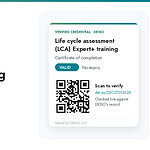
The certificate recognises completion of the DEISO training program and its assessment. It is not a formal accreditation, and DEISO is not a certification or verification body. The examination is optional and carries an additional fee. It is pass or fail, two attempts are allowed, and the passing score is 50 per cent.
What sets this training apart
- The trainer — run by a PhD-level expert LCA trainer
- Complete curriculum — covers the entire LCA process, from basic principles to advanced techniques, including attributional and consequential LCA
- Practical focus — hands-on learning through case studies, exercises, and real-world applications
- Expert instructors — experienced LCA professionals guide participants through the program
- ISO 14040/44 alignment — the training follows the international standards for LCA, so participants learn recognised practice
- Data collection and management — practical training on collecting and managing LCI data, including supply chain data collection templates
- LCA software and databases — introduces participants to relevant LCA software and databases
- Communication and visualisation — focuses on communicating LCA results through visualisation techniques
- Advanced topics — uncertainty analysis, sensitivity analysis, scenario development, and trade-off analysis
Curriculum and features
- 영어 교육 — the program is conducted entirely in English
- Optional examination and training certificate (paid) — participants can opt for the certification exam and certificate for an additional fee
- 심화 교육 — in-depth coverage of LCA principles and practice
- 가속 학습 방식 — a blended learning approach that strengthens retention
- Theoretical case studies — LCA concepts illustrated through real-world cases
- Theoretical and practical training — combines theoretical knowledge with practical application
- Zero to hero LCA — built to take participants from beginner to proficient LCA practitioner
- LCA modelling — covers various LCA modelling techniques
- LCA data training — hands-on training on LCI data collection and management
- Advanced life cycle assessment case study — explores complex LCA cases
- Attributional life cycle assessment (ALCA) — assessing the environmental impacts associated with a specific product or service
- Consequential life cycle assessment (CLCA) — examining the potential environmental consequences of decisions or system changes
- How to communicate your LCA results — guidance on communicating LCA findings to different audiences
- How to visualise LCA results — techniques for building clear visualisations of LCA data
- How to collect supply chain data — practical strategies for gathering data from supply chains
- Supply chain data collection template (Excel) — a prepared template for organising supply chain data
- ISO 14040 demonstration — the application of the ISO 14040 standard
- ISO 14044 demonstration — the application of the ISO 14044 standard
- Sensitivity analysis — assessing the effect of data variation on LCA results
- Uncertainty analysis — methods for quantifying and managing uncertainty in LCA
- Trade-off analysis — evaluating environmental trade-offs in decision-making
- Scenario development (what-if analysis) — building and analysing different scenarios
- Carbon footprint — calculating and interpreting carbon footprints
- Types and assessment of CO₂ emissions — different types of CO₂ emissions and their assessment
- Water footprint — the concept of water footprint and its assessment
- GHG emissions scopes 1–3 — the different scopes of greenhouse gas emissions
- Global warming potential (climate change) assessment — assessing climate change impacts
- LCA manual calculations: linear approach — manual LCA calculations using a linear approach
- LCA manual calculations: matrix approach — manual LCA calculations using a matrix approach
- Manual calculations with Microsoft Excel — performing LCA calculations in Excel
- Midpoint modelling — the concept of midpoint impact assessment
- Endpoint modelling — the concept of endpoint impact assessment
- Unit process versus system process — the difference between unit and system processes
- Dealing with multi-output processes — methods for handling multi-output processes in LCA
- Allocation methods — different allocation methods for multi-output processes
- The cut-off method — the cut-off method for simplifying LCA studies
- System expansion — the system expansion method for handling multi-functionality
- Types of LCI data and databases — different LCI data sources and databases
- General principles of LCA — the fundamental principles of LCA
- Principles of system modelling — the principles of defining system boundaries
- Advanced topics on LCA — advanced LCA concepts and applications
- The four phases of LCA — the four phases of an LCA study in detail
- 시스템 경계 — how to define system boundaries in LCA
- Step-by-step procedures for performing an LCA — a step-by-step guide to conducting an LCA
- System function — the concept of system function in LCA
- Functional unit and reference unit — the importance of functional units in LCA
- Inventory analysis — the process of conducting a life cycle inventory analysis
- Input and output inventory — how to compile an input/output inventory
- Process calculations of inventory — performing calculations for LCI
- LCA databases — the main LCA databases in use
- Step-by-step procedure of inventory analysis — a detailed guide to conducting an LCI
- LCA steps: classification — the classification step in LCIA
- LCA steps: characterisation — the characterisation step in LCIA
- LCA optional steps: normalisation — the optional normalisation step in LCIA
- LCA optional steps: weighting — the optional weighting step in LCIA
- LCA optional steps: grouping — the optional grouping step in LCIA
- Analysis of inventory results — how to analyse LCI results
- Analysis of life cycle impact assessment (LCIA) results — how to analyse LCIA results
- Life cycle impact assessment (LCIA) methods — the main LCIA methods
- The CML method — the CML LCIA method in detail
- The IMPACT 2002+ method — the IMPACT 2002+ LCIA method in detail
- ReCiPe 2008/2016 LCIA method — the ReCiPe LCIA method in detail
- IMPACT World+ — the IMPACT World+ LCIA method in detail
- Flowcharts and process flow diagrams (PFD) — how to build flowcharts and PFDs for LCA
- Final results interpretation — how to interpret final LCA results
- LCA applications — the range of LCA applications
- Calculation by hand versus using software — the trade-offs between manual and software-based LCA calculation
- Guideline for the correct use of LCA software — guidelines for using LCA software well
- Data availability and LCA software selection — data availability and software selection criteria
- Applications to product comparisons — using LCA for product comparisons
- Applications to eco-design — applying LCA to eco-design
- Sustainability assessment — the role of LCA in sustainability assessment
프로젝트에 적합한 서비스를 찾기 어려우신가요?
범위, 일정 및 목표 성과를 알려주세요 — DEISO 적합한 서비스를 안내하거나 업무 범위를 직접 설정해 드립니다.