


DEISO Enterprise Life Cycle Assessment (LCA) Services
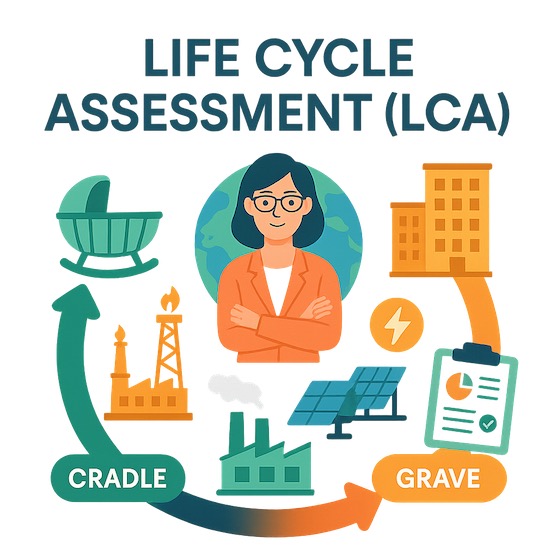

🌍 Life Cycle Assessment (LCA) Services — Globally Delivered by DEISO
At DEISO, Life Cycle Assessment is not a peripheral offering — it is a core technical discipline embedded in our consulting practice.
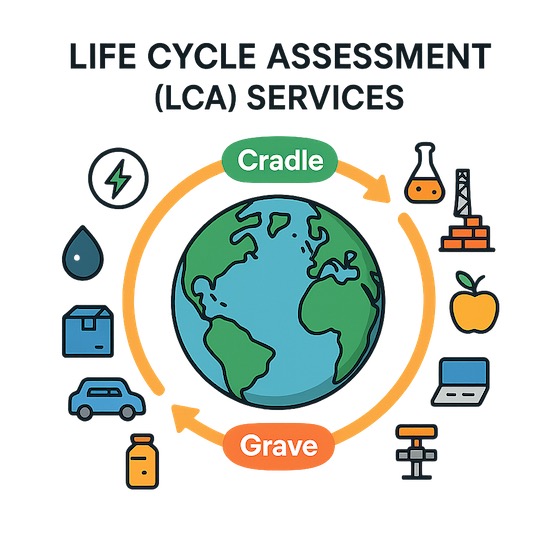
We deliver cradle-to-grave LCA studies across industries and geographies, covering products, systems, infrastructure, and complex energy assets. From emerging product lines to large-scale industrial and energy developments, our work is structured to support strategic decision-making, regulatory alignment, and investment-grade environmental disclosures.
Our LCA services are designed to provide:
ISO 14040 and ISO 14044–aligned modeling
Transparent system boundary definition and functional unit discipline
Data-driven impact quantification
Scenario analysis for strategic decision support
Audit-ready documentation suitable for third-party review
Whether assessing a single product or a multi-billion-dollar asset, DEISO delivers technically rigorous, defensible Life Cycle Assessments that translate environmental complexity into structured, decision-grade insight.
What We Offer — Full LCA Execution
We execute Life Cycle Assessment projects as structured technical engagements — from initial scoping to final interpretation and reporting.
Our role is not limited to modeling. We establish the methodological architecture, data governance framework, and documentation structure required for defensible results.
Scope of Services
End-to-end LCA studies (product, system, infrastructure, portfolio level)
Attributional LCA (ALCA) and Consequential LCA (CLCA) modeling
Comparative assessments and scenario analysis
Sensitivity and uncertainty evaluation
Critical review preparation and technical documentation support
Structured Support Across the Four LCA Phases
We provide technical leadership across all ISO 14040/14044 phases:
Goal & Scope Definition
Functional unit discipline, system boundary design, allocation logic, and stakeholder alignmentLife Cycle Inventory (LCI)
Primary data collection frameworks, supplier coordination, data validation, and traceability architectureLife Cycle Impact Assessment (LCIA)
Method selection, regionalization considerations, midpoint, and endpoint interpretationInterpretation
Hotspot analysis, scenario evaluation, consistency checks, and decision-support synthesis
Foreground & Background Data Governance
Structured foreground data acquisition and validation
Background dataset selection and alignment
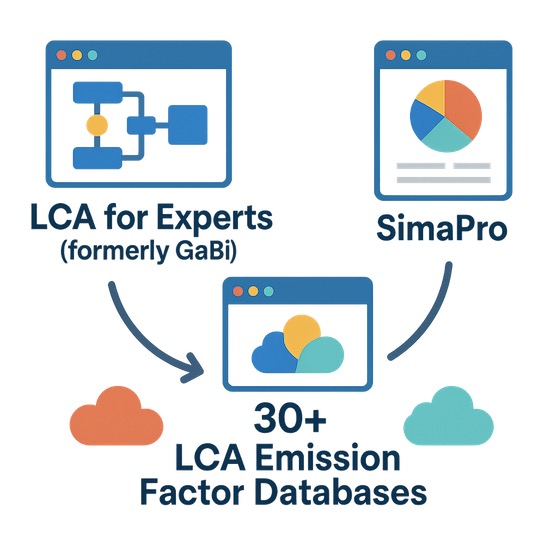
Emission factor integration from leading international databases (30+ sources, where relevant to project scope)
Documentation of assumptions and transparency of data limitations
Our objective is to deliver technically robust, traceable, and review-ready LCA results suitable for regulatory submission, disclosure frameworks, EPD development, and strategic investment decisions.
AI-Powered LCA Delivery
Advanced Life Cycle Assessment requires more than modeling capability. It requires data discipline, structural consistency, and the ability to extract strategic insight from complex environmental datasets.
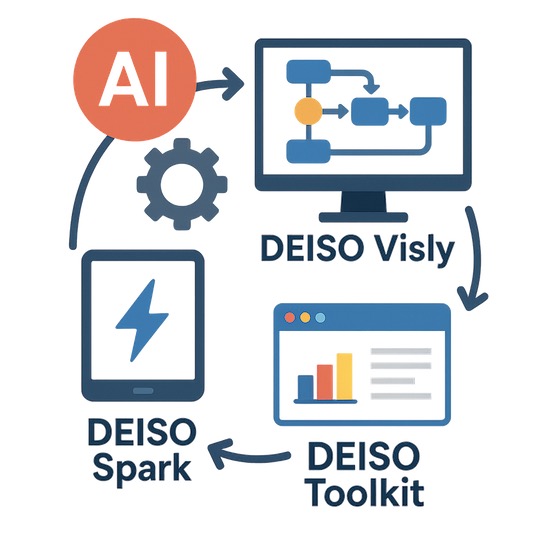
DEISO integrates proprietary AI-supported tools into LCA execution to enhance methodological rigor, analytical depth, and project efficiency. These systems support — but never replace — technical judgment.
DEISO Visly → Visualizes system boundaries and life cycle flows
DEISO Spark → Cleans and maps large emission factor datasets
DEISO AI → DESIO Data and Environmental Intelligence
Tools & Software We Master
Robust Life Cycle Assessment requires disciplined modeling environments and defensible dataset selection.
We operate across leading professional LCA platforms to ensure methodological alignment with client ecosystems, verification expectations, and regional regulatory contexts.
Core Modeling Platforms
LCA for Experts (formerly GaBi)
Advanced industrial modeling with structured database integration and sector-specific extensions.SimaPro
Widely used for product-level assessments, EPD development, and program operator-aligned studies.openLCA
Flexible, transparent modeling environment suitable for customized methodological architectures and region-specific adaptations.
Platform selection is determined by project scope, verification pathway, client requirements, and data compatibility — not preference.
Global Dataset & Inventory Integration
We model using internationally recognized emission factor datasets and regionally relevant inventories, including:
European background databases
North American inventories
MENA regional datasets
Asian industrial and energy datasets
Dataset selection is documented transparently, with justification aligned to functional unit definition, geographic representativeness, and temporal relevance.
The objective is not software proficiency alone — it is structured, reproducible modeling that withstands technical review and third-party scrutiny.
Industries We Serve
Our Life Cycle Assessment services support organizations operating in technically complex, regulation-sensitive, and investment-driven sectors.
We work with:
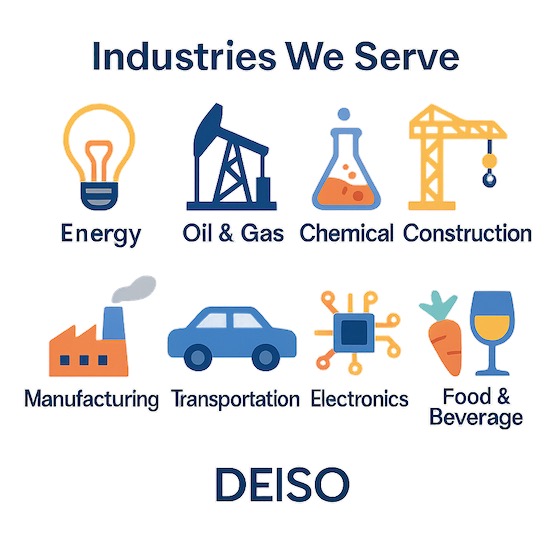
Energy & Renewables
Oil & Gas
Chemical & Process Industries
Construction & Building Materials
Automotive & Mobility Systems
Packaging & Materials Engineering
Healthcare & Medical Products
Electronics & Technology Manufacturing
Academia & Research Institutions
Governmental & Development Agencies
Engagements range from product-level assessments to infrastructure-scale evaluations, including portfolio-level environmental performance studies.
Our sector exposure enables:
Industry-specific system boundary design
Sector-relevant impact category prioritization
Alignment with regional regulatory frameworks
Integration into procurement, disclosure, and compliance systems
From East Asia to the Middle East and Europe, our LCA projects are delivered across jurisdictions requiring methodological rigor and regulatory alignment.
Global reach does not replace contextual understanding — each engagement is grounded in sector-specific technical realities and geographic representativeness.
ISO & Regulatory Alignment
Life Cycle Assessment must align with recognized international standards to ensure defensibility, comparability, and verification readiness.
Our LCA services are structured in accordance with the latest applicable versions of leading ISO and EN frameworks, including:
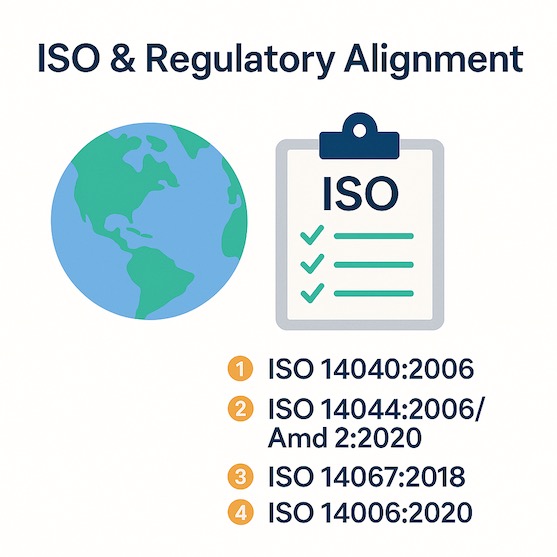
ISO 14040:2006 – Life Cycle Assessment: Principles and Framework
ISO 14044:2006 – Life Cycle Assessment: Requirements and Guidelines
ISO 14067:2018 – Carbon Footprint of Products
ISO 14025:2006 – Type III Environmental Declarations
EN 15804+A2:2019 – EPDs for Construction Products
ISO 21930:2017 – Environmental Product Declarations in Building & Construction
Standard alignment is embedded at the scoping stage — not applied retroactively.
Functional unit definition, system boundary design, allocation logic, impact method selection, and interpretation protocols are structured to meet formal compliance expectations from project initiation.
Compliance & Verification Readiness
Where LCA studies support EPD development or public disclosure, we guide clients through:
Methodological alignment with applicable Product Category Rules (PCRs)
Documentation architecture suitable for third-party review
Data traceability and transparency requirements
Pre-verification internal review preparation
Technical response coordination during external verification
Our objective is not only compliance, but structured readiness for audit, review, and formal publication.
When Life Cycle Assessment Becomes Critical
Life Cycle Assessment is not always a reporting requirement — but in many strategic contexts, it becomes essential.
Organizations typically initiate LCA when facing:
Entry into procurement markets requiring environmental documentation
Preparation for Environmental Product Declarations (EPDs)
ESG reporting and investor due diligence requirements
Regulatory submissions or compliance audits
Comparative evaluation of materials, technologies, or suppliers
Product redesign, decarbonization, or transition strategies
Cross-border market expansion requiring environmental transparency
In these scenarios, LCA shifts from optional analysis to a strategic necessity.
Early methodological clarity reduces later regulatory friction.
How Our LCA Engagements Are Structured
LCA projects are delivered through a defined, milestone-based structure to ensure transparency, accountability, and readiness for review.
1. Scoping & Alignment
Clarification of objectives and intended use
Functional unit and system boundary definition
Stakeholder alignment
Regulatory or disclosure pathway identification
2. Data Architecture & Collection
Structured primary data request framework
Supplier coordination (where applicable)
Background dataset selection and justification
Data validation and documentation
3. Modeling & Technical Review
ISO-aligned modeling execution
Scenario and sensitivity analysis (if required)
Interim review checkpoints
Alignment with disclosure or EPD objectives
4. Interpretation & Decision Support
Hotspot identification
Comparative analysis
Consistency and completeness checks
Strategic implications synthesis
5. Final Documentation & Optional Review Support
Structured LCA report
Technical annexes and data traceability documentation
Preparation for third-party critical review (if applicable)
Integration guidance for EPD, ESG, or disclosure frameworks
Each engagement is scoped according to project complexity, sector, and intended use.
Why DEISO
Selecting an LCA partner is a governance decision, not a procurement formality.
The credibility of results depends on methodological discipline, data architecture, and technical accountability.DEISO is chosen by organizations that require defensible, structured environmental analysis.
Established Consulting & Research Foundation
Built on formal LCA methodology, applied research exposure, and execution across regulated industries.International Delivery, Tokyo-Based Headquarters
Cross-jurisdictional project execution with regional awareness across Asia, Europe, and the Middle East.Integration of 30+ Emission Factor Databases
Structured background data selection and harmonization aligned with geographic and sectoral relevance.Structured, Expert-Led Communication
Direct interaction with technical leads — clear documentation, defined milestones, and accountable reporting.AI-Enhanced Analytical Workflows
Controlled use of proprietary tools to strengthen data governance, reduce modeling friction, and improve interpretative clarity.
Our role is not limited to producing impact numbers.
We deliver traceable analysis that withstands review, supports disclosure, and informs strategic decision-making.


Request a Project Scoping Discussion
If your organization is evaluating Life Cycle Assessment for regulatory, disclosure, or strategic purposes, we welcome a technical discussion.
📅 Schedule a remote meeting
💬 Discuss scope, software, timeline, and deliverables
📁 Share files to receive a fast-track proposal
📈 Get clarity on how LCA aligns with your ESG and sustainability KPIs
👉 https://dei.so/contact
📧 Or email: info@dei.soRequest a Project Scoping Discussion
Share this:
- Email a link to a friend (Opens in new window) Email
- Share on LinkedIn (Opens in new window) LinkedIn
- Share on X (Opens in new window) X
- Share on Facebook (Opens in new window) Facebook
- Share on WhatsApp (Opens in new window) WhatsApp
- Share on Reddit (Opens in new window) Reddit
- Print (Opens in new window) Print
- More