


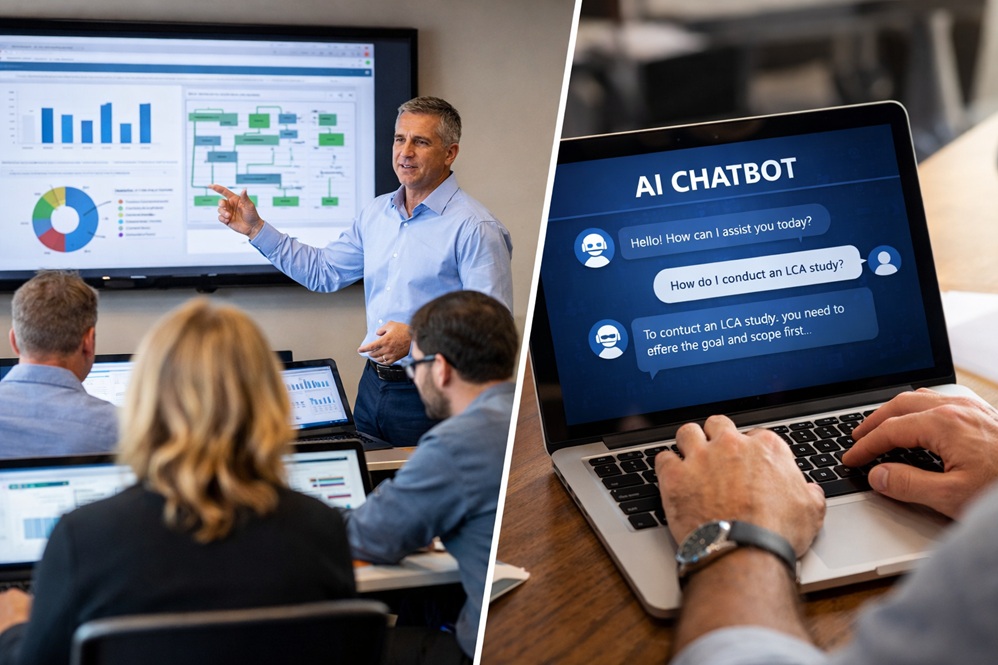
Why AI Cannot Replace Professional Training Programs and Courses — A Strategic Perspective for Organizations and Experts
The Rise of AI in Learning — and the Misconception It Creates
Artificial Intelligence is transforming how professionals access information. Tools powered by AI can explain concepts, summarize standards, and provide instant answers. However, a critical misconception has emerged in the market:
that AI can replace structured professional training programs.
For organizations operating in sustainability, engineering, ESG, and environmental management, this assumption is not only incorrect — it is strategically risky.
This article explains, with real-world examples, why AI cannot replace professional training programs, and why organizations that rely solely on AI will face capability gaps, compliance risks, and operational inefficiencies.
1. Training Delivers Structured Skill Transfer — AI Delivers Fragmented Information
What Happens in Real Training
Professional training programs are designed to transfer structured, sequential skills — from foundational understanding to advanced application. Trainers guide learners through a logical progression that builds competence step by step.
Why AI Fails Here
AI provides answers on demand, but it does not design or enforce a learning pathway. The result is fragmented knowledge without real capability development.
Real-World Example
An environmental engineer attempting to learn LCA modeling using AI may understand terms like “functional unit” or “system boundaries,” but fail to:
- Structure a complete product system
- Link foreground and background datasets correctly
- Interpret results for ISO 14040/44 compliance
In contrast, a structured training program ensures the engineer can build and deliver a full LCA study independently.
2. Knowledge Transfer Requires Context — AI Lacks Practical Interpretation
What Happens in Real Training
Expert trainers do not just provide knowledge — they translate it into real-world context, tailored to industries, regulations, and business objectives.
Why AI Fails Here
AI lacks situational awareness of:
- Industry-specific constraints
- Client expectations
- Regulatory nuances
- Data limitations in real projects
Real-World Example
A company preparing an Environmental Product Declaration (EPD) may use AI to understand EN 15804 requirements. However, without expert training, they may:
- Misinterpret system boundaries (A1–A3 vs A1–A5)
- Apply incorrect allocation rules
- Fail pre-verification checks
A trained professional avoids these costly errors through guided interpretation and applied learning.
3. Skill Building Requires Practice and Feedback — AI Cannot Evaluate Competence
What Happens in Real Training
Training programs involve:
- Hands-on exercises
- Live corrections
- Expert feedback loops
- Performance validation
Why AI Fails Here
AI cannot reliably assess whether a learner’s work is:
- Technically correct
- Compliant with standards
- Professionally acceptable for submission
Real-World Example
A trainee building a GHG Scope 3 inventory may incorrectly categorize emissions (e.g., confusing Category 1 vs Category 4).
AI may provide generic advice, but only an expert trainer can:
- Identify the exact error
- Explain why it is incorrect
- Correct the methodology in real time
This is the difference between learning concepts and building professional competence.
4. Face-to-Face Interaction Enables Adaptive Learning — AI Cannot Personalize at Depth
What Happens in Real Training
In professional training environments, the trainer continuously adapts:
- Adjusts pace based on learner progress
- Simplifies or deepens explanations
- Responds to confusion instantly
- Aligns content with trainee background
Why AI Fails Here
AI does not truly understand:
- Cognitive load
- Learning style
- Professional experience level
Real-World Example
During a SimaPro training session, a beginner may struggle with:
- Process tree structures
- Parameterization
- Impact assessment methods
An expert trainer will immediately:
- Pause the session
- Reframe the explanation visually
- Provide a simplified example
AI cannot dynamically adjust training delivery at this level of precision.
5. Complex Technical Software Requires Expert Guidance — AI Cannot Replace Hands-On Training
Critical Reality
Advanced software tools such as:
are not theoretical systems — they are professional engineering environments.
Why AI Fails Here
AI cannot:
- Navigate real project datasets
- Debug modeling errors in software
- Guide workflow execution step-by-step
- Train users on interface logic and advanced features
Real-World Example
A company attempting to model a Product Carbon Footprint (PCF) using openLCA may face:
- Database mismatches
- Incorrect process linking
- Impact calculation inconsistencies
Without expert training, the model becomes unreliable — even if AI explanations are correct in theory.
This is where professional training becomes indispensable.
6. Training Transfers Experience — AI Does Not Deliver Professional Judgment
The Missing Element: Experience
The most critical gap in AI-driven learning is the absence of experience-based judgment.
What Trainers Deliver
- Lessons learned from real projects
- Common pitfalls and how to avoid them
- Decision-making frameworks under uncertainty
- Industry best practices
Real-World Example
In an ESG reporting project, choosing between:
- Screening data
- Hybrid LCA
- Supplier-specific data
is not a theoretical decision — it requires experience, trade-offs, and strategic judgment.
AI cannot make this decision reliably. An experienced trainer can.
7. Accountability and Certification Readiness — AI Cannot Guarantee Outcomes
What Organizations Actually Need
Organizations do not need “information.” They need:
- Competent teams
- Audit-ready outputs
- Confidence in deliverables
Why AI Fails Here
AI provides no accountability for:
- Errors
- Compliance failures
- Submission rejection
Real-World Example
A failed EPD submission or incorrect GHG inventory can result in:
- Financial losses
- Project delays
- Reputation damage
Professional training ensures teams are prepared to deliver correctly the first time.
Conclusion — AI Is a Tool, Not a Substitute for Professional Training
AI is a powerful assistant. It enhances productivity and accelerates access to information.
But it does not:
- Build structured skills
- Transfer real-world knowledge
- Develop professional competence
- Provide expert judgment
- Ensure compliance and accuracy
Organizations that replace training with AI will not reduce costs — they will increase risk.
The future is not AI versus training.
The future is AI + expert-led training.
Advance Your Expertise with DEISO Professional Training Programs
DEISO delivers high-impact, expert-led training in:
- Life Cycle Assessment (LCA)
- GHG Accounting (Scope 1, 2, 3)
- Environmental Product Declarations (EPDs)
- SimaPro, GaBi, and openLCA software
All programs are designed for professionals, consultants, and organizations seeking real capability development — not just theoretical knowledge.
Explore Training Programs
Explore DEISO’s full training portfolio and identify the program that aligns with your goals, experience level, and technical requirements.
Explore Training ProgramsTraining Case Studies
Explore real-world training engagements delivered by DEISO, showcasing how professionals and organizations build practical, verification-ready sustainability capabilities.
View Case Studies →Ask AI About a Training Program
Get instant guidance and explore specific training programs by chatting directly with the DEISO AI assistant.
Ask DEISO AIWhy DEISO Training
Understand why organizations choose DEISO for expert-led, practical, and globally delivered training programs.
Why DEISO TrainingWhat Makes DEISO Training Premium?
Discover DEISO’s premium delivery model, advanced training methods, and globally trusted expertise.
Discover Premium TrainingTraining FAQ
Review key details about delivery formats, scheduling, certification, and program structure.
View FAQRequest a Training Quotation
Ready to proceed? Request a quotation tailored to your selected training program and delivery format.
Request a QuotationNeed Help Choosing the Right Training?
Schedule a consultation to receive expert guidance and select the most suitable training program.
Schedule ConsultationShare this:
- Email a link to a friend (Opens in new window) Email
- Share on LinkedIn (Opens in new window) LinkedIn
- Share on X (Opens in new window) X
- Share on Facebook (Opens in new window) Facebook
- Share on WhatsApp (Opens in new window) WhatsApp
- Share on Reddit (Opens in new window) Reddit
- Print (Opens in new window) Print
- More