



Download the DEISO EPD Data Collection Framework Template (A1–D) for Client-Ready Use
Download the DEISO EPD Framework-Template
Access DEISO’s structured EPD Framework-Template designed to support organized data collection, stronger documentation quality, and better preparation for EPD development and verification readiness workflows.
v1.0
March 26, 2026
Why This Framework Exists
Many Environmental Product Declarations (EPDs) fail or face delays during verification not because of calculation errors, but due to weak data structure, inconsistent system boundaries, poor data quality, and lack of methodological transparency.
This framework is designed to address these challenges at the data collection stage — where most critical issues originate.
What This Framework Enables
- Structured data collection aligned with EPD modules (A1–D)
- Clear distinction between primary, secondary, and proxy data
- Early identification of data gaps and inconsistencies
- Improved traceability and documentation readiness
- Alignment with ISO 14025 and PCR-based reporting requirements
Why It Is Needed
- Most EPD delays originate from poor data structuring
- Verification bodies focus heavily on transparency and justification
- Proxy data and weak assumptions often lead to verification findings
- Unclear system boundaries create inconsistencies across modules
Key Advantages
- Mirrors verifier expectations and review structure
- Highlights high-risk areas before submission
- Supports internal alignment across sustainability, engineering, and data teams
- Reduces costly rework and verification delays
- Transforms EPD preparation into a structured, audit-ready process
Designed for Professional Use
This framework is intended for organizations actively developing EPDs, conducting LCA studies, or preparing for verification and program operator submission.
| Sheet Name | Purpose |
|---|---|
| Lists | Contains dropdown values and controlled input options used across the workbook, including units, module categories, data source types, and representativeness levels. |
| Read_Me | Provides instructions for using the template, explains the overall workflow, and guides users on the intended sequence of data entry. |
| Project_Overview | Captures high-level project information such as company, product, intended purpose, study scope, geography, and readiness stage. |
| Product_Definition | Defines the assessed product, including functional unit, reference flow, product description, technical characteristics, and intended application. |
| System_Boundaries | Specifies which life cycle stages, modules, and processes are included or excluded, supporting consistency with PCR and ISO 14025 expectations. |
| BOM_Data | Collects bill of materials data, including raw materials, quantities, units, suppliers, origins, and source classifications for product composition modeling. |
| Process_Energy | Captures process-level operational inputs such as manufacturing steps, electricity use, fuel consumption, heat inputs, and related activity data. |
| Datasets_EmissionFactors | Documents selected datasets, databases, emission factors, versions, geography, and representativeness assumptions used in the assessment model. |
| Data_Quality | Evaluates data quality across temporal, geographical, and technological representativeness, as well as completeness and reliability, to support defensible verification. |
| Allocation_Logic | Records allocation methods applied to shared processes, co-products, recycled content, or energy flows, together with methodological justification. |
| Impact_Mapping | Maps the selected LCIA method and required impact categories to the relevant PCR or EPD reporting requirements. |
| EPD_Draft | Supports drafting of the EPD reporting structure, including product description, declared unit, boundary notes, results summary, and key technical disclosures. |
| EPD_Modules_Data | Provides a pre-structured module-level data collection sheet covering A1–A5, B1–B7, C1–C4, and D. It allows users to capture process/activity data, quantities, units, functional unit references, data source types, source descriptions, geography, time period, technological representativeness, data quality scores, verification risk flags, and supporting notes at the life cycle module level. |
| Verification_Risk_Flags | Highlights likely verification risks such as missing data, proxy dependence, low-quality inputs, unsupported assumptions, incomplete documentation, or weak methodological transparency. |
| DEISO_Audit_CTA | Introduces DEISO’s independent pre-submission audit and advisory support, guiding users toward technical review before EPD verification or program operator submission. |
Download the EPD Data Collection Framework Template (A1–D)
Access a professional, client-ready framework designed to structure EPD data collection across A1–D modules, aligned with ISO 14025 and PCR requirements.
Start Structuring Your EPD Data
Download the full framework and begin organizing your data immediately for verification-ready EPD development.
Get Updates & Expert Guidance (Optional)
Receive advanced insights and updates designed for professionals actively developing EPDs:
- Updated versions of the framework
- Verification risk insights and common findings
- Best practices for A1–D data structuring
- Advanced EPD and LCA methodology updates
Optional. Intended for professionals working on active EPD or LCA projects.
What Is the DEISO EPD Data Collection Framework?
The DEISO EPD Data Collection Framework is a structured system designed to help organizations collect, organize, and manage all data required for Environmental Product Declaration (EPD) development.
Instead of treating EPD preparation as a fragmented or ad hoc process, this framework provides a step-by-step, logic-driven structure that aligns with:
- ISO 14025 requirements
- Product Category Rules (PCRs)
- Life Cycle Assessment (LCA) methodology
It ensures that all required information—from raw materials to final reporting—is captured in a consistent, transparent, and verification-ready format.
Why This Framework Matters
In practice, most EPD challenges do not come from calculations—they come from:
- Poor data organization
- Missing or inconsistent inputs
- Unclear system boundaries
- Weak documentation and assumptions
The DEISO framework addresses these issues at the source: the data collection stage.
By structuring data correctly from the beginning, it prevents:
- Verification delays
- Rework and corrections
- Loss of credibility during review
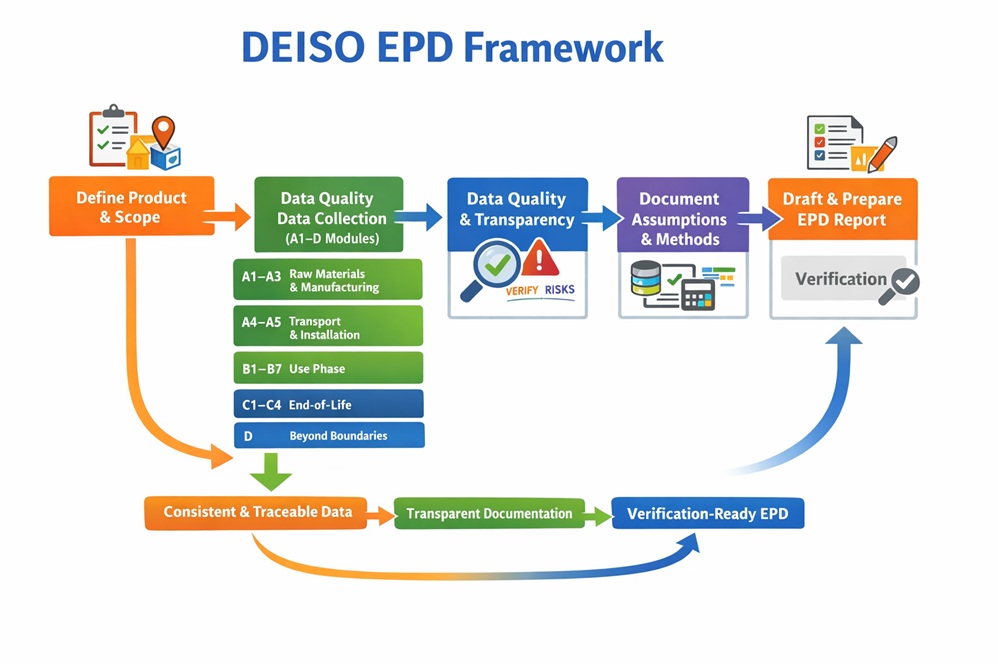
How the Framework Works (Simple View)
The framework follows a logical workflow from definition → data collection → validation → reporting:
1. Define the Product and Scope
You start by clearly describing:
- What product is assessed
- What functional unit is used
- What system boundaries apply
This ensures alignment with PCR and avoids scope inconsistencies later.
2. Collect Structured Data (A1–D Modules)
All data is organized according to life cycle stages:
- A1–A3: Raw materials and manufacturing
- A4–A5: Transport and installation
- B1–B7: Use phase
- C1–C4: End-of-life
- D: Benefits beyond system boundaries
Each dataset includes:
- Quantities and units
- Data source (primary, secondary, proxy)
- Geography and time period
- Quality and representativeness
This creates complete traceability for every data point.
3. Ensure Data Quality and Transparency
The framework requires users to:
- Score data quality (1–5)
- Indicate representativeness (high/low)
- Flag risks (e.g., proxy use, missing data)
This step is critical because verification bodies evaluate transparency as much as results.
4. Document Assumptions and Methods
Key methodological elements are recorded, including:
- Allocation rules
- Dataset selection
- Emission factors
- Impact assessment methods
This ensures that every assumption is:
- Justified
- Traceable
- Defensible during verification
5. Prepare the EPD Structure
The framework directly supports drafting:
- Product description
- System boundaries
- Results summary
- Technical disclosures
This means your EPD is not built from scratch—it is assembled from already structured data.
What Makes This Framework Different
- Mirrors how verifiers review EPDs
- Highlights risks before submission
- Enforces consistency across all modules
- Integrates data quality into the workflow
- Supports both consultants and internal teams
It transforms EPD development into a controlled, audit-ready process rather than a reactive exercise.
Who Should Use This Framework
This framework is ideal for:
- Companies preparing EPDs for products
- Sustainability and LCA teams
- Consultants managing EPD projects
- Organizations preparing for third-party verification
It is especially valuable when:
- Multiple teams are involved
- Data comes from different sources
- Verification readiness is critical
In One Sentence
The DEISO EPD Framework is a professional system that turns complex, scattered EPD data into a structured, transparent, and verification-ready workflow.
Advance Your EPD Development & Verification Readiness
Subscribe for Framework Updates & EPD Insights
Get access to the latest versions of the EPD Data Collection Framework and expert-level guidance on structuring A1–D modules for verification readiness.
Receive practical insights on common verification issues, data quality risks, and methodological gaps identified in real EPD reviews — before they impact your submission.
Stay informed on DEISO’s EPD services, audit approaches, and advanced sustainability methodologies supporting high-quality, verification-ready environmental declarations.
Explore DEISO’s Environmental Product Declaration (EPD) Services Hub
Access DEISO’s integrated EPD ecosystem in one place—from EPD development support and pre-submission audit to professional training and structured data collection tools for verification readiness. Explore the hub to identify the right pathway for strengthening product environmental communication, improving documentation quality, and advancing ISO-aligned EPD preparation.
Share this:
- Email a link to a friend (Opens in new window) Email
- Share on LinkedIn (Opens in new window) LinkedIn
- Share on X (Opens in new window) X
- Share on Facebook (Opens in new window) Facebook
- Share on WhatsApp (Opens in new window) WhatsApp
- Share on Reddit (Opens in new window) Reddit
- Print (Opens in new window) Print
- More