

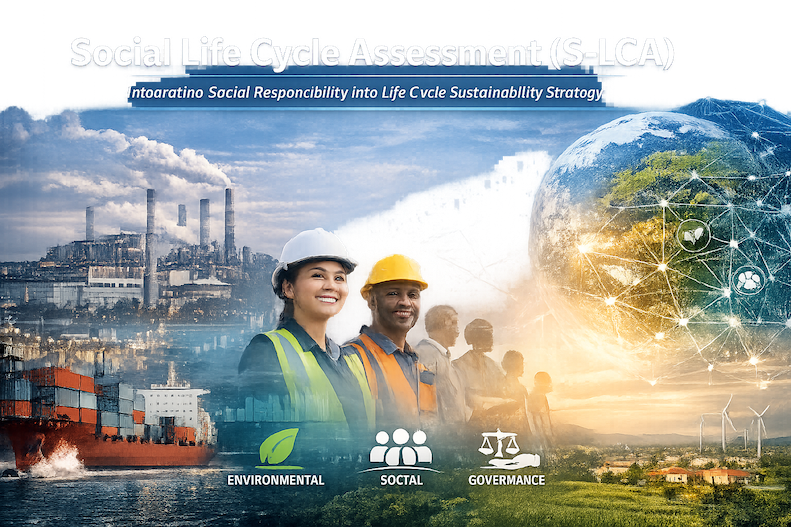
Social Life Cycle Assessment S-LCA
Integrating Social Responsibility into Life Cycle Sustainability Strategy

Why Environmental LCA Alone Is Not Enough
For more than two decades, organizations have relied on Environmental Life Cycle Assessment (LCA) to measure carbon footprints, resource use, and environmental impacts across product systems.
Environmental LCA is essential — but it does not tell the full sustainability story.
A product with a low carbon footprint can still:
- Be produced under unsafe labor conditions
- Depend on suppliers with weak human rights practices
- Create socio-economic disruption in local communities
- Expose your organization to reputational and regulatory risk
Sustainability today is no longer defined only by emissions and resource efficiency. Investors, regulators, and customers increasingly expect visibility into how products are made, not just how much they emit.
This is where Social Life Cycle Assessment (S-LCA) becomes strategic.
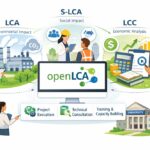
S-LCA complements Environmental LCA by evaluating the social and socio-economic impacts embedded within supply chains and product systems. Together, they create a more resilient and future-ready sustainability strategy.
In an era of increasing transparency, social impact is no longer optional.
What Is Social Life Cycle Assessment (S-LCA)?
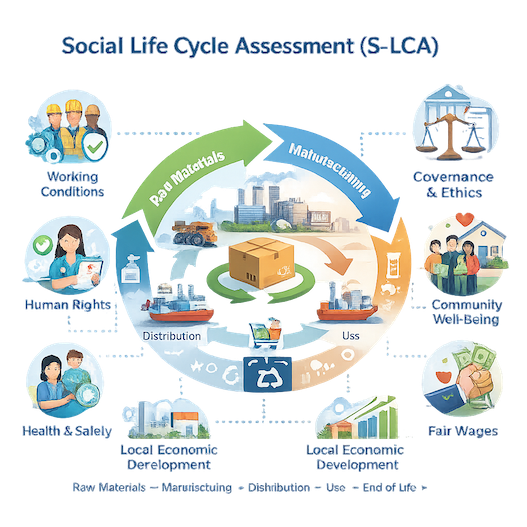
Social Life Cycle Assessment (S-LCA) is a structured methodology for evaluating the social and socio-economic impacts of a product’s life cycle.
While Environmental LCA measures emissions and resource use, S-LCA examines how business activities affect people — workers, communities, consumers, and other stakeholders across the supply supply chain.
It provides systematic insight into areas such as:
- Labor conditions and worker rights
- Health and safety performance
- Community well-being
- Supply chain social risk exposure
- Socio-economic value creation
S-LCA transforms social responsibility from qualitative statements into structured, decision-support information.
Why S-LCA Matters Now
Regulatory Pressure, ESG Expectations & Supply Chain Risk
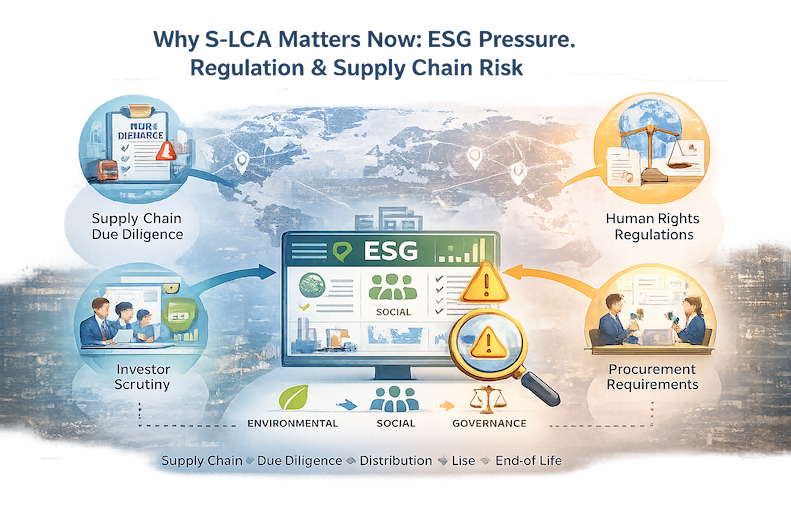
Sustainability expectations have shifted. Carbon disclosure is no longer sufficient. Investors, regulators, and customers increasingly scrutinize how companies manage social risk within their value chains.
Environmental metrics show performance. Social metrics reveal exposure.
Organizations today face growing pressure from:
ESG reporting frameworks requiring social transparency
Supply chain due diligence regulations
Investor scrutiny on human rights risk
Procurement requirements from multinational buyers
Public exposure through digital transparency
A single supplier-related incident — labor violations, unsafe conditions, or governance failures — can create reputational and financial consequences that outweigh environmental non-compliance risks.
S-LCA provides structured visibility into these vulnerabilities.
From Compliance to Strategic Risk Intelligence
S-LCA allows organizations to:
Identify social risk hotspots across suppliers
Prioritize high-risk tiers in the supply chain
Strengthen responsible sourcing policies
Support ESG disclosures with structured evidence
Prepare for evolving due diligence obligations
Rather than reacting to crises, companies can proactively manage risk exposure.
In today’s sustainability landscape, social performance is no longer a peripheral issue. It is a core governance concern.
Organizations that integrate S-LCA move from reactive compliance toward strategic resilience.
What Does S-LCA Evaluate?
Stakeholders, Impact Categories & Indicators
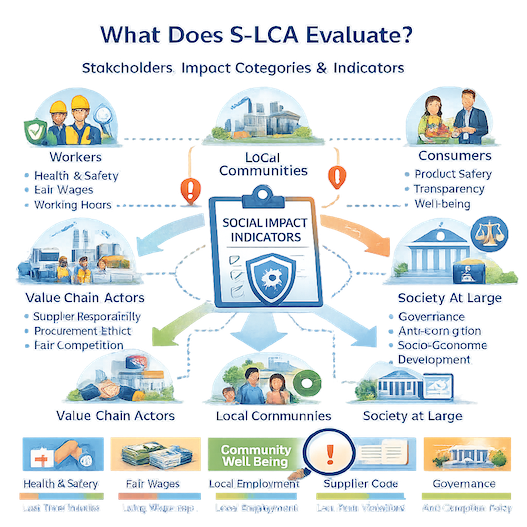
Social Life Cycle Assessment does not assess “society” in abstract terms.
It evaluates specific stakeholder groups, across defined life cycle stages, using structured social indicators.
This ensures analysis is measurable, comparable, and decision-relevant.
Key Stakeholder Groups
S-LCA typically evaluates impacts across five primary stakeholder categories:
• Workers
Occupational health & safety
Fair wages
Working hours
Freedom of association
Non-discrimination
• Local Communities
Access to resources
Community engagement
Local employment generation
Socio-economic development
• Value Chain Actors
Fair competition
Responsible procurement
Supplier transparency
• Consumers
Product safety
Transparency
Ethical marketing
• Society at Large
Contribution to economic development
Corruption prevention
Governance practices
This structured stakeholder lens ensures that risks are not overlooked in complex supply chains.
| Stakeholder | Example Indicator | Strategic Relevance |
|---|---|---|
| Workers | Lost Time Injury Rate | Operational risk |
| Workers | Living Wage Gap | Reputational & compliance risk |
| Communities | Local Hiring Ratio | Social license to operate |
| Value Chain | Supplier Code Compliance | Due diligence readiness |
| Society | Anti-Corruption Policy Strength | Governance credibility |
From Indicators to Decision Intelligence
The objective is not merely to collect data.
S-LCA identifies:
Social hotspots
High-risk supplier regions
Priority intervention areas
Procurement leverage points
It supports executives in answering:
Where are we socially exposed?
Where should we act first?
What level of risk is acceptable?
This is what converts social responsibility into strategic management.
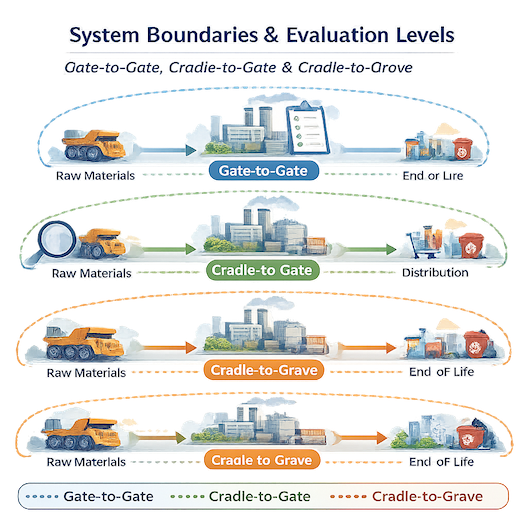
System Boundaries & Evaluation Levels
Gate-to-Gate, Cradle-to-Gate & Cradle-to-Grave
One of the most critical strategic decisions in Social Life Cycle Assessment is defining the system boundary.
The boundary determines:
Which life cycle stages are included
Which stakeholders are evaluated
How far upstream and downstream the analysis extends
The level of data depth required
A well-defined boundary ensures clarity, transparency, and decision relevance.
Gate-to-Gate
Scope: A specific production stage or facility.
This boundary focuses on internal operations or direct suppliers.
Typically used when:
Assessing a manufacturing plant
Evaluating Tier 1 suppliers
Performing targeted social risk screening
Supporting procurement decisions
Advantages:
High data precision
Practical for supplier engagement
Faster execution
Ideal for phased implementation
Gate-to-gate is often the starting point for companies building social due diligence capacity.
Cradle-to-Gate
Scope: From raw material extraction to finished product leaving the factory.
Includes:
Upstream supply chain stages
Direct and indirect suppliers
Raw material sourcing
Used when:
Mapping social hotspots in upstream supply chains
Supporting ESG disclosure
Evaluating responsible sourcing strategies
This provides broader visibility while remaining operationally focused.
Cradle-to-Grave
Scope: Full life cycle — from raw material extraction to end-of-life.
Includes:
Use phase impacts
Consumer safety considerations
End-of-life socio-economic effects
Typically used for:
Comprehensive sustainability strategy
High-visibility product categories
Public sustainability reporting
This is the most comprehensive, but also the most resource-intensive.
Strategic Boundary Selection
The “right” boundary depends on:
Regulatory requirements
Industry risk exposure
Data availability
Strategic objectives
Budget and timeline
DEISO supports clients in selecting a boundary that balances accuracy, feasibility, and decision value.
Not every organization needs cradle-to-grave analysis immediately.
Often, a structured gate-to-gate implementation is the most effective starting point.
How DEISO Executes S-LCA
Methodology, Tools & Supplier-Level Intelligence
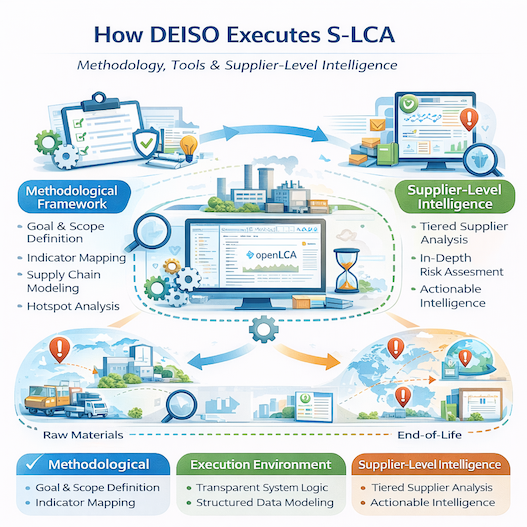
A Social Life Cycle Assessment requires more than a conceptual understanding.
It requires structured modeling, disciplined data management, and strategic interpretation.
DEISO executes S-LCA as a professional consulting engagement, not as a generic reporting exercise.
Structured Methodological Framework
Every S-LCA project at DEISO follows a defined analytical pathway:
• Goal & Scope Definition
Clear study objectives, stakeholder prioritization, system boundary selection, and functional unit definition.
• Indicator Selection & Mapping
Alignment of stakeholder groups with relevant social impact categories and measurable indicators.
• Supply Chain Mapping
Identification of direct and indirect suppliers, risk regions, and data availability levels.
• Social Life Cycle Inventory (S-LCI)
Structured data collection using:
Company data
Supplier disclosures
International risk databases
Sector benchmarks
• Hotspot & Risk Analysis
Identification of:
High-risk geographies
Critical suppliers
Priority intervention areas
• Interpretation & Strategic Integration
Translation of findings into:
Procurement strategies
ESG reporting inputs
Risk mitigation roadmaps
Executive-level recommendations
Execution Environment & Modeling Capability
DEISO executes S-LCA studies using a structured modeling environment to ensure:
Transparent system logic
Reproducibility
Clear documentation
Transferable methodology
Where clients use alternative platforms internally, DEISO ensures the modeling structure, indicator logic, and system architecture are fully transferable.
This allows organizations to:
Maintain internal continuity
Integrate S-LCA into existing sustainability workflows
Build internal capacity progressively
Supplier-Level Intelligence — Beyond Generic Risk Screening
DEISO does not rely solely on generic country risk indicators.
Our approach includes:
Tier 1 supplier evaluation
Region-specific risk mapping
Stakeholder-sensitive analysis
Structured risk prioritization
This ensures S-LCA outputs are:
Actionable
Procurement-relevant
Strategically defensible
Integrated Consulting + Training Model
Where required, DEISO supports:
Executive briefings
Sustainability team training
Capacity-building workshops
Methodology transfer sessions
This ensures S-LCA is embedded in the organization—not isolated in a single report.
S-LCA at DEISO is delivered as a decision-support system, not just a sustainability document.
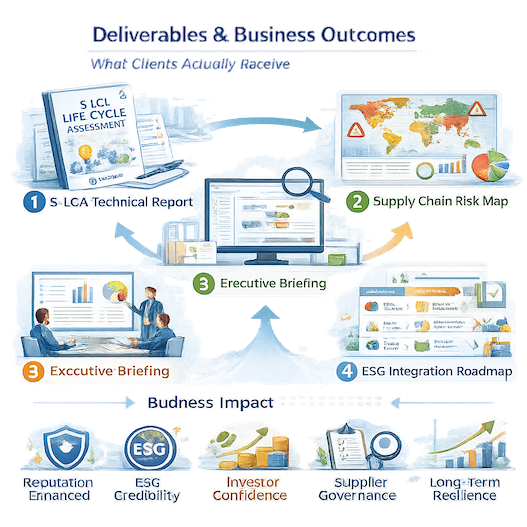
Deliverables & Business Outcomes
What Clients Actually Receive
An S-LCA engagement must deliver more than analysis.
It must produce decision-ready outputs that executives and sustainability teams can act upon immediately.
DEISO structures every S-LCA project around tangible, implementation-oriented deliverables.
Comprehensive S-LCA Technical Report
Clients receive a structured, transparent report including:
Goal & scope definition
System boundary description
Stakeholder mapping
Indicator selection rationale
Inventory data sources
Risk and hotspot analysis
Interpretation & limitations
This ensures methodological defensibility and audit readiness.
Social Hotspot & Risk Mapping
Visual and analytical outputs identifying:
High-risk supplier regions
Priority stakeholder concerns
Critical intervention points
Comparative supplier risk levels
This supports procurement prioritization and supplier engagement strategies.
Executive-Level Strategic Summary
A concise decision-brief including:
Key exposure areas
Risk severity ranking
Recommended mitigation pathways
Short-, medium-, and long-term action roadmap
Designed for board-level and C-suite discussion.
ESG & Due Diligence Integration Support
Where required, DEISO supports integration into:
ESG reporting frameworks
Sustainability disclosures
Responsible sourcing programs
Human rights due diligence processes
S-LCA findings become embedded in corporate governance structures.
Organizational Capacity Building (Optional)
To ensure continuity, DEISO may provide:
Internal workshops
Sustainability team training
Methodology transfer sessions
Supplier engagement guidance
This transforms S-LCA from a one-time study into an ongoing capability.
The Business Impact
A professionally executed S-LCA delivers:
Reduced social risk exposure
Strengthened ESG credibility
Improved investor confidence
Structured supplier governance
Enhanced long-term brand resilience
It shifts sustainability from narrative to measurable management.
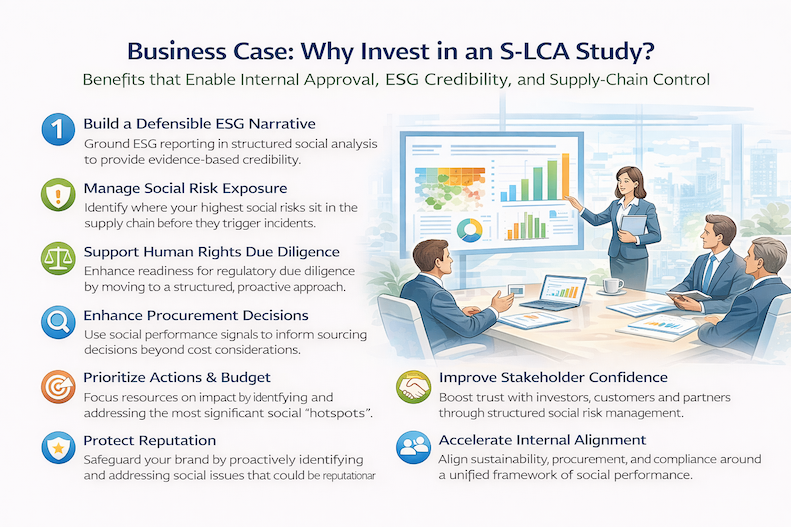
Business Case:
Why Invest in an S-LCA Study?
Benefits that Enable ESG Credibility, and Supply-Chain Control
1) Build a Defensible ESG Narrative (Evidence, Not Claims)
Benefit: Strengthen ESG reporting and credibility by grounding the “Social” pillar in structured analysis.
Example: Instead of stating “we respect human rights,” the company can show a documented assessment of worker safety, wage risk, and supplier governance aligned to the product/system boundary.
2) Reduce Social Risk Exposure in the Supply Chain
Benefit: Identify where the highest social risks sit in the value chain before they become incidents.
Example: An S-LCA reveals that a specific supplier region has elevated labor or safety risk — enabling targeted supplier engagement, audits, or sourcing alternatives before reputational or operational disruption occurs.
3) Support Human Rights Due Diligence Readiness
Benefit: Improve preparedness for evolving due diligence expectations by moving from ad hoc supplier checks to a structured assessment approach.
Example: Procurement and compliance teams can use S-LCA outputs as a documented basis for risk prioritization (which suppliers and regions require deeper due diligence first).
4) Strengthen Procurement Decisions with Social Intelligence
Benefit: Enable procurement to compare sourcing options based on social performance signals, not just cost.
Example: When evaluating two suppliers, S-LCA highlights differences in working conditions, governance maturity, or community impact — supporting a more defensible supplier selection decision.
5) Prioritize Actions and Budget Where They Matter Most
Benefit: Avoid scattered initiatives by focusing interventions on the biggest social “hotspots.”
Example: Instead of broad training across all suppliers, the company focuses resources on the top 20% of suppliers, driving 80% of the social risk, improving cost-effectiveness and impact.
6) Improve Stakeholder Confidence (Investors, Customers, Partners)
Benefit: Provide credible, structured answers to stakeholder questions about social performance.
Example: Investor ESG reviews often probe the social dimension beyond climate. An S-LCA provides the company with a structured framework for explaining social risk management and improvements.
7) Protect Reputation and Strengthen Social License to Operate
Benefit: Reduce vulnerability to reputational shock by proactively identifying and addressing social issues.
Example: For infrastructure and renewable projects, local community concerns and labor conditions can become high-visibility risks. S-LCA supports early identification and engagement planning.
8) Accelerate Internal Alignment Across Functions
Benefit: Align sustainability, procurement, compliance, and leadership through a shared evidence base.
Example: S-LCA provides a common framework for discussing social risk and performance, reducing internal debate and enabling faster approvals and clearer ownership.
9) Create a Repeatable Framework (Not a One-Off Report)
Benefit: Establish a scalable approach that can expand from gate-to-gate to broader boundaries over time.
Example: A company may start with a gate-to-gate S-LCA for direct suppliers and later extend to cradle-to-gate as data maturity improves, without having to restart from zero.
10) Convert ESG Commitments into Measurable Governance
Benefit: Move from policy statements to measurable, manageable social performance.
Example: S-LCA provides indicator-based tracking and prioritization that can feed supplier codes, procurement KPIs, and continuous improvement programs.
Executive Summary for Internal Approval (One Sentence)
An S-LCA is a decision-support and risk-governance tool that delivers structured evidence of social impacts and supply-chain exposure—enabling defensible ESG reporting, procurement prioritization, and due diligence readiness.
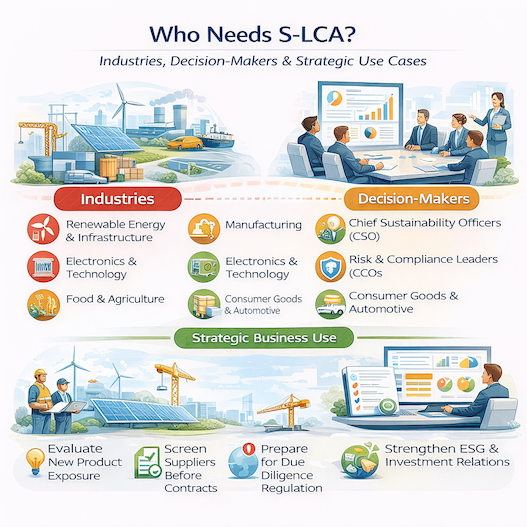
Who Needs S-LCA?
Industries, Decision-Makers & Strategic Use Cases
Social Life Cycle Assessment is not limited to one industry.
It is relevant wherever supply chains, labor conditions, sourcing regions, or stakeholder exposure create social risk.
S-LCA becomes critical when organizations need structured visibility into how their products affect people across the value chain.
Industries with High S-LCA Relevance
S-LCA is particularly valuable in sectors with:
Global multi-tier supply chains
Labor-intensive production
Raw material sourcing from high-risk regions
Strong ESG scrutiny
Public-facing brand exposure
High-Impact Sectors Include:
Renewable energy & infrastructure
Manufacturing & industrial production
Electronics & technology
Construction materials
Food & agriculture
Consumer goods
Automotive & mobility
Extractives & raw materials
These industries face increasing pressure from regulators, investors, and consumers to demonstrate social accountability.
Decision-Makers Who Benefit from S-LCA
S-LCA is not only for sustainability departments.
It supports strategic functions across the organization:
• Chief Sustainability Officers (CSO)
Strengthen ESG reporting and readiness for due diligence.
• Procurement Directors
Prioritize supplier engagement based on social risk intelligence.
• Risk & Compliance Leaders
Prepare for emerging human rights regulations.
• CEOs & Board Members
Understand enterprise-level exposure and governance risk.
• ESG & Reporting Teams
Integrate structured social indicators into disclosures.
S-LCA becomes a cross-functional decision-support tool.
Practical Business Use Cases
Organizations typically engage DEISO for S-LCA when they need to:
Evaluate social exposure of a flagship product
Screen suppliers before long-term contracts
Prepare for human rights due diligence regulation
Strengthen ESG credibility with investors
Identify social hotspots in renewable energy projects
Support responsible sourcing initiatives
It is particularly effective when organizations want to move from general sustainability statements to measurable social governance.
If your organization is asking:
“Where are we socially exposed?”
“Which suppliers represent elevated risk?”
“How defensible is our ESG social disclosure?”
Then S-LCA is no longer optional — it is strategic.
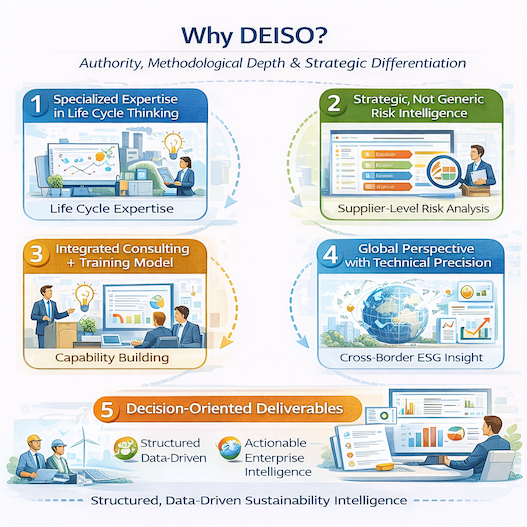
Why DEISO?
Authority, Methodological Depth & Strategic Differentiation
Choosing the right S-LCA partner is not only about technical capability.It is about strategic alignment, methodological rigor, and decision-focused execution.
DEISO delivers Social Life Cycle Assessment as an integrated sustainability intelligence service — not a generic assessment exercise.
Specialized Expertise in Life Cycle Thinking
DEISO operates at the intersection of:
Life Cycle Assessment (LCA)
Social risk analysis
ESG integration
Supply chain governance
Sustainability training & capacity building
Our expertise in life cycle methodologies ensures that S-LCA is implemented with:
Clear system logic
Transparent modeling structure
Defensible indicator selection
Structured interpretation
This protects clients from superficial or checklist-based social reporting.
Strategic, Not Generic, Risk Intelligence
Many providers rely solely on country-level risk databases.
DEISO goes further by:
Structuring supplier-level evaluation
Aligning indicators with stakeholder relevance
Mapping risks across defined system boundaries
Translating findings into procurement decisions
The result is not just risk identification, but also prioritization and action.
Integrated Consulting + Training Model
Unlike firms that deliver static reports, DEISO enables:
Internal capability development
Executive-level understanding
Methodology transfer
Progressive scaling of S-LCA scope
This ensures continuity and long-term value creation.
Global Perspective with Technical Precision
Operating across international markets, DEISO understands:
Cross-border supply chain complexity
Emerging due diligence regulations
Investor ESG expectations
Multi-tier sourcing challenges
Our approach balances:
Technical depth
Strategic clarity
Practical implementation feasibility
Decision-Oriented Deliverables
Every S-LCA engagement is structured around:
Clear risk visualization
Actionable supplier insights
Executive-ready summaries
Governance integration pathways
DEISO’s objective is simple:
To convert social sustainability from abstract responsibility into measurable enterprise intelligence.
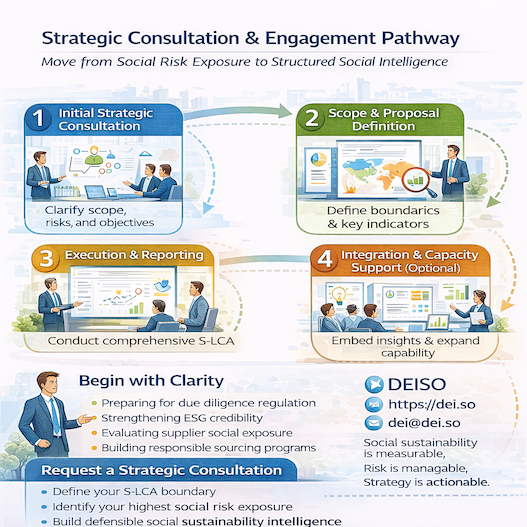
Strategic Consultation & Engagement Pathway
Move from Social Risk Exposure to Structured Social Intelligence
Social Life Cycle Assessment is not a generic sustainability add-on.
It is a strategic decision.
DEISO engages clients through a structured, outcome-oriented pathway designed to reduce uncertainty and accelerate implementation.
Step 1 — Initial Strategic Consultation
A focused discussion to clarify:
Product or system under evaluation
Industry-specific risk exposure
Regulatory context
Desired system boundary (e.g., gate-to-gate)
Timeline and reporting objectives
This ensures alignment before any modeling begins.
Step 2 — Scope & Proposal Definition
DEISO provides:
Clearly defined system boundaries
Stakeholder and indicator framework
Data requirements outline
Timeline & milestone structure
Transparent engagement structure
No ambiguity. No generic templates.
Step 3 — Execution & Reporting
Structured implementation including:
Supply chain mapping
Indicator analysis
Hotspot identification
Risk prioritization
Executive-level interpretation
Deliverables are tailored for strategic decision-making.
Step 4 — Integration & Capacity Support (Optional)
Where required:
Executive briefings
Sustainability team workshops
Methodology transfer
Progressive expansion of scope
S-LCA becomes embedded in governance systems.
Begin with Clarity
If your organization is:
Preparing for due diligence regulation
Strengthening ESG credibility
Evaluating supplier social exposure
Building responsible sourcing programs
Then a structured S-LCA is a strategic next step.
Request a Strategic Consultation
Engage DEISO to:
Define your S-LCA boundary
Identify your highest social risk exposure
Build defensible social sustainability intelligence
Contact: https://dei.so
Email: dei@dei.so
Social sustainability is measurable.
Risk is manageable.
Strategy is actionable.
Share this:
- Email a link to a friend (Opens in new window) Email
- Share on LinkedIn (Opens in new window) LinkedIn
- Share on X (Opens in new window) X
- Share on Facebook (Opens in new window) Facebook
- Share on WhatsApp (Opens in new window) WhatsApp
- Share on Reddit (Opens in new window) Reddit
- Print (Opens in new window) Print
- More