


Scope 3 Category-Level Pre-Submission Audit & Methodology Review

Scope 3 Category-Level Pre-Submission Audit & Methodology Review
Scope 3 is the largest and most volatile emissions domain for most enterprises. The highest risk is not the final total — it is category-level defensibility: boundary interpretation, data governance, method selection, allocation logic, and traceability of assumptions across the full value chain.
This engagement provides structured independent technical review across all Scope 3 categories (1–15), upstream and downstream. DEISO strengthens governance integrity, documentation defensibility, and pre-submission assurance readiness without acting as a verification body or issuing verification statements.
What This Page Covers
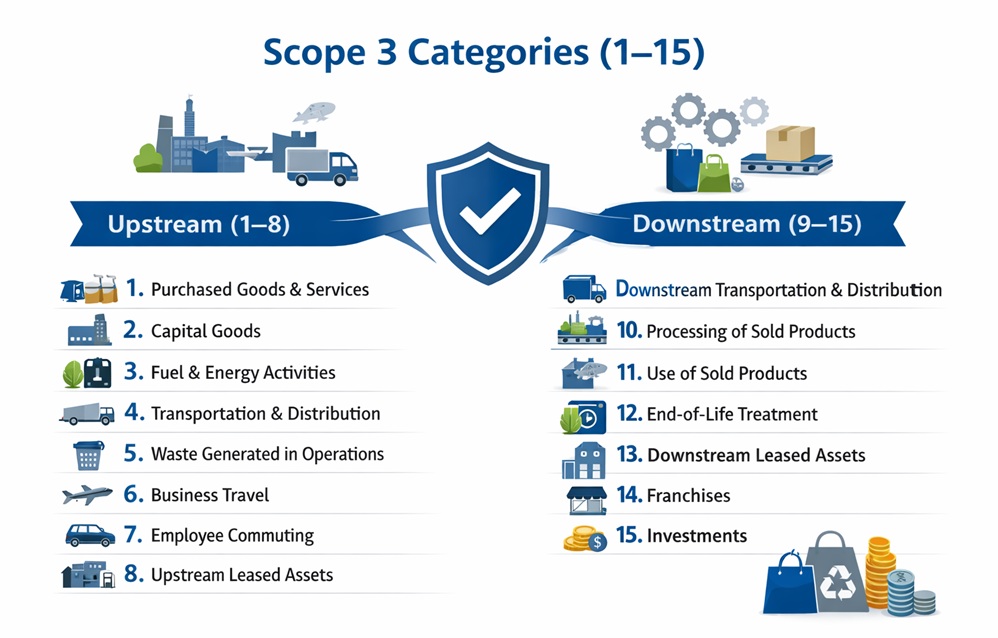
This page covers every Scope 3 category as defined in the GHG Protocol Scope 3 framework:
- Upstream categories: 1–8
- Downstream categories: 9–15
INSERT TABLE BLOCK HERE
Why Category-Level Review Matters
Scope 3 exposure emerges when category construction is weak or inconsistent. These issues typically surface during procurement qualification, investor scrutiny, internal audit escalation, or external assurance engagement.
Common risk drivers include:
- Boundary ambiguity and inconsistent category perimeter interpretation
- Weak supplier/partner data governance and uncontrolled quality variability
- Inconsistent method selection (supplier-specific vs activity-based vs spend-based vs hybrid)
- Emission factor selection weaknesses and poor update/change control
- Allocation and cut-off rules that are undocumented or inconsistently applied
- Double counting across categories or business units
- Proxy and secondary data usage without defensibility logic
- Evidence traceability gaps and incomplete documentation packages
Scope of Review
DEISO evaluates the category-level design and defensibility of your Scope 3 system across all categories, and scopes review depth by materiality, decision risk, and stakeholder exposure (procurement, financial, regulatory, or public commitments).
Review coverage includes:
- Category boundary definitions and perimeter consistency across entities, sites, and business units
- Data source governance (supplier data, spend data, activity data, logistics data, product use data)
- Method selection logic (supplier-specific, activity-based, spend-based, hybrid)
- Emission factor selection, hierarchy, and governance controls
- Allocation rules, cut-offs, and double-counting prevention logic
- Proxy, estimation, and secondary data defensibility assessment
- Documentation completeness and evidence traceability controls
- Internal controls over models, versions, approvals, and recalculation governance
Methodology Validation & Stress Testing
DEISO applies structured pre-submission review procedures aligned with recognized Scope 3 guidance and reasonable/limited assurance logic to evaluate category-level consistency, transparency, and defensibility.
Stress-testing may include:
- Boundary consistency checks across categories and organizational units
- Sensitivity testing of high-impact assumptions and emission factor selections
- Sampling-based traceability checks to source evidence and supplier documentation
- Review of supplier questionnaire design, controls, and governance (where used)
- Evaluation of estimation models and transparency of calculation logic
Procurement, Tender, and Stakeholder Exposure
Upstream categories often drive supplier-facing procurement scrutiny, while downstream categories drive product-use and lifecycle exposure. Most organizations carry risk on both sides of the value chain.
This engagement strengthens:
- Category-level defensibility under stakeholder scrutiny
- Supplier and partner data governance credibility
- Tender-aligned documentation architecture and internal review controls
- Executive oversight clarity for Scope 3 risk decision-making
What This Engagement Does Not Include
This service does not include execution of Scope 3 inventory development, supplier data collection, or operational calculation work. Where DEISO provides Scope 3 execution services, those are contracted separately and are never performed on the Scope 3 framework subject to this independent review.
Deliverables
- Comprehensive category-level technical findings report covering Scope 3 categories 1–15
- Defensibility observations and identified gaps (where applicable)
- Methodology refinement and governance/control enhancement recommendations
- Documentation and evidence traceability improvement guidance
- Prioritized corrective action roadmap for assurance readiness
Engagement Process
Step 1 — Scope 3 Category Scope Confirmation
Define review perimeter and exposure context, including:
- Confirmation that all categories (1–15) are in scope, with prioritization by materiality and exposure
- Organizational boundary and reporting perimeter
- Data sources and method mix across categories
- Emission factor governance and update controls
- Internal control environment and documentation maturity
Step 2 — Category-Level Technical Review Execution
Structured pre-submission audit procedures aligned with reasonable/limited assurance logic, including boundary consistency testing, methodology validation, governance evaluation, documentation review, and traceability checks across upstream and downstream categories.
Step 3 — Defensibility Conclusion & Improvement Roadmap
You receive:
- Independent technical findings report
- Category-level defensibility observations across Scope 3 categories 1–15
- Identified methodological and governance gaps (if any)
- Corrective and improvement recommendations
- Pre-submission readiness guidance for external scrutiny
DEISO does not issue verification statements or act as a certification body. The objective is readiness and defensibility prior to engagement with authorized assurance providers where applicable.
Why DEISO
- Industrial and manufacturing value-chain emissions specialization
- Category-level methodology depth across upstream and downstream Scope 3
- Governance-first pre-submission audit framework
- Risk-aware assessment focused on procurement, stakeholder, and assurance exposure
- Independent, technically grounded review and documentation reinforcement
Submit Scope 3 Category Review Inquiry
For Scope 3 Category-Level Pre-Submission Audit and methodology validation engagements, please submit a structured request to initiate a confidential scope and exposure assessment.
| Upstream Categories (1–8) | Downstream Categories (9–15) |
|---|---|
|
1. Purchased Goods & Services 2. Capital Goods 3. Fuel- and Energy-Related Activities (not included in Scope 1 or 2) 4. Upstream Transportation & Distribution 5. Waste Generated in Operations 6. Business Travel 7. Employee Commuting 8. Upstream Leased Assets |
9. Downstream Transportation & Distribution 10. Processing of Sold Products 11. Use of Sold Products 12. End-of-Life Treatment of Sold Products 13. Downstream Leased Assets 14. Franchises 15. Investments |
Engagement Process
Step 1 — Scope 3 Category Scope Confirmation (1–15)
Define:
- Confirmation that all Scope 3 categories (1–15) are in scope (upstream and downstream)
- Category prioritization logic based on materiality and stakeholder exposure
- Organizational boundary and reporting perimeter
- Value chain segmentation (suppliers, logistics, product lifecycle, investments, leased assets)
- Calculation methodologies by category (supplier-specific, activity-based, spend-based, hybrid)
- Emission factor hierarchy, selection logic, and data sources
- Internal control environment, documentation maturity, and evidence traceability readiness
Step 2 — Category-Level Technical Review Execution (Upstream & Downstream)
Structured pre-submission audit procedures aligned with GHG Protocol Scope 3 guidance and reasonable/limited assurance logic.
This includes methodological validation, boundary consistency testing, data governance evaluation across supplier and downstream value-chain inputs, allocation and double-counting stress-testing, proxy logic assessment, and transparency review across the full category structure (1–15).
Step 3 — Defensibility Conclusion & Improvement Roadmap
You receive:
- Independent technical findings report covering Scope 3 categories (1–15)
- Category-level defensibility observations (upstream and downstream)
- Identified methodological, governance, or documentation gaps
- Corrective and improvement recommendations
- Pre-submission readiness guidance for structured external scrutiny
Why DEISO
- Industrial and manufacturing value-chain emissions specialization
- Category-level methodology depth across upstream and downstream Scope 3
- Governance-first review framework aligned with GHG Protocol
- Risk-aware assessment focused on procurement and stakeholder exposure
- Independent, technically grounded review and documentation reinforcement
We operate with discipline, documentation rigor, and governance sensitivity appropriate for complex value chains.
Request a Scope 3 Category Assessment
If your organization has prepared Scope 3 reporting across upstream and downstream categories and requires structured independent review prior to procurement disclosure or external assurance engagement:
Request a Confidential Scope 3 Category Review
A structured scoping discussion determines:
- Category materiality and exposure level across Scope 3 (1–15)
- Value chain complexity (supplier, logistics, product lifecycle, financial holdings)
- Methodology depth and data maturity by category
- Required defensibility reinforcement level
- Estimated timeline and engagement structure
Submit Scope 3 Category Review Inquiry
For enterprise Scope 3 Category-Level Pre-Submission Audit and value-chain methodology validation engagements across categories 1–15, submit a structured request to initiate a confidential scope and exposure assessment.
Direct inquiries may also be sent to:
info@dei.so
Share this:
- Email a link to a friend (Opens in new window) Email
- Share on LinkedIn (Opens in new window) LinkedIn
- Share on X (Opens in new window) X
- Share on Facebook (Opens in new window) Facebook
- Share on WhatsApp (Opens in new window) WhatsApp
- Share on Reddit (Opens in new window) Reddit
- Print (Opens in new window) Print
- More