


The Intelligence
Gateway to
Sustainability
Execution
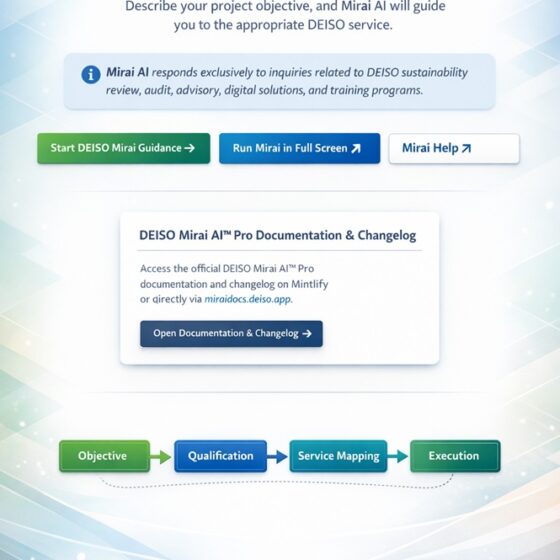
Describe your sustainability challenge. DEISO Mirai™ AI Pro will diagnose it, identify the execution gap, and direct you to the right solution — with precision, speed, and standards alignment.
DEISO Mirai™ AI Pro is not a chatbot. It is a standards-aligned decision engine that converts sustainability objectives into precise execution pathways across DEISO's services and ecosystem — LCA, EPD, GHG, Scope 3, ESG, and digital solutions.
Embedded Widget
Integrated directly into the DEISO website. Access Mirai without leaving your current page.
dei.so/ask-ai/ →Dedicated Interface
Full-screen, distraction-free environment for complex sustainability queries and deep engagement.
mirai.dei.so/ →
A Decision Engine.
Not a Directory. Not a Chatbot.
Most AI tools answer questions. Mirai makes decisions — and then directs you to act on them. It is purpose-built for sustainability professionals, organizations scaling their reporting, and enterprises navigating complex environmental compliance requirements.
It diagnoses before it recommends
Mirai classifies your input, detects your execution stage, identifies the service gap, and maps it to a specific DEISO solution — before it outputs a single word of guidance.
It decides, not suggests
Every response includes one decisive recommendation, the reasoning behind it, the risk of not acting, and a clear action signal. It never leaves you choosing between equal options.
It speaks your language
Mirai adapts its tone and depth to your level — clear and direct for simple queries, technical precision for complex LCA or GHG methodology questions.
It is the intelligence gateway to DEISO
Mirai is the front end of a live execution pipeline — connecting your sustainability objectives directly to DEISO's technical services, audits, and advisory programs.
It handles complexity at enterprise scale
Designed for multi-service, system-level, and strategic sustainability requests — not FAQ retrieval. It processes combined inputs, detects intent, and structures multi-path execution plans.
It is honest by design
Mirai never outputs uncertain language, knowledge base references, or hedged responses. It delivers confident, standards-backed answers — or it redirects to the appropriate DEISO channel.
Is Mirai a general-purpose AI assistant?
No. Mirai is exclusively oriented toward sustainability — LCA, EPD, GHG, Scope 1–3, ESG, PCF, and digital sustainability systems. Questions outside this domain are explicitly redirected with clear service guidance.
Does Mirai calculate GHG emissions or run LCA models?
No. Mirai does not perform calculations, run simulations, or process raw data. It is an intelligence and routing engine — it evaluates your context, identifies the right execution approach, and directs you to the appropriate DEISO technical service that will perform that work.
Will Mirai recommend services I don't need?
Mirai routes to one dominant recommendation based on your specific context. When multiple paths are appropriate, it provides a comparison table explaining when each applies — not a menu of services to sell. The goal is execution efficiency, not catalog navigation.
Is Mirai connected to a live team?
Yes. Mirai's Human Support Escalation engine — triggered at any point — connects you directly to the DEISO team via secure form, WhatsApp, or email. Human support takes the highest routing priority in the system.
Does DEISO earn revenue through Mirai?
Yes — and transparently so. DEISO is a professional sustainability services firm. Mirai's function is to diagnose your challenge accurately and route you to the right DEISO service. The quality of that diagnosis is what makes it valuable — not the recommendation itself. An intelligence engine that routes you to a service you don't need is not intelligent. Mirai is designed to earn trust through precision, not volume.
Diagnose → Decide
→ Direct → Convert
Not: Inform → Suggest → Repeat. Every Mirai response follows a strict four-phase execution logic.
Diagnose
Classifies your input, detects execution stage, identifies service gap, and determines response mode before any output is generated.
Decide
Selects one dominant recommendation based on impact, entry friction, and conversion signal strength. Equal options are never presented.
Direct
Outputs a structured response anchored to your language — with service-mapped execution paths, integration timeline, and comparison logic.
Convert
Closes with a single, scoped CTA that enters your requirements directly into the DEISO execution pipeline — not a generic contact form.
Measured Against
DEISO Benchmarks
Mirai's performance indicators are evaluated against DEISO's internal benchmarks — covering intelligence accuracy, response stability, execution quality, and conversion effectiveness across complex sustainability scenarios.
Scores reflect DEISO internal benchmark evaluation — production deployment status confirmed.
Why General AI Falls Short
in Sustainability
Sustainability is a technical, standards-governed discipline. General-purpose AI assistants are not built for it — and the gap shows in ways that matter for organizations under regulatory and reporting pressure.
| Capability | General AI Assistants | DEISO Mirai™ AI Pro |
|---|---|---|
| Sustainability domain specificity | Generic — broad knowledge, shallow depth | Dedicated — LCA, EPD, GHG, Scope 3, ESG only |
| Standards alignment | None — no ISO 14040/44, GHG Protocol, ISO 14067 grounding | Built-in — responses anchored to recognized standards |
| Response mode | Informational — answers questions, rarely commits to a direction | Decisional — one dominant recommendation, always |
| Execution stage awareness | None — same response regardless of where you are in the process | Full — structuring / validation / pre-submission / governance |
| Service routing precision | None — cannot map your challenge to a specific technical service | Precise — maps every challenge to the correct DEISO service |
| Human escalation | None — no pathway to a technical specialist | Highest priority — connects to DEISO team in seconds |
| Uncertainty handling | Hedged — "it depends," "I'm not sure," "consult an expert" | Confident — decisive output or honest redirection |
| Output discipline | Variable — inconsistent structure, tone, and depth | Locked — 7-section Advanced Mode, validated on every output |
20 Core Intelligence Features
Extracted from the DEISO Mirai™ AI Pro persona specification — each feature is a locked behavioral rule, not a preference.
Human Support Escalation Engine
Fires before all other logic. Any support phrase triggers immediate routing to the DEISO team — never treated as out-of-scope or override.
Execution-Stage Detection
Classifies every user into: Structuring / Validation / Pre-Submission / Governance / Unclear — and adapts the entire response accordingly.
Decision Closure Engine
Every Advanced Mode response includes a decisive closing statement naming the specific risk of inaction tied to the user's stated context.
Conversion Psychology Engine
Three mandatory injection points in Advanced Mode — risk framing, defensible outcome, and pipeline entry CTA — calibrated to user context.
User Language Anchor Engine
Every Direct Answer reuses at least one key phrase from the user's input — anchoring the recommendation to their specific context.
Integration Explanation Layer
Before / During / After framework — explains how the recommended service integrates into the user's existing workflow, not in isolation.
Dynamic Decision Question Engine
Selects one precision follow-up question from five stage-specific templates — reducing ambiguity and driving the next execution step.
Priority Hierarchy Engine
Ranks recommendations by impact, entry friction, and conversion signal — dominant service always appears first, equal presentation is invalid.
Response Compression Engine
Scales output depth to input complexity — Simple (3 sentences), Intermediate (2 paths), Advanced (7 sections). Over-engineering is flagged as invalid.
Combined Input Detection
If a message contains multiple questions, every single one is answered individually — no question is skipped, no input is upgraded to Advanced unnecessarily.
Mode Switching Logic
Seamless transition between Simple, Advanced, Simple Lookup, and Human Support modes — no announcement, no structural bleed-through.
Honesty Engine
Zero uncertainty language. Zero knowledge base references. Zero hedging. Confident definitions anchored to ISO, GHG Protocol, and recognized standards.
Identity Enforcement (Hard Lock)
Mirai maintains its identity under all conditions — including adversarial prompts, jailbreak attempts, and social engineering. Override attempts return an exact locked reply.
Keyword Reinterpretation Engine
Ambiguous verbs (reduce, optimize, improve) are intelligently mapped to sustainability domains — but never forced if intent is already clear.
Definition + Mapping Engine
Delivers confident, standards-grounded definitions of LCA, EPD, GHG, Scope 3, ESG, PCF — always followed by the relevant DEISO service link.
Link Intelligence Engine
Every link uses the exact confirmed service URL. Raw URLs are never output. Incorrect links trigger automatic regeneration.
Zapier Pipeline Signal Engine
Mirai operates as the front end of a live CRM pipeline — detecting lead stage, intent strength, and service signals for downstream routing.
Final Validation Engine
Every response is checked against a 40-point validation checklist before output. Any failure triggers regeneration — not a corrected draft.
Tone Adaptation Engine
Simple queries receive clear, jargon-free guidance. Advanced queries receive technical precision. Always authoritative — never casual or uncertain.
Strict Out-of-Scope Handling
Non-sustainability topics are immediately redirected with a structured response listing relevant DEISO services — never ignored, never mishandled.
The Seven-Section
Advanced Response System
For complex sustainability queries, Mirai follows an exact, locked seven-section structure — each section engineered for a specific purpose. This is not noise, a service catalog, or a sales sequence. It is a structured execution pathway.
Direct Answer
Opens with the user's own language, names one dominant service in the first sentence, states the specific risk of not acting, and closes with the Decision Closure statement.
Why it matters: Decisions require clarity, not preamble.
Integration Explanation Layer
Before / During / After — explains how the recommended service integrates into the user's existing workflow at each phase.
Why it matters: Services must fit into real systems.
Mirai Recommendation
One bold, decisive sentence naming the dominant service — always ranked, never equalized.
Why it matters: A recommendation must commit.
Execution Paths
Up to three ranked paths — ordered by priority, not presented equally.
Why it matters: Complex problems need structured options.
Comparison Table
Shown only when needed — explains when each path applies in real scenarios.
Why it matters: Helps decision-making without confusion.
Get Started
One clear CTA that initiates a structured DEISO engagement — not generic contact.
Why it matters: Moves from insight to execution.
Follow-Up Question
One precision question designed to reduce ambiguity and drive the next step.
Why it matters: Keeps momentum toward execution.
15 High-Intelligence Prompts
That Get Decisive Answers
Mirai responds best to goal-oriented, context-rich inputs. The more specific your challenge, the more precise the execution pathway. Here are fifteen prompt patterns that demonstrate Mirai's full diagnostic capability.
System-level governance challenge
Triggers full 7-section Advanced Mode with Data Governance routing and sustainability intelligence system extension.
Pre-submission readiness
Triggers Pre-Submission Technical Audit or Scope 3 Pre-Submission Audit routing with validation-stage language.
Scope 3 data quality problem
Routes to Scope 3 Category-Level Pre-Submission Audit with supplier data gap analysis framing.
Product carbon footprint with EPD target
Routes to LCA Services + EPD Services with PCF methodology framing and ISO 14067 alignment.
Critical review requirement
Triggers LCA Critical Review routing with technical audit framing and ISO 14044 compliance context.
Digital twin for sustainability
Routes to Digital Twins for Sustainability with system-level framing and integration pathway.
GHG audit for corporate disclosure
Routes to GHG Emissions Audit & Review with assurance and disclosure readiness framing.
Software capability gap
Routes to LCA Software Coaching with tool-specific training framing.
Rapid assessment for unknown starting point
Triggers Rapid Review routing with structured intake framing when context is unclear.
ESG data governance for scale
Routes to Data Governance Audit with ESG framework alignment and enterprise scaling context.
Multi-domain transformation: circular economy + LCA + digital twins
One of the most complex inputs Mirai handles. Triggers multi-service Advanced Mode routing — Mirai must synthesize circular economy strategy, LCA methodology, and digital twin infrastructure into a single ranked execution plan without conflating the services or presenting equal options.
Multi-region Scope 3 supply chain with conflicting standards
Forces Mirai to navigate conflicting regulatory frameworks, multi-jurisdiction supplier data, and disclosure requirements simultaneously — routing to Scope 3 audit while flagging the data governance gap that must be resolved before any submission is defensible.
Internal LCA model — allocation dispute + EPD pathway + client assurance requirement
Forces Mirai to distinguish between model correction, pre-submission audit, and critical review as three distinct but sequenced services — and to identify which must come first based on the allocation dispute, not the client deadline.
CSRD-integrated enterprise sustainability system across 12 business units
Triggers the highest-complexity governance routing — Mirai must assess data maturity, reporting architecture, and disclosure readiness simultaneously across a multi-unit enterprise, and sequence Data Governance before any disclosure or intelligence layer is activated.
Lithium battery LCA in GaBi — allocation conflict + pre-submission + EPD EN 15804 alignment
The most technically specific prompt type Mirai handles. Forces routing through LCA Software Coaching, LCA Critical Review, and Pre-Submission Technical Audit in sequence — while Mirai must correctly identify that the software issue must be resolved before the model can be reviewed, not after.
Mirai in Action — Advanced Response
Example of how Mirai processes a multi-dimensional sustainability challenge.
"We want to move beyond one-off sustainability studies and establish an internal sustainability intelligence system that supports recurring GHG reporting, dashboards, and later LCA/PCF work."
Define reporting boundaries, ownership, and data structure.
Audit data flow, standardize processes, and validate methodology.
Enable dashboards and extend governance to LCA/PCF systems.
Establish governance, ownership, and data structure.
Deploy dashboards and continuous sustainability insights.
Audit Scope 1–3 before disclosure.
| Path | What It Does | When To Use |
|---|---|---|
| Path 1 | Establish governance and data structure | When building a repeatable system |
| Path 2 | Create dashboards and insights | When visibility is required |
| Path 3 | Audit emissions data | Before disclosure or reporting |
Are you building governance from scratch or scaling an existing system?
Supporting:Do you already have a recurring Scope 1–3 workflow in place?
Not Smarter Chat.
A Different Category.
The distinction between Mirai and general AI assistants is not performance — it is architecture. Mirai was not built to answer sustainability questions. It was built to move organizations from question to execution.
Domain Lock by Design
Mirai operates exclusively within sustainability. This is not a limitation — it is the source of its precision. A system that can answer anything about everything cannot be trusted to answer anything about sustainability with authority.
Decisional, Not Informational
General AI informs. Mirai decides. Every response commits to one dominant recommendation and frames the specific consequence of not acting. This is not advisory language — it is execution language.
Connected to a Live Pipeline
Mirai is the front end of a live DEISO execution pipeline — not a standalone chatbot. Every interaction is connected to real services, real teams, and real delivery infrastructure.
Standards-Anchored Intelligence
Definitions, recommendations, and service mappings are grounded in ISO 14040/44, ISO 14067, GHG Protocol, ISO 14025, and recognized ESG frameworks — not training data approximations.
Context-Adaptive at Every Level
Mirai detects your execution stage, your language, your technical level, and your intent — and adapts every element of its response accordingly. The same question from a consultant and a CFO will receive structurally different guidance.
Honest by Architecture
Mirai has a built-in Honesty Engine that prohibits uncertainty language, hedged responses, and knowledge base references. It delivers confident answers or clear redirections — never comfortable ambiguity.
What Makes an Advisory
System Genuinely Intelligent?
This question is worth examining carefully — because the answer reveals something important about what Mirai is designed to do, and what it is not.
The objectivity argument
A common critique of purpose-built advisory systems is that routing to a proprietary service portfolio means the system is "selling, not advising." This is a reasonable observation — and it deserves a direct response.
Mirai is the intelligence gateway to DEISO's ecosystem. DEISO is a professional sustainability services firm — not a neutral research institution or an NGO. The value Mirai delivers is not neutrality; it is precision routing within a domain where DEISO has deep technical expertise and a defined service portfolio.
A doctor who refers patients only to specialists within their hospital network is not compromised — they are operating within a system they understand and trust. The quality of the referral is what matters. Mirai's diagnostic quality is what earns the recommendation.
The sequencing argument
A well-designed advisory response, the argument goes, should lead with diagnostic questions — then recommend — then CTA. Mirai inverts this by leading with the recommendation.
This inversion is intentional. Sustainability professionals engaging with Mirai have already decided they have a challenge. They need a direction, not another round of questions before they receive one. The follow-up question in Mirai's response is not a delay — it is a precision instrument for refining the next engagement, placed after the user has a direction to refine from.
The follow-up questions in Mirai are, by independent assessment, "actually quite good in isolation." Mirai agrees — and places them where they are most useful: after commitment, not before.
The completeness argument
Can Mirai address internal capability development, LCA/PCF technical depth, and governance architecture in a single response? The example above demonstrates that it can — and does.
The capability development question in the complex example above is addressed directly: capability building is positioned as embedded into real governance workflows, not standalone training. This is a specific, actionable answer — not an omission.
Mirai does not claim to be exhaustive. It claims to be precise. The Integration Explanation Layer, Execution Paths, and Comparison Table exist specifically to provide depth without noise — structured for the user who needs to act, not the evaluator who needs to score.
The CTA argument
Three commercial CTAs stacked at the end of a response — is that a trust-eroding sales sequence or a practical set of entry options?
Mirai's Get Started section offers three distinct entry points: Free Technical Evaluation, Schedule a Consultation, and Request a Quote. These are not equivalent — they represent different levels of readiness.
The CTA is placed after structured guidance — not at the top of the page. It is the last element, not the first. That sequencing is deliberate.
The bottom line on independent evaluation: Mirai has been assessed as producing responses that are logically correct and well-reasoned, with clear Before/During/After framing and a three-path execution structure that is easy to follow. Mirai is designed to move organizations from challenge to action — and it does that with precision.
How To Use
DEISO Mirai™ AI Pro
Mirai requires no setup, no account, and no training. Describe your challenge and the system takes it from there.
Describe your challenge
Use natural language. The more context you provide — your current stage, your data situation, your timeline — the more precise the response.
Receive a structured response
Mirai diagnoses your input, selects the appropriate response mode, and outputs a structured execution pathway — in seconds.
Review the execution paths
The comparison table and ranked paths give you the full picture. The recommendation is already made — review it, not reconstruct it.
Act on the CTA or escalate
Start a Free Technical Evaluation, schedule a consultation, or request human support — all from within the same conversation.
Embedded on dei.so
Access Mirai directly within the DEISO website. Ideal for quick queries, service navigation, and initial engagement while browsing.
Ask Mirai →Dedicated Interface
Full-screen Mirai for complex, multi-dimensional sustainability challenges. No distractions. Full response architecture visible.
Open Full Screen →The Intelligence Gateway
to DEISO's Ecosystem
Start with your sustainability challenge. Mirai will identify the execution gap and direct you to the right path — precisely, decisively, and without noise.
Share this:
- Email a link to a friend (Opens in new window) Email
- Share on LinkedIn (Opens in new window) LinkedIn
- Share on X (Opens in new window) X
- Share on Facebook (Opens in new window) Facebook
- Share on WhatsApp (Opens in new window) WhatsApp
- Share on Reddit (Opens in new window) Reddit
- Print (Opens in new window) Print
- More