


LCA of Sodium Hydroxide Production in the Chemical Industry
A DEISO-developed Life Cycle Assessment of sodium hydroxide production, illustrating process structure, CML-based impact results, weighted hotspot interpretation, and product-system modeling for 1 kg of sodium hydroxide production mix at plant.
This case study demonstrates how DEISO structures chemical-industry LCA from process mapping to impact interpretation, transforming a rich technical model into decision-ready environmental insight for manufacturing, sustainability strategy, and lifecycle-based product intelligence.
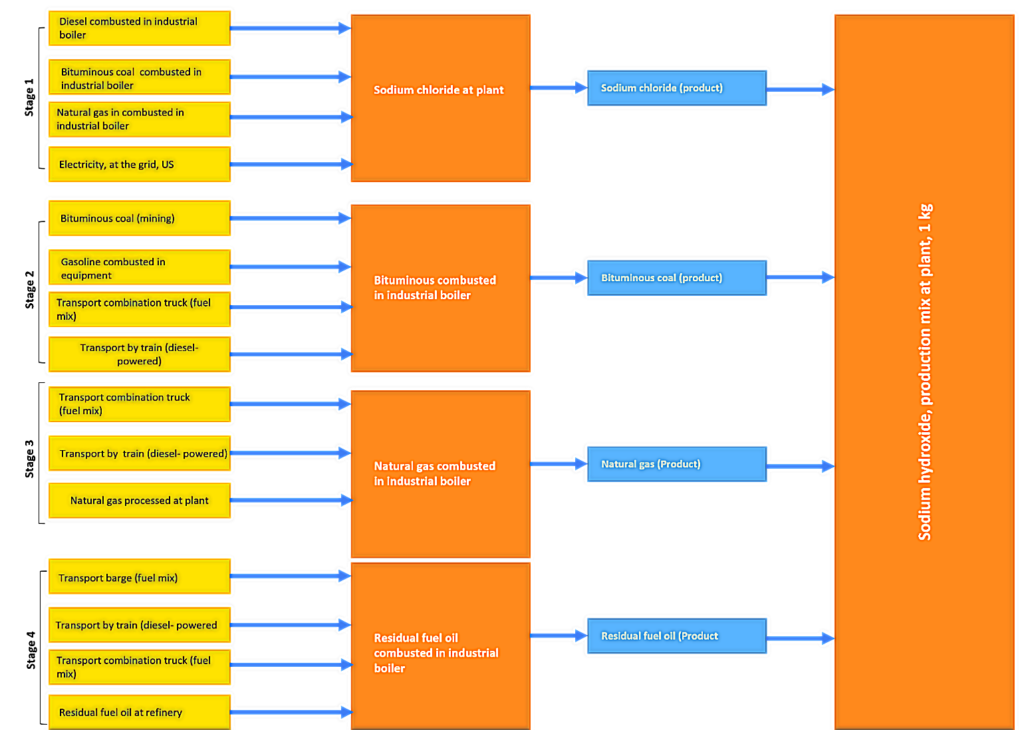
Figure — Process Flow Diagram of Sodium Hydroxide Production (1 kg Functional Unit)
This diagram illustrates the structured life cycle model of sodium hydroxide production at the plant level, developed by DEISO. It captures the integration of upstream resource extraction, fuel combustion processes, energy supply (including US grid electricity), and multi-modal transport systems feeding into intermediate production stages. These stages—comprising sodium chloride processing and combustion-based energy inputs (bituminous coal, natural gas, and residual fuel oil)—are represented as discrete process blocks, each contributing to the final production mix. The diagram highlights the interconnected nature of chemical manufacturing systems and provides a transparent representation of system boundaries, process dependencies, and material-energy flows used in the Life Cycle Assessment.
Life Cycle Assessment of Sodium Hydroxide Production in the Chemical Industry
This illustrative case study presents a full Life Cycle Assessment developed by DEISO for the production of sodium hydroxide in the chemical industry. It is based on a real internally developed DEISO model and is published here as a technical demonstration case to show methodology, process structure, impact quantification, and result interpretation.
Case Positioning
This case is presented as an illustrative DEISO technical study. It was developed end-to-end by DEISO and used here to demonstrate how an LCA for a chemical production system can be structured, analyzed, and communicated without relying on client-confidential information.
Product and Functional Unit
The assessed product system is sodium hydroxide production mix at the plant. The functional unit is defined as the production of 1 kg of sodium hydroxide. The report evaluates the environmental implications of this unit of production using the CML Life Cycle Impact Assessment method.
System Scope
The model includes the main upstream and operational inputs required to produce the product mix at the plant. These include:
- Sodium chloride at plant
- Bituminous coal combusted in an industrial boiler
- Natural gas combusted in an industrial boiler
- Residual fuel oil combusted in an industrial boiler
- Electricity from the US grid mix
Why This Chemical LCA Matters
Chemical products have distinct environmental profiles because their burdens are shaped by raw material sourcing, energy demand, combustion pathways, transport modes, and process-specific emissions to air, water, and soil. For sodium hydroxide, understanding these interactions is essential for evaluating environmental performance, identifying hotspots, and comparing improvement opportunities across production routes.
Sodium hydroxide is widely used across pulp and paper, textiles, soaps and detergents, organic synthesis, oil refining, drain cleaning, pH adjustment, and several industrial processing systems. That broad use profile makes product-level environmental intelligence especially valuable for manufacturers, buyers, and technical decision-makers.
Illustrative Use Note
This case is presented as a DEISO demonstration study. It is suitable for technical illustration, educational presentation, and authority-building content, but should not be framed as a client-specific commercial declaration.
Environmental Impact Dashboard — Sodium Hydroxide Production Mix (1 kg)
Results based on the CML Life Cycle Impact Assessment method for the production of 1 kg of sodium hydroxide at plant.
| Impact Category | Unit | Result | Interpretation |
|---|---|---|---|
| Abiotic Depletion (ADP elements) | kg Sb eq | 1.47E-05 | Mineral resource depletion indicator |
| Abiotic Depletion (ADP fossil) | MJ | 15 | Embedded fossil energy demand |
| Acidification Potential (AP) | kg SO2 eq | 0.00961 | Acidifying emissions to air |
| Eutrophication Potential (EP) | kg Phosphate eq | 0.000286 | Nutrient enrichment burden |
| Freshwater Aquatic Ecotoxicity (FAETP) | kg DCB eq | 0.0624 | Freshwater toxicity profile |
| Global Warming Potential (100 years) | kg CO2 eq | 1.05 | Headline climate indicator |
| Global Warming Potential excl. biogenic carbon | kg CO2 eq | 1.05 | Same reported value in this case |
| Human Toxicity Potential (HTP) | kg DCB eq | 0.381 | Human toxicity profile |
| Marine Aquatic Ecotoxicity (MAETP) | kg DCB eq | 936 | Largest magnitude category in this result set |
| Ozone Layer Depletion Potential (ODP) | kg R11 eq | 1.18E-07 | Low-magnitude ozone depletion indicator |
| Photochemical Ozone Creation Potential (POCP) | kg Ethene eq | 0.000776 | Smog-forming emissions indicator |
| Terrestrial Ecotoxicity Potential (TETP) | kg DCB eq | 0.00913 | Terrestrial toxicity burden |
Weighted Environmental Impact Dashboard — Sodium Hydroxide Production Mix (1 kg)
This dashboard represents the weighted results of the case study, based on the report’s normalized and weighted CML interpretation for the overall production technology. It is intentionally separated from the page 6 quantified LCIA results table with units.
Aggregated Weighted Impact Profile
Weighted Interpretation
This means the purpose of this section is priority interpretation: which impact families are most influential after normalization and weighting.
In this case, the weighted profile is led by marine aquatic ecotoxicity, followed by a stronger cluster that includes global warming, fossil depletion, and human toxicity. Lower-priority weighted categories appear toward the tail of the profile.
Process Hotspot Dashboard — Weighted Impact Contribution
This dashboard translates the process-level weighted results into a ranked hotspot profile, identifying the most influential processes and pathways driving environmental burden in the sodium hydroxide production system.
Top Process Hotspots (Weighted Contribution)
Process Family Intelligence
Feedstock System
Sodium chloride acts as a structural hotspot because it is central to the modeled production system and linked to multiple downstream impacts.
Fuel Combustion Systems
Coal, natural gas, and residual fuel oil form the dominant weighted burden cluster, making combustion pathways the most critical improvement focus.
Transport Systems
Transport contributes cumulatively through repeated barge, truck, and rail nodes rather than through a single dominant transport process.
Energy Supply
US grid electricity contributes at a moderate level and acts as a supporting burden driver across multiple impact families.
Key Insight
The environmental burden of sodium hydroxide production is driven by interconnected feedstock and combustion pathways, not by one isolated process. Fuel-related systems dominate the weighted profile, while transport creates repeated supporting burdens across the lifecycle.
Engage with DEISO
Conduct confidential LCA studies and strategic environmental assessments with DEISO.
- 🔗 Services:
https://dei.so/services - 📅 Schedule Consultation:
https://dei.so/schedule
Build a Chemical LCA with Decision-Level Insight — Not Just Results
DEISO supports chemical manufacturers, industrial operators, and sustainability teams with full Life Cycle Assessment modeling, hotspot identification, scenario analysis, and pre-submission audit readiness. Transform complex process data into structured environmental intelligence that supports product strategy, compliance, and performance improvement.