

Why 70% of Scope 3 Carbon Inventories Fail — And the Governance Framework That Fixes It
Scope 3 emissions are no longer optional disclosure metrics.
They represent:
Regulatory exposure
Investor scrutiny
Supply chain transparency pressure
Transition risk visibility
Board-level governance accountability
Yet internal audits and verification reviews repeatedly show the same pattern:
Most Scope 3 inventories collapse under scrutiny.
Not because companies lack intent —
but because they lack structural architecture.
Scope 3 is not a spreadsheet exercise.
It is enterprise carbon governance.
The Real Reasons Scope 3 Inventories Fail
Based on structured execution experience across industries, failures typically originate from five systemic weaknesses:
1. Undefined Organizational & Value Chain Boundaries
Scope 3 categories are applied without structured mapping of:
Operational control vs equity share boundaries
Supplier tiers
Downstream product use phases
Capital goods lifecycle implications
Result:
Category overlap, exclusion errors, and audit vulnerability.
2. Overreliance on Spend-Based Estimation
Many inventories default to:
Financial proxies
Generic emission factors
Inconsistent databases
Without:
Data hierarchy justification
Supplier data improvement strategy
Data quality scoring
Result:
Inventories that appear complete — but lack defensibility.
3. Category Duplication & Allocation Errors
Common issues include:
Capital goods are double-counted across categories
Transportation embedded in purchased goods
Internal transfer emissions misclassified
Improper allocation between business units
Result:
Inflated or distorted emission profiles.
4. Weak Documentation Architecture
When verification begins, organizations struggle to produce:
Source traceability logs
Assumption registers
Version histories
Change control documentation
Result:
Delays, credibility erosion, and reputational risk.
5. Lack of Governance Integration
Scope 3 results are published — but not integrated into:
Procurement policy
Supplier engagement
Climate transition planning
Capital allocation
Executive decision frameworks
Result:
Carbon disclosure without operational transformation.
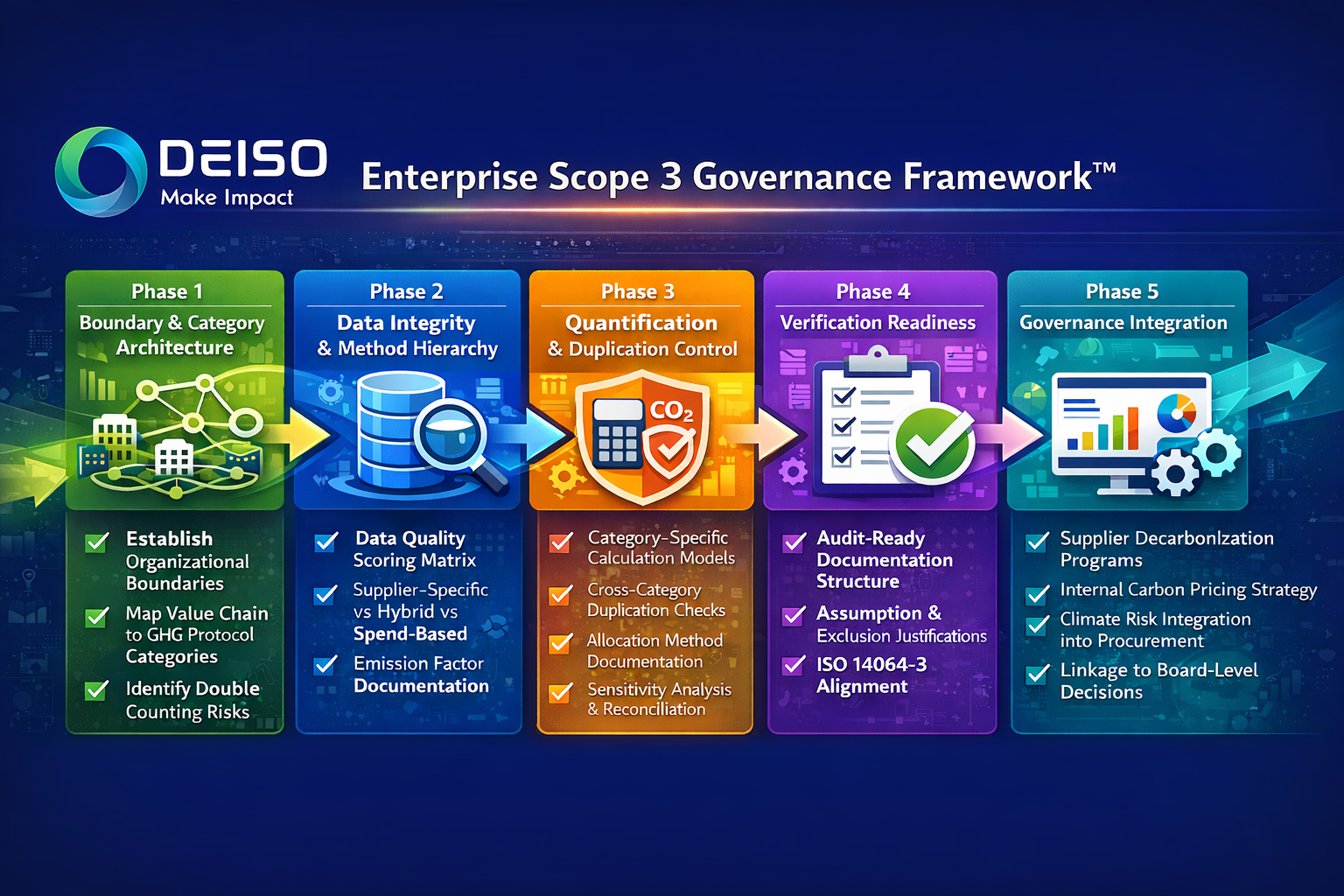
The Enterprise Scope 3 Governance Framework
(ISO 14064 + GHG Protocol Aligned Execution Model)
To prevent systemic failure, DEISO applies a structured five-phase architecture.
This is not a reporting checklist.
It is a carbon governance system.
Phase 1 — Boundary & Category Architecture
Before data collection begins, structural clarity is established.
Includes:
Organizational boundary definition (ISO 14064)
Full value chain mapping
Relevance screening across all 15 GHG Protocol Scope 3 categories
Double-counting risk mapping
Category materiality assessment
Output:
A defensible Scope 3 category matrix with documented justification.
Without this phase, all downstream work becomes unstable.
Phase 2 — Data Integrity & Method Hierarchy
Scope 3 data must follow a structured hierarchy:
Primary supplier data
Hybrid data models
Activity-based estimation
Spend-based estimation (last resort)
This phase includes:
Emission factor selection documentation
Data quality scoring
Supplier engagement roadmap
Database justification (e.g., sector-specific factors)
Gap resolution strategy
Output:
Traceable methodology register with an improvement pathway.
This converts estimation into structured accounting.
Phase 3 — Quantification & Duplication Control
Technical modeling prevents:
Category overlap
Internal double counting
Allocation inconsistencies
Scope boundary confusion
Includes:
Category-by-category modeling logic
Allocation documentation
Reconciliation across categories
Sensitivity analysis
Cross-functional validation
Output:
Reconciled the Scope 3 inventory with duplication safeguards.
Phase 4 — Documentation & Verification Readiness
ISO-aligned governance requires documentation architecture:
Assumption registry
Data source archive
Version control log
Change management history
Evidence repository structure
Output:
Verification-ready Scope 3 package aligned with ISO 14064-3 principles.
This is where most inventories fail.
Phase 5 — Governance & Strategic Integration
Scope 3 becomes meaningful only when integrated into:
Science-based target setting
Supplier decarbonization programs
Procurement governance
Investment decisions
ESG reporting frameworks
Board-level risk management
Output:
Executive carbon governance roadmap.
Carbon accounting must influence enterprise direction — not sit in a report.
How This Framework Differentiates DEISO
Most providers offer:
Carbon calculations
Template-based reporting
Generic spend-based estimations
DEISO delivers:
Structural boundary architecture
Methodological defensibility
ISO-aligned documentation governance
Scope 3 duplication control modeling
Supplier data engagement frameworks
Integration into ESG and transition strategy
We operate at the intersection of:
LCA methodology
GHG Protocol standards
ESG governance
Climate risk management
Verification discipline
This is execution — not presentation.
Standards Alignment
All Scope 1–3 engagements align with:
ISO 14064-1 (Organizational GHG quantification)
ISO 14064-3 (Verification principles)
GHG Protocol Corporate Standard
GHG Protocol Scope 3 Standard
Sector-specific regulatory expectations
We prioritize:
Defined system boundaries
Transparent emission factor logic
Structured documentation
Governance-level integration
The objective is structural defensibility.
Who This Is Designed For
Corporate sustainability directors
ESG governance teams
Climate strategy leaders
Procurement risk officers
Regulatory-facing organizations
Companies preparing for assurance
Not designed for:
Low-cost carbon template seekers
Casual estimations
Unstructured reporting exercises
Scope 3 requires institutional seriousness.
The Framework
Title:
Enterprise Scope 3 Governance Framework
Visual structure:
Five horizontal connected phases, color-coded:
Green — Boundary Architecture
Blue — Data Integrity
Amber — Quantification
Purple — Verification Readiness
Teal — Governance Integration
Each phase is visually represented with:
Network diagram
Database stack
Calculation shield
Audit checkmark
Executive dashboard
Modern flat design, enterprise tone, landscape orientation.
The illustration reinforces structure — it does not replace text.
Structured Engagement Options
DEISO supports organizations through:
• Full Scope 1–3 GHG Inventory Execution
• Scope 3 Architecture Development
• Verification Preparation & Documentation Structuring
• Climate Strategy Integration
• Supplier Data Governance Programs
• Executive Carbon Governance Advisory
Delivery formats:
Remote | Hybrid | Onsite
If Your Scope 3 Inventory Must Withstand Scrutiny
Board review
Regulatory examination
Investor due diligence
Third-party verification
Then structural governance is non-negotiable.
All inquiries are treated confidentially and scoped according to the institutional requirements.
Share this:
- Email a link to a friend (Opens in new window) Email
- Share on LinkedIn (Opens in new window) LinkedIn
- Share on X (Opens in new window) X
- Share on Facebook (Opens in new window) Facebook
- Share on WhatsApp (Opens in new window) WhatsApp
- Share on Reddit (Opens in new window) Reddit
- Print (Opens in new window) Print
- More