


Greenhouse Gas (GHG) Accounting & Climate Strategy

Greenhouse Gas (GHG) Accounting & Climate Strategy
Greenhouse Gas (GHG) accounting is not a reporting exercise. It is a structural mapping of organizational exposure across operational, financial, and supply chain systems.
DEISO delivers Scope 1, Scope 2, and Scope 3 emissions accounting aligned with internationally recognized standards, including ISO 14064, ISO 14040/14044, and the GHG Protocol. The objective is not carbon estimation—it is governance-ready, verification-aligned climate intelligence.
When Carbon Accounting Fails
Many organizations quantify emissions but cannot defend them under scrutiny.
Common structural failures include:
- Undefined organizational and operational boundaries
- Inconsistent consolidation methodologies
- Incomplete Scope 3 category mapping
- Double counting across entities and subsidiaries
- Untraceable supplier emission assumptions
- Misaligned emission factors and data sources
- Absence of verification-ready documentation systems
Under regulatory pressure, investor due diligence, or third-party assurance, weak structures fail. Carbon figures without system logic create exposure.
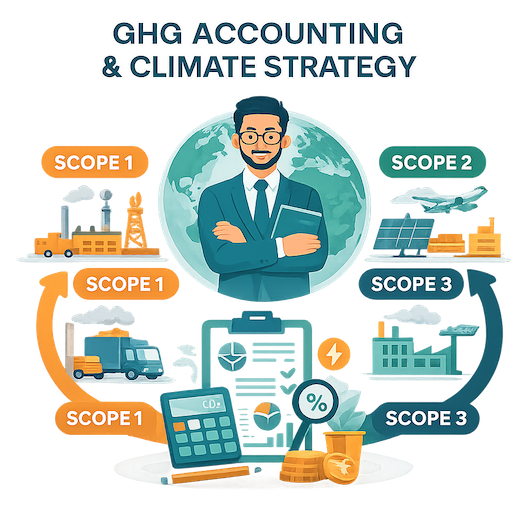
Scope 1–3 Emissions: Structural Mapping Framework
Scope 1 — Direct Emissions
Emissions from owned or controlled sources, including fuel combustion, industrial processes, and operational assets.
Scope 2 — Indirect Energy Emissions
Electricity-related emissions using both location-based and market-based methodologies, supported by supplier-specific data where available.
Scope 3 — Value Chain Emissions
Comprehensive mapping of upstream and downstream emissions across all relevant GHG Protocol categories, including purchased goods, capital goods, logistics, waste, business travel, employee commuting, product use, and end-of-life treatment.
Scope 3 requires system boundary clarity, allocation logic, and in many cases, hybrid Life Cycle Assessment (LCA) integration to ensure defensibility.
What Makes DEISO Different
Many providers rely on spreadsheets, generic emission factors, and narrative-driven reporting. DEISO delivers structured, technically grounded systems.
- Defined organizational and operational boundaries aligned with ISO methodology
- LCA-integrated Scope 3 modeling where required
- Transparent allocation methodologies
- Traceable emission factor selection
- Structured documentation for assurance readiness
- Governance-level reporting alignment
Carbon accounting must integrate with operations and decision-making systems—not remain isolated within reporting functions.
Standards & Framework Alignment
All engagements are aligned with:
- ISO 14064-1 (GHG Quantification & Reporting)
- ISO 14064-3 (Verification & Validation)
- ISO 14040 / 14044 (Life Cycle Assessment)
- GHG Protocol Corporate Standard
- GHG Protocol Scope 3 Standard
- Science-Based Target methodologies where applicable
- Sector-specific regulatory frameworks
Methodological coherence is prioritized through:
- Clearly defined system boundaries
- Transparent data sources and assumptions
- Consistent calculation logic
- Version-controlled data systems
- Verification-ready reporting structures
The objective is defensibility, not presentation.
From Accounting to Climate Strategy
Carbon accounting without transition planning is incomplete. DEISO transforms emissions data into structured climate strategy.
- Emission hotspot identification
- Scenario modeling and sensitivity analysis
- Decarbonization pathway development
- Supplier engagement strategies
- Net-zero alignment frameworks
This enables organizations to move from reporting to actionable climate governance.
Who This Service Is Designed For
- Corporate sustainability and ESG leaders
- Climate strategy and compliance teams
- Engineering and operations leadership
- Multinational organizations with complex supply chains
- Companies preparing for regulatory disclosure or assurance
- Organizations under investor scrutiny
Not Designed For
- Basic carbon calculators or simplified estimates
- Template-based reporting requests
- Academic or non-operational exercises
- Organizations without structured operational data
Engagement Models
- Full Scope 1–3 organizational accounting
- Scope 3 structural rebuild and refinement
- Climate governance integration
- Assurance and verification preparation
- LCA-integrated emissions modeling
- Long-term advisory retainers
- Internal capacity development programs
Delivery formats include remote, hybrid, and on-site engagements depending on scope and organizational requirements.
Begin Structured Climate Engagement
If your organization requires defensible, verification-ready Scope 1–3 emissions accounting aligned with ISO and GHG Protocol standards:
- Discuss applicability
- Request a quotation
- Explore climate strategy integration
All inquiries are treated confidentially and scoped according to regulatory and institutional requirements.
Share this:
- Email a link to a friend (Opens in new window) Email
- Share on LinkedIn (Opens in new window) LinkedIn
- Share on X (Opens in new window) X
- Share on Facebook (Opens in new window) Facebook
- Share on WhatsApp (Opens in new window) WhatsApp
- Share on Reddit (Opens in new window) Reddit
- Print (Opens in new window) Print
- More