


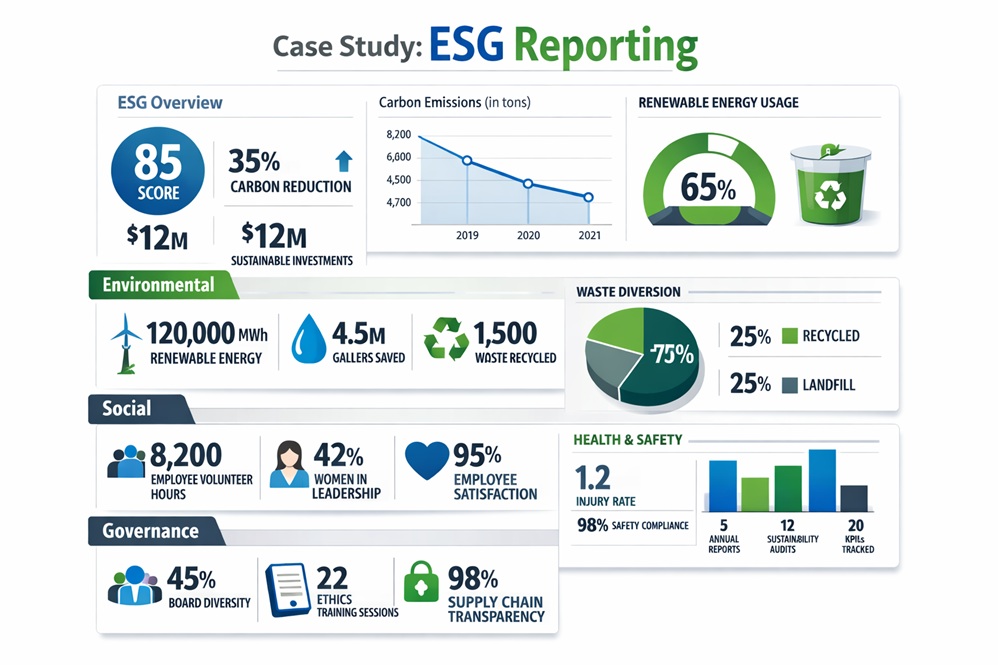
ESG Reporting Transformation for a Consumer Electronics Manufacturer in Malaysia
This illustrative case study demonstrates how DEISO can structure an ESG reporting transformation for a manufacturing organization seeking more credible, data-driven, and strategically aligned sustainability disclosure. The scenario is designed to show how environmental, social, and governance indicators can be organized, quantified, evaluated, and translated into reporting improvement priorities.
Case Positioning
This is an illustrative technical case study prepared to demonstrate DEISO’s ESG reporting methodology. It does not represent a real client engagement, a real manufacturer, or confidential company data. It is intended as a representative scenario showing how a structured ESG reporting system can reveal disclosure gaps, strengthen reporting logic, and improve decision usefulness.
Scenario Overview
- Country: Malaysia
- Industry: Consumer electronics manufacturing
- Operational Structure: Manufacturing site with regional suppliers and export-oriented distribution
- Assessment Focus: ESG reporting structure, data quality, material themes, and disclosure readiness
- Coverage: Environmental, social, governance, and reporting control environment
- Assessment Basis: Indicator-based scoring and reporting maturity analysis
Business Context
The illustrative company had already published sustainability content, but its reporting structure remained uneven. Environmental performance data existed for energy, waste, and water, while social and governance disclosures were partly narrative and lacked sufficient KPI depth, evidence traceability, and supplier-level integration.
Management needed a more reliable ESG reporting architecture that could improve internal visibility, strengthen investor and customer confidence, and prepare the organization for higher expectations around disclosure quality, data defensibility, and future assurance readiness.
DEISO Technical Approach
DEISO’s methodological workflow for this type of ESG reporting engagement includes:
- Review of organizational boundaries and reporting scope
- Identification and prioritization of material ESG themes
- Indicator selection across environmental, social, and governance pillars
- Assessment of data quality, completeness, and audit trail strength
- Gap analysis against structured reporting expectations
- Development of an improvement pathway toward stronger disclosure readiness
Illustrative Results Summary
Overall Reporting Position
- Overall ESG readiness score: 68 / 100
- Framework alignment score: 72%
- Modeled advanced improvement scenario: 86 / 100
- Largest reporting gap: Supply chain ESG data visibility
Pillar-Level Scores
- Environmental: 71 / 100
- Social: 64 / 100
- Governance: 69 / 100
Key Findings
Environmental Reporting
Environmental reporting in this scenario was relatively more mature than the other pillars. Energy use, waste performance, and water management data were available with acceptable structure. However, Scope 3 emissions, supplier environmental impact data, and broader lifecycle visibility remained limited, reducing the strategic depth of the environmental narrative.
Social Reporting
Social reporting showed a mixed pattern. Internal workforce safety and training indicators were stronger, but disclosures related to supplier labor oversight, grievance trends, and diversity progression required better evidence, stronger metrics, and clearer management linkage. As a result, the social narrative appeared less mature than internal operational practice in some areas.
Governance Reporting
Governance performance benefited from a formal policy structure and anti-corruption controls, but ESG governance had not yet been fully embedded into board cadence, KPI accountability, and evidence-backed reporting systems. The reporting therefore showed a credible governance foundation, but not yet a fully integrated ESG management model.
Strategic Interpretation
This illustrative case shows that ESG reporting quality is not determined only by how much information is disclosed, but by how well material issues are structured, quantified, evidenced, and connected to management action. A report may appear complete at a surface level while still lacking the internal controls and performance logic needed for credible, decision-useful disclosure.
The results also show that supply-chain visibility is often the decisive factor separating basic ESG reporting from more advanced reporting maturity. Without stronger supplier data, Scope 3 logic, and social oversight across the value chain, organizations face limits in both reporting depth and external credibility.
Illustrative Improvement Pathways
- Build a supplier ESG data collection and screening system
- Expand Scope 3 screening and value-chain disclosure depth
- Create a KPI evidence library with stronger audit trail logic
- Integrate ESG review more directly into board and executive governance
- Improve disclosure quality for diversity, grievance, and supply-chain labor topics
- Conduct a structured pre-assurance technical review of reporting content
Under the modeled improvement scenario, the organization’s overall ESG reporting readiness increased from 68 to 86, reflecting substantial gains in data defensibility, supply-chain visibility, governance integration, and disclosure credibility.
Conclusion
This illustrative case demonstrates how ESG reporting can evolve from fragmented sustainability communication into a more strategic, structured, and assurance-ready reporting system. By organizing performance around material issues, measurable indicators, and stronger governance logic, DEISO helps organizations produce reporting that is more credible, more decision-useful, and better aligned with rising market expectations.
For organizations facing investor scrutiny, customer requirements, or internal sustainability transformation pressures, a robust ESG reporting system is not only a disclosure exercise. It is an operational management tool that improves visibility, accountability, and strategic readiness.
Illustrative Case Disclaimer
This case study represents a technical demonstration scenario created to illustrate ESG reporting methodology, quantified indicator structuring, reporting gap analysis, and improvement pathway logic. It does not represent a real client, real company, or confidential dataset.
Illustrative ESG Reporting Dashboard — Consumer Electronics Manufacturing
Malaysia | Consumer Electronics Manufacturer | Illustrative ESG Reporting Case | Environmental, Social, Governance, and Disclosure Readiness
ESG Pillar Performance
ESG Indicator Score Distribution
Material Issue Mix
Social Themes 34%
Governance Themes 28%
Selected ESG Performance Figures
ESG Indicator Matrix
| Indicator | Pillar | Score /100 | Weight | Weighted Result | Interpretation |
|---|---|---|---|---|---|
| Climate Strategy and GHG Accounting | Environmental | 74 | 10% | 7.4 | Solid Scope 1 and 2 control, but Scope 3 incomplete |
| Energy Management | Environmental | 76 | 6% | 4.6 | Efficiency systems established |
| Water and Effluent | Environmental | 70 | 5% | 3.5 | Operational controls acceptable |
| Waste and Circularity | Environmental | 73 | 5% | 3.7 | Diversion systems fairly mature |
| Biodiversity and Local Impact Screening | Environmental | 58 | 3% | 1.7 | Limited site-adjacent ecological data |
| Occupational Health and Safety | Social | 77 | 8% | 6.2 | Strong internal safety systems |
| Training and Workforce Development | Social | 72 | 5% | 3.6 | Coverage is broad but not universal |
| Diversity, Equity and Inclusion | Social | 61 | 5% | 3.1 | Leadership representation gap remains |
| Supply Chain Labor Oversight | Social | 55 | 9% | 5.0 | Largest social weakness in supplier visibility |
| Grievance and Remedy Mechanisms | Social | 62 | 4% | 2.5 | Mechanism exists but analytics are limited |
| Board ESG Oversight | Governance | 63 | 7% | 4.4 | Periodic review exists but not fully embedded |
| Policies, Ethics and Anti-Corruption | Governance | 75 | 5% | 3.8 | Formal governance architecture established |
| Data Quality and Control Environment | Governance | 66 | 8% | 5.3 | Audit trail improving but not complete |
| Target Setting and KPI Linkage | Governance | 60 | 6% | 3.6 | Targets exist but operational linkage is limited |
Primary Reporting Gaps
🔴 Incomplete Scope 3 value-chain data
🔴 Inconsistent KPI evidence and traceability
🔴 Board review not yet integrated into strategic cadence
🔴 Social grievance analytics underdeveloped
🔴 External assurance readiness not yet complete
Illustrative Improvement Actions
Scope 3 screening expansion → +4 pts
KPI evidence library and audit trail → +3 pts
Board governance redesign → +2 pts
DEI and leadership inclusion roadmap → +1.5 pts
Pre-assurance reporting review → +1.5 pts
Reporting Maturity Pathway
Need Support with ESG Reporting, Disclosure Structure, or Readiness Review?
DEISO helps organizations structure ESG reporting systems, improve data quality, strengthen disclosure logic, identify reporting gaps, and enhance readiness for investor, customer, and assurance expectations.
Contact DEISOEngage with DEISO
Conduct confidential LCA studies and strategic environmental assessments with DEISO.
- 🔗 Services:
https://dei.so/services - 📅 Schedule Consultation:
https://dei.so/schedule