


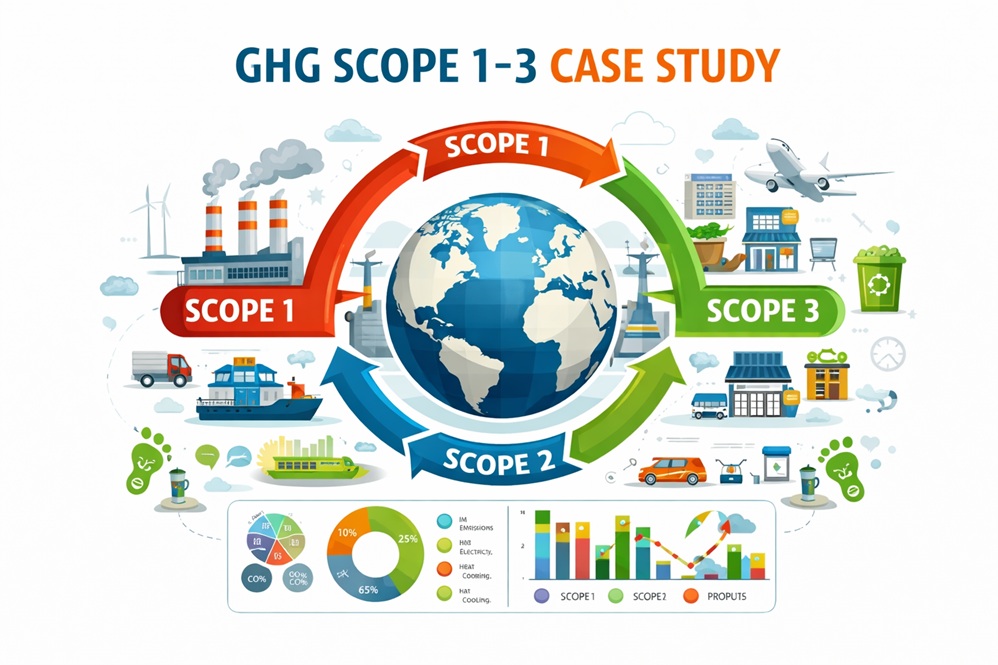
Illustrative GHG Inventory for a Packaged Food Manufacturing Plant in Germany
This illustrative case study demonstrates how DEISO structures a full greenhouse gas inventory across Scopes 1, 2, and 3 for a manufacturing organization. The scenario highlights value-chain hotspots, category-level Scope 3 screening, and indexed reduction pathways to show how emissions data can be translated into strategic action.
Case Positioning
This is an illustrative technical case study designed to demonstrate how DEISO structures a full GHG inventory across Scopes 1, 2, and 3 using a realistic industrial scenario. It does not represent a real client engagement or confidential company dataset.
Scenario Overview
- Country: Germany
- Industry: Packaged Food Manufacturing
- Facility Type: Processed foods production plant with national retail and export channels
- Operational Boundary: One manufacturing site, purchased electricity, and full upstream and downstream value-chain screening
- Reporting Basis: Annual inventory
- Methodological Reference: GHG Protocol Corporate Standard and Corporate Value Chain (Scope 3) Standard
Business Context
The illustrative company needed to establish a full corporate GHG baseline, identify major emission hotspots, understand the contribution of upstream purchased materials, assess distribution and end-of-life impacts, and build a practical foundation for target setting and reduction planning.
The organization had already measured utility consumption and fuel usage internally, but lacked a structured and decision-oriented view of value-chain emissions, especially across all Scope 3 categories.
DEISO Technical Approach
DEISO’s methodological workflow for this type of project includes:
- Organizational and operational boundary setting
- Activity data mapping across all relevant scopes
- Emission factor selection by geography and activity type
- Category-level Scope 3 screening
- Materiality review and hotspot identification
- Indexed scenario modeling for reduction pathways
Illustrative Results Summary
Total Corporate Emissions
- Total annual footprint: 148,600 tCO2e
- Baseline index: 100
Emissions by Scope
- Scope 1: 12,400 tCO2e (8.3%)
- Scope 2: 9,800 tCO2e (6.6%)
- Scope 3: 126,400 tCO2e (85.1%)
Primary Hotspot
Purchased goods and services represent the dominant emissions category, driven mainly by agricultural raw materials, packaging inputs, and ingredient processing.
Key Findings
Value-Chain Dominance
Scope 3 dominates the inventory, accounting for more than four-fifths of the total footprint. This indicates that procurement decisions, supplier characteristics, product logistics, consumer use assumptions, and end-of-life treatment have greater strategic importance than direct site emissions alone.
Upstream Hotspots
The largest upstream drivers are purchased goods and services, upstream transportation and distribution, capital goods, and fuel- and energy-related activities. These categories point to supplier engagement, lower-carbon sourcing, packaging optimization, and logistics redesign as major areas for intervention.
Downstream Hotspots
On the downstream side, transportation and distribution, use of sold products, and end-of-life treatment are the most significant contributors. This reinforces the importance of distribution strategy, product design, packaging recovery, and realistic use-phase assumptions in corporate carbon management.
Strategic Implications
This type of GHG inventory provides more than a compliance-oriented baseline. It creates a strategic management framework for prioritizing supplier engagement, identifying operational and value-chain hotspots, structuring reduction programs, and improving disclosure readiness for customers, investors, and regulatory stakeholders.
The results also show that organizations with relatively modest Scope 1 and Scope 2 emissions may still carry substantial climate exposure through Scope 3. For manufacturing businesses, this often means that decarbonization strategy must extend beyond internal energy management into procurement, transport, packaging, and product lifecycle design.
Illustrative Reduction Pathways
- Lower-carbon material sourcing and supplier transition programs
- Renewable electricity procurement and electricity decarbonization
- Freight optimization, route redesign, and modal shift
- Packaging redesign and end-of-life improvement measures
- Process heat efficiency upgrades and thermal energy optimization
Combined illustrative reduction modeling showed substantial improvement potential, reducing the carbon performance index from 100 to 77 under a staged intervention scenario.
Conclusion
This illustrative case demonstrates how a comprehensive Scope 1–3 inventory can reveal the true carbon structure of a manufacturing organization. By combining direct emissions, purchased energy, and full value-chain screening, DEISO helps organizations move from fragmented data toward a clear, prioritized, and decision-ready emissions strategy.
Illustrative Case Disclaimer
This case study represents a technical demonstration scenario created to illustrate methodology, reporting structure, hotspot analysis, and reduction logic. It does not represent a real client, real facility, or confidential company data.
Illustrative GHG Inventory Dashboard — Scopes 1–3
Germany | Packaged Food Manufacturing Plant | Annual Corporate Inventory | Illustrative Technical Demonstration
Scope-Level Emissions Summary
Stationary combustion, process heat, site vehicles, fugitive refrigerants
Purchased electricity for production lines, cold storage, and site operations
Dominated by purchased materials, inbound logistics, distribution, use-phase assumptions, and end-of-life
Scope 1 Breakdown
Diesel for site vehicles and generators 2,000 tCO2e
Fugitive refrigerants 1,300 tCO2e
LPG and other direct fuels 2,000 tCO2e
Scope 2 Breakdown
Refrigeration and chilled storage 1,900 tCO2e
Office, lighting, utilities 1,500 tCO2e
Scope 3 Category Dashboard — Upstream and Downstream
| Category | Value Chain Side | tCO2e | % of Scope 3 | % of Total | Interpretation |
|---|---|---|---|---|---|
| 1. Purchased Goods and Services | Upstream | 58,000 | 45.9% | 39.0% | Agricultural inputs, additives, packaging materials |
| 2. Capital Goods | Upstream | 8,200 | 6.5% | 5.5% | Processing equipment and line upgrades |
| 3. Fuel- and Energy-Related Activities | Upstream | 5,400 | 4.3% | 3.6% | Well-to-tank and upstream electricity fuel cycle |
| 4. Upstream Transportation and Distribution | Upstream | 11,300 | 8.9% | 7.6% | Inbound freight, packaging movement, warehousing |
| 5. Waste Generated in Operations | Upstream | 2,600 | 2.1% | 1.8% | Organic waste, reject packaging, wastewater sludge |
| 6. Business Travel | Upstream | 700 | 0.6% | 0.5% | Sales, procurement, technical travel |
| 7. Employee Commuting | Upstream | 1,500 | 1.2% | 1.0% | Private car commuting dominates |
| 8. Upstream Leased Assets | Upstream | 900 | 0.7% | 0.6% | Leased storage and support facilities |
| 9. Downstream Transportation and Distribution | Downstream | 14,100 | 11.2% | 9.5% | National retail and export logistics |
| 10. Processing of Sold Products | Downstream | 3,400 | 2.7% | 2.3% | Retail handling, repacking, cold-chain touchpoints |
| 11. Use of Sold Products | Downstream | 9,800 | 7.8% | 6.6% | Consumer refrigeration, heating, or preparation assumptions |
| 12. End-of-Life Treatment of Sold Products | Downstream | 7,600 | 6.0% | 5.1% | Packaging disposal, recycling losses, food waste |
| 13. Downstream Leased Assets | Downstream | 400 | 0.3% | 0.3% | Limited downstream leased infrastructure |
| 14. Franchises | Downstream | 0 | 0.0% | 0.0% | Not applicable in this scenario |
| 15. Investments | Downstream | 2,500 | 2.0% | 1.7% | Minor investment-related emissions screening |
Hotspot Findings
🔴 Downstream Transport = 14,100 tCO2e
🔴 Upstream Transport = 11,300 tCO2e
🔴 Use of Sold Products = 9,800 tCO2e
🔴 Capital Goods = 8,200 tCO2e
Illustrative Reduction Scenarios
Renewable electricity procurement → -7,800 tCO2e
Freight optimization and modal shift → -5,400 tCO2e
Packaging redesign and waste reduction → -4,100 tCO2e
Process heat efficiency upgrades → -2,700 tCO2e
Carbon Reduction Pathway Snapshot
Need a Full Scope 1–3 GHG Inventory for Your Organization?
DEISO helps organizations structure corporate GHG inventories, identify high-impact categories, and convert complex emissions data into actionable reduction strategies, disclosure readiness, and management insight.
Contact DEISOEngage with DEISO
Conduct confidential LCA studies and strategic environmental assessments with DEISO.
- 🔗 Services:
https://dei.so/services - 📅 Schedule Consultation:
https://dei.so/schedule