

Confidential Screening LCA for Advanced Recycling Pathways: Supporting Strategic Material Decisions for Yazaki Corporation
Executive Summary
DEISO conducted a confidential screening Life Cycle Assessment (LCA) study for Yazaki Corporation, Japan, to evaluate and compare the environmental performance of multiple recycling pathways for key polymer materials. The study assessed material recycling, thermal recycling, and chemical recycling (pyrolysis) across polyethylene (PE), polypropylene (PP), and polyvinyl chloride (PVC).
Due to confidentiality constraints, results are presented using relative performance indicators (%) rather than absolute values, enabling strategic comparison while preserving sensitive data.
Client Profile
- Client: Yazaki Corporation
- Region: Japan
- Industry: Automotive / Electrical Systems Manufacturing
- Project Type: Screening LCA (Decision-Support Study)
Materials Assessed
- PE: Polyethylene
- PP: Polypropylene
- PVC: Polyvinyl chloride
Strategic Objective
The study aimed to support internal decision-making by evaluating the environmental implications of different recycling technologies applied to key polymer materials used in industrial applications.
- compare recycling pathways across multiple materials
- identify lower-impact alternatives
- support circular economy strategy development
- enable early-stage technology screening
DEISO Approach
1. Screening LCA Framework
- rapid comparative modeling across scenarios
- consistent system boundaries and assumptions
- focus on directional insights rather than absolute precision
2. Multi-Technology Comparison
- Material Recycling (mechanical processes)
- Thermal Recycling (energy recovery)
- Chemical Recycling (pyrolysis)
3. Cross-Material Analysis
- comparative evaluation across PE, PP, and PVC
- assessment of material-specific behavior under each pathway
Relative Performance Insights
Overall Environmental Performance (Relative Index)
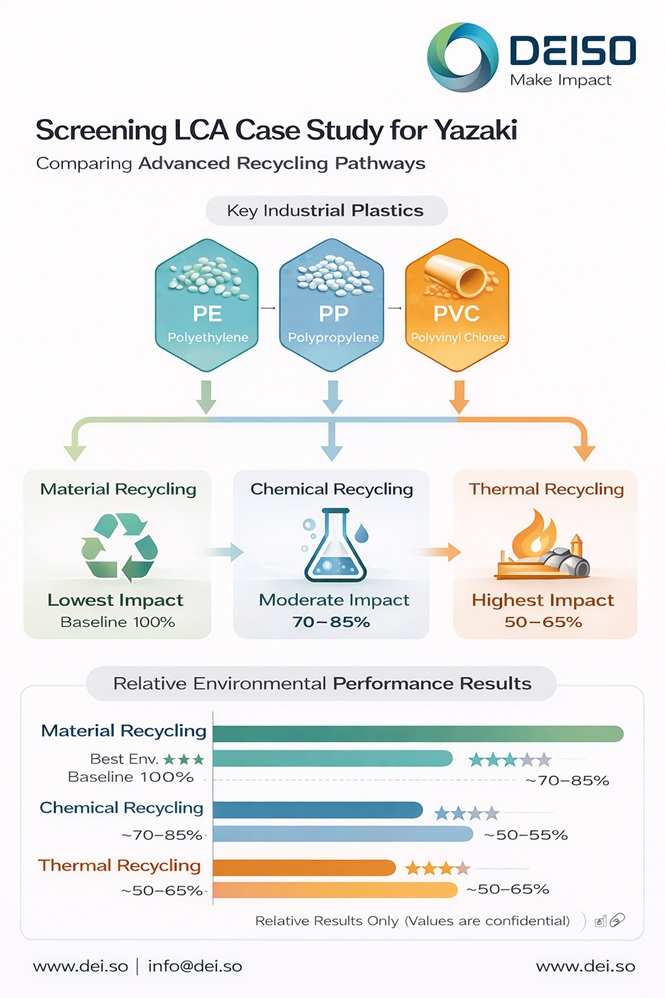
Chemical Recycling (Pyrolysis): ███████████░░ ~70–85%
Thermal Recycling: ████████░░░░ ~50–65%
👉 Material recycling consistently demonstrated the lowest relative environmental impact across most materials.
—
Performance by Material Type (Relative Comparison)
PE (Polyethylene)
Material Recycling ██████████████ (Best)
Chemical Recycling ███████████░░
Thermal Recycling ████████░░░░
PP (Polypropylene)
Material Recycling ██████████████ (Best)
Chemical Recycling ██████████░░░
Thermal Recycling ███████░░░░░
PVC (Polyvinyl Chloride)
Material Recycling ███████████░░
Chemical Recycling █████████░░░░
Thermal Recycling ██████░░░░░░ (Lowest)
—
Technology Sensitivity Insight
Chemical recycling (pyrolysis) showed moderate-to-high variability depending on process assumptions and energy inputs, indicating strong sensitivity to operational conditions.
Thermal recycling consistently resulted in higher relative impacts, primarily due to energy conversion losses and emissions.
Key Strategic Insights
- Material recycling is the preferred pathway where technically feasible
- Chemical recycling offers strategic potential for complex or contaminated streams
- Thermal recycling is less favorable environmentally but may remain relevant for non-recyclable fractions
- PVC presents additional challenges due to composition and treatment complexity
Measurable Outcomes
- comparative evaluation of 3 recycling technologies across 3 key polymers
- development of a relative environmental performance framework
- identification of preferred recycling pathways by material
- support for early-stage technology and strategy decisions
Strategic Value for Yazaki
This study enabled Yazaki to:
- prioritize lower-impact recycling strategies
- support circular economy initiatives
- align material decisions with environmental performance goals
- reduce uncertainty in technology selection
Why This Matters
In complex industrial systems, early-stage decisions on material treatment pathways can significantly influence long-term environmental performance.
This case demonstrates how screening LCA can be used as a powerful tool for:
- rapid decision support
- technology comparison
- strategic sustainability planning
👉 The result is not just analysis — but actionable environmental intelligence for industrial decision-making.
Confidentiality Note
All results are presented in relative terms to protect sensitive project data. Absolute values, datasets, and detailed modeling assumptions remain confidential.
Real Industrial LCA Decision Support
DEISO conducted a screening LCA for a major industrial client in Japan to compare advanced recycling pathways for key polymer materials. To preserve project sensitivity, the visual below presents only relative performance signals.
Material Recycling
Lowest relative impact across assessed pathways.
Chemical Recycling
Moderate-to-strong performance with process sensitivity.
Thermal Recycling
Highest relative impact among compared pathways.
Case signal: Relative results only. Absolute values and model details remain project-sensitive.
Comparative LCA Insight Across Key Polymer Materials
In a project for a major industrial manufacturer in Japan, DEISO compared recycling pathways for key polymers using a screening LCA approach. The result: pathway preference changes by material, but a clear relative pattern emerged.
PE Polyethylene
PP Polypropylene
PVC Polyvinyl chloride
Relative directional signals only. No absolute LCA results disclosed.
LCA That Supports Real Industrial Decisions
DEISO supports manufacturers with screening and advanced LCA studies used for technology comparison, recycling strategy, product design, and circularity planning.
Based on a real industrial screening LCA project delivered in Japan. Relative representation only.
Engage with DEISO
Conduct confidential LCA studies and strategic environmental assessments with DEISO.
- 🔗 Services:
https://dei.so/services - 📅 Schedule Consultation:
https://dei.so/schedule